Mizoram Declared Insurgency-Free as Last Militant Group HPC-D Lays Down Arms on April 30

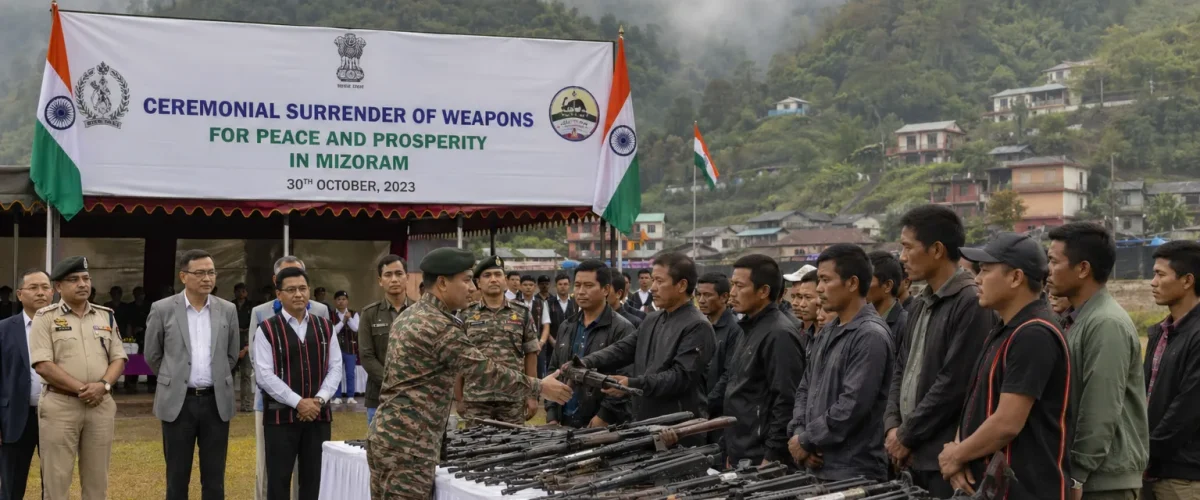
Mizoram was officially declared insurgency-free on 30 April 2026, as the Lalhmingthanga Sanate-led faction of the Hmar People’s Convention-Democratic (HPC-D (LF)) formally laid down its weapons at a designated peace camp near Mauchar village. The ceremony marked the culmination of a Memorandum of Settlement signed between the group and the Mizoram government on 14 April 2026, bringing an end to decades of armed insurgency in the northeastern state.
With this surrender, no armed insurgent group remains active in Mizoram — a milestone that the state’s Home Department described as a historic achievement for both the government and the people of the region. The event was attended by senior officials, including the Deputy Inspector General of Police (Northern Range) Rodingliana Chawngthu and members of the state legislature.
The Road to Peace: How the Agreement Was Reached
The Mizoram government began formal talks with HPC-D (LF) in mid-2024, identifying the Sanate-led faction as the last active underground armed group operating in the state. Multiple rounds of discussions took place between September 2024 and March 2026, involving representatives from the Home Department, security agencies, and community leaders from the Hmar-majority Sinlung Hills Council area in northern and northeastern Mizoram.
The Memorandum of Settlement, signed on 14 April by David Lalthanthluanga, Secretary of the Home Department, and Lalhmingthanga Sanate, the president of HPC-D (LF), outlines a comprehensive development roadmap for the Hmar-dominated areas. Key provisions include infrastructure investment, educational initiatives, and livelihood support for former cadres who will be rehabilitated into civilian life.
The signing ceremony on 14 April was attended by MLA and Chief Minister’s political advisor Lalmuankpuiya Punte and was presided over by Joint Secretary (Home) P.C. Lalduhthlanga. Religious leaders, including Rev. Lalmalsawma, offered prayers for lasting peace.
A History of Insurgency in Mizoram
Mizoram’s tryst with insurgency dates back to the 1960s, when the Mizo National Front (MNF) launched an armed rebellion against the Indian government, driven by grievances over neglect and the devastating famine of 1959. The insurgency lasted two decades before a landmark peace accord was signed in 1986 between the MNF and the Government of India, paving the way for Mizoram to become a full-fledged state.
However, smaller ethnic insurgent groups continued to operate in pockets of the state. The Hmar People’s Convention, representing the Hmar tribal community, first took up arms in the 1980s to demand greater autonomy for the Hmar-dominated areas in the north. The movement splintered over the years into multiple factions, each with its own set of demands and strategies.
In 2018, the Mizoram government signed an agreement with HPC (D), a faction that had broken away from the original HPC. The Sanate-led HPC-D (LF) was the last remaining splinter group, and its decision to lay down arms effectively closes a chapter that has shaped Mizoram’s political and social landscape for over six decades.
What This Means for Northeast India
Mizoram’s achievement stands in contrast to the political turbulence witnessed in other Indian states and the persistent security challenges in parts of the northeast, including Manipur, Nagaland, and Assam. The state has long been regarded as one of the more peaceful in the region, with a literacy rate above 90 per cent and a vibrant civil society. The formal end of insurgency is expected to boost investor confidence and accelerate economic development.
The Centre’s approach to resolving insurgencies through negotiation rather than purely military means has shown results across the northeast. Tripura was declared insurgency-free in 2019, and political transitions in other states have also created space for peace talks. However, Nagaland’s decades-long Naga peace process remains unresolved, and Manipur continues to grapple with ethnic violence between the Meitei and Kuki communities.
Rehabilitation and Development Roadmap
Under the terms of the settlement, former HPC-D (LF) cadres will be housed at the peace camp near Mauchar village before being integrated into government rehabilitation programmes. The state Home Secretary announced that the cadres will receive vocational training, financial assistance, and support in securing employment or self-employment opportunities.
The development roadmap for the Sinlung Hills Council area includes improved road connectivity, expansion of healthcare facilities, construction of educational institutions, and investments in agriculture and local industries. Community leaders have expressed cautious optimism, noting that the success of the agreement will ultimately depend on the government’s commitment to delivering on its promises.
A Model for Conflict Resolution
The peaceful resolution of Mizoram’s last insurgency offers a model for other conflict-ridden regions in India and beyond. It demonstrates that sustained dialogue, respect for ethnic identities, and credible development commitments can bring even long-standing armed movements to the negotiating table.
As India strengthens its defence capabilities and border security, the Mizoram example is a reminder that lasting peace often comes not from the barrel of a gun, but from the willingness to listen, negotiate, and invest in the aspirations of marginalised communities. For Mizoram, 30 April 2026 marks the beginning of a new chapter — one written in hope rather than conflict.

- Indian Army Gets New Chief as General Dwivedi Hands Over Command Amid Push for Indigenous Defence Tech - July 1, 2026
- Ayodhya Ram Temple Donation Scandal Deepens as Trustees Resign and SIT Arrests Eight - June 29, 2026
- Bengal Seven Weeks On: Modi’s Historic Win and the Questions That Won’t Go Away - June 28, 2026