Bihar Cabinet Expansion: 32 Ministers Take Oath Including Nitish Kumar’s Son Nishant in Samrat Choudhary Government

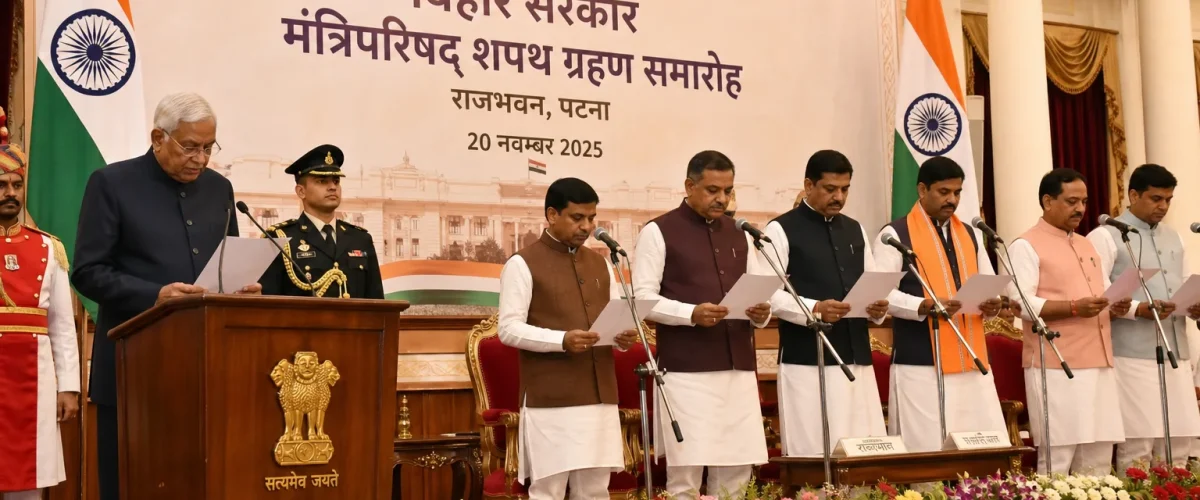
Bihar Chief Minister Samrat Choudhary’s government was expanded on 08 May 2026 with 32 new ministers taking oath at Raj Bhavan in Patna. The most talked-about induction was that of Nishant Kumar, son of former Chief Minister and Janata Dal (United) president Nitish Kumar, marking the entry of the Kumar political dynasty into formal governance. The oath was administered by Governor Lieutenant General (retired) Syed Ata Hasnain in a ceremony attended by Prime Minister Narendra Modi, Union Home Minister Amit Shah, and Defence Minister Rajnath Singh.
NDA Coalition Represented in Full Strength
The 32 new ministers represent the full spectrum of the National Democratic Alliance coalition that returned to power in Bihar after the 2025 Assembly elections with a commanding majority of 202 seats. The party-wise distribution includes 15 ministers from the BJP, 13 from the JD(U), two from the Lok Janshakti Party (Ram Vilas), and one each from the Hindustani Awam Morcha (Secular) and the Rashtriya Lok Morcha.
The composition reflects the NDA’s commitment to maintaining coalition balance while also rewarding party loyalty and electoral performance. Union Ministers Chirag Paswan, Jitan Ram Manjhi, and Lalan Singh, along with RLM’s Upendra Kushwaha and other NDA leaders, attended the swearing-in ceremony, signalling solidarity across the alliance.
The expansion comes 22 days after Samrat Choudhary was sworn in as Chief Minister on 15 April, along with Vijay Kumar Chaudhary and Bijendra Prasad Yadav as Deputy Chief Ministers. The delay was widely attributed to the ongoing state assembly elections in five states, the results of which were declared on 04 May, including the BJP’s historic victory in West Bengal.
Nishant Kumar: The Entry of a Political Dynasty
The inclusion of Nishant Kumar in the cabinet has generated the most discussion, both within political circles and among the general public. Nitish Kumar, who served as Bihar’s Chief Minister for nearly two decades across multiple stints, has been one of the most prominent leaders in Indian politics. His decision to step aside and facilitate a generational transition within the JD(U) was seen as a strategic move to ensure the party’s relevance in an evolving political landscape.
Nishant Kumar, who had largely stayed away from active politics until the 2025 elections, was elected from a constituency in central Bihar on the JD(U) ticket. His induction into the cabinet at the age of 34 has drawn both praise and criticism — supporters see it as a natural progression, while opponents have questioned whether merit or lineage drove the selection.
Political commentators in Patna note that dynasticism is deeply embedded in Indian politics, cutting across party lines and ideological boundaries. “Nishant Kumar’s entry is neither surprising nor unprecedented. What matters is what he does with the opportunity,” said Professor Ashok Mishra of Patna University’s political science department.
Key Ministers and Expected Portfolios
While formal portfolio allocations had not been announced at the time of the ceremony, several key appointments were widely anticipated. Vijay Kumar Sinha, who won the Lakhisarai constituency by defeating his Congress rival by 24,940 votes, is expected to receive a senior ministry. Sinha previously served as Deputy Chief Minister in January 2024 and held portfolios including Agriculture, Road Construction, Mines, and Geology.
Dilip Jaiswal, who has been the president of the Bihar BJP state unit and a member of the Bihar Legislative Council, is likely to continue in a role related to revenue and land reforms. Nitish Mishra, an MLA from Jhanjharpur, brings experience from previous cabinet stints in tourism, rural development, and disaster management.
The two LJP(RV) ministers are expected to receive portfolios that reflect the party’s base among Dalit and backward caste communities, while the HAM(S) and RLM representatives are likely to be given ministries aligned with their respective constituencies and expertise areas.
Bihar’s Governance Challenges
The expanded cabinet takes charge at a time when Bihar faces multiple governance challenges. The state’s per capita income remains among the lowest in India, and development indicators in health, education, and infrastructure lag behind national averages. The NDA’s electoral campaign centred heavily on promises of accelerated development, industrial investment, and improved public services.
Flood management remains a perennial challenge, with the annual monsoon regularly devastating large parts of North Bihar. The state government has committed to completing several long-delayed infrastructure projects, including new bridges across the Ganges and improved road connectivity in remote districts.
The BJP’s strong performance across multiple states in the 2026 elections, including Bihar, gives the NDA government a mandate for ambitious governance reforms. However, translating electoral mandates into tangible outcomes has historically been challenging in Bihar, where bureaucratic inertia and coalition politics often slow the pace of implementation.
PM Modi’s Presence Signals Central Support
Prime Minister Modi’s decision to attend the swearing-in ceremony in person was widely interpreted as a signal of strong central support for the Samrat Choudhary government. In his brief remarks at the event, Modi emphasised Bihar’s potential as an engine of economic growth in eastern India and pledged continued central government support for development initiatives in the state.
The PM’s presence also served to reinforce the BJP’s message of coalition harmony within the NDA. With the party preparing to form its first government in West Bengal and strengthening its position across eastern India, Bihar remains a crucial state in the BJP’s national political calculus.
Opposition Response
The Rashtriya Janata Dal, Bihar’s principal opposition party, criticised the cabinet expansion as being driven by caste calculations rather than merit. RJD spokesperson Tejashwi Yadav said the NDA was more focused on distributing ministerial berths among coalition partners than addressing the state’s pressing development needs.
Congress leaders in Bihar echoed the criticism, pointing to the inclusion of Nishant Kumar as evidence that the NDA’s claims of opposing dynasty politics are hollow. “On one hand they attack the Gandhi family, and on the other hand they induct Nitish Kumar’s son into the cabinet. The hypocrisy is breathtaking,” said a senior Bihar Congress leader.
The expanded cabinet now faces the challenge of delivering on the NDA’s electoral promises while managing the complexities of coalition governance in one of India’s most politically dynamic states.
Follow political developments on Social Trends and Culture & Lifestyle at Daily Tips.

- Indian Army Gets New Chief as General Dwivedi Hands Over Command Amid Push for Indigenous Defence Tech - July 1, 2026
- Ayodhya Ram Temple Donation Scandal Deepens as Trustees Resign and SIT Arrests Eight - June 29, 2026
- Bengal Seven Weeks On: Modi’s Historic Win and the Questions That Won’t Go Away - June 28, 2026