Forensic Report Reveals Zinc Phosphide Rat Poison Inside Watermelon Killed Mumbai Dokadia Family of Four

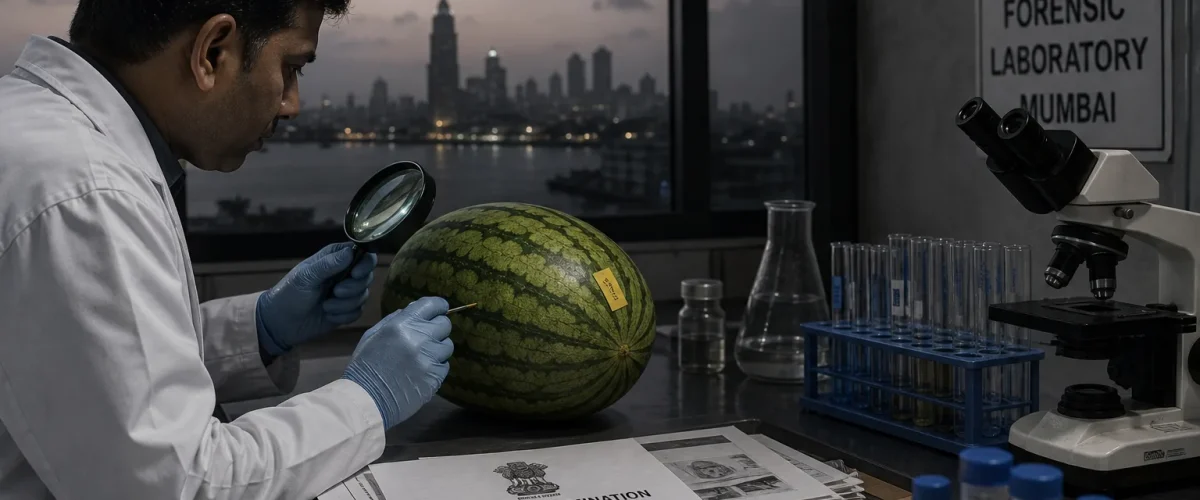
Eleven days and 54 rounds of forensic testing after the deaths of four members of the Dokadia family in Mumbai’s Bhendi Bazaar area, the Maharashtra State Forensic Science Laboratory (FSL) in Kalina has confirmed that the cause of death was zinc phosphide — a highly toxic chemical commonly used as rat poison. The poison was found inside the watermelon the family consumed on the night of their deaths, as well as in their viscera samples, including liver, kidney, spleen, stomach bile, and abdominal bile.
The findings, released on 07 May 2026, have shifted the investigation from a suspected case of food poisoning to a complex probe that will now examine whether the deaths were accidental, suicidal, or homicidal. The J J Marg police, who are handling the case, confirmed that they have received the FSL report and will study it in depth before determining the next course of action.
What the Forensic Report Found
According to senior FSL officials, zinc phosphide was detected both within the watermelon itself and in the viscera of all four deceased family members. Critically, the officials noted that “there was no indication of external contamination on the fruit” — meaning the poison was present on the inside of the watermelon, not on its surface.
The officials further stated that it was “unlikely” the poison had been injected into the fruit, raising the question of how the toxic substance entered the watermelon in the first place. This mystery now forms the central focus of the police investigation.
The forensic analysis was unusually complex and time-consuming. While toxins are typically detected within the first 10 to 20 rounds of testing, the Dokadia case required 54 rounds. Officials explained that the family had vomited out a large portion of the toxin before they died, leaving only trace amounts in their bodies. The low concentrations required highly sensitive analytical techniques to identify definitively.
The Dokadia Family: What Happened
The tragedy struck the Dokadia family in their home in Pydhonie, a densely populated neighbourhood in Mumbai’s Bhendi Bazaar area. On the evening of the incident, the family consumed watermelon after dinner. Within hours, all four members began experiencing severe symptoms including vomiting, abdominal pain, and respiratory distress. They were rushed to nearby hospitals but could not be saved.
Initial reports had speculated that the deaths could be linked to contaminated biryani or food poisoning from street-bought food. However, the forensic analysis has now conclusively ruled out all other potential causes and identified zinc phosphide as the sole toxin responsible.
What Is Zinc Phosphide?
Zinc phosphide is an inorganic chemical compound widely used as a rodenticide (rat poison) in India and around the world. It works by releasing phosphine gas when it comes into contact with stomach acid, which damages the heart, liver, kidneys, and lungs. Even small quantities can be fatal if ingested.
In India, zinc phosphide-based rat poisons are readily available in agricultural supply shops and even some general stores, often without stringent purchase controls. The compound has been involved in numerous poisoning cases across the country, both accidental and deliberate, prompting periodic calls for tighter regulation of its sale and distribution.
The lethal dose for humans is estimated at 20 to 40 milligrams per kilogram of body weight, meaning that just a few grams can be fatal for an adult. For children and elderly individuals, even smaller amounts can prove deadly.
Police Investigation: Three Possible Scenarios
DCP Dr Pravin Mundhe confirmed that the police will investigate three possible scenarios:
- Accidental contamination: Could the watermelon have been inadvertently contaminated with rat poison during storage, transport, or sale? This scenario would require the poison to have somehow entered the interior of the fruit without visible external damage — a possibility that food safety experts consider unlikely but not impossible.
- Suicide: Police will examine whether any family member deliberately introduced the poison into the food. Investigators will review the family’s financial situation, personal relationships, and any history of mental health issues.
- Homicide: The possibility that someone outside the family deliberately poisoned the watermelon is also being investigated. Police sources said they will trace the watermelon’s supply chain, from the vendor to the wholesale market, to identify any opportunity for deliberate contamination.
Importantly, police noted that no rat poison was found anywhere in the Dokadia residence, which could weigh against the accidental or suicidal theories — though it does not conclusively rule them out.
Food Safety Concerns in Mumbai
The case has reignited public health concerns about food safety in Mumbai and across India. The possibility that a commonly consumed fruit could contain lethal levels of a toxic pesticide has alarmed consumers and prompted calls for stronger regulation of the pesticide supply chain.
Food safety experts have pointed out that watermelons, which are typically consumed raw and without cooking, are particularly vulnerable to contamination at any point in the supply chain. In India’s complex food distribution network — which often involves multiple intermediaries between the farm and the consumer — tracing the source of contamination can be extremely difficult.
The Food Safety and Standards Authority of India (FSSAI) has not yet commented on the case, but consumer advocacy groups have called for mandatory testing of fresh produce at wholesale markets, stricter regulation of pesticide sales near food storage and distribution centres, and enhanced traceability systems that can track produce from farm to consumer.
A City in Shock
The Dokadia family’s deaths have sent shockwaves through Mumbai’s close-knit Bhendi Bazaar community. Neighbours described the family as quiet and well-liked, and the sudden loss of four members has left the local community in mourning.
For Mumbai — a city that prides itself on its resilience — the case is a grim reminder of the everyday risks that millions of residents face in their daily lives. Whether the poisoning was deliberate or accidental, the outcome is the same: a family destroyed and a community searching for answers.
The forensic report may have answered the question of what killed the Dokadia family, but the question of how and why the poison ended up inside their watermelon remains unanswered. As the police investigation deepens, the people of Mumbai — and India — will be watching closely for the truth behind one of the city’s most disturbing food safety incidents in recent memory.

- Fentanyl Vaccine Breakthrough: Scripps Research Develops Shot That Blocks Deadly Overdoses Before They Reach the Brain - June 13, 2026
- Nipah Virus Returns to Kerala — First Case of 2026 Confirmed, State Declares High Alert - June 12, 2026
- Jill Biden Reveals She Wanted to Keep PM Modi’s 7.5-Carat Diamond Gift but Returned It After State Department Valued It at $20,000 - June 8, 2026