Jaipur on High Alert as Authorities Demolish 5 Religious Sites Including Noorani Mosque — Internet Shut Down, 3,000 Police Deployed

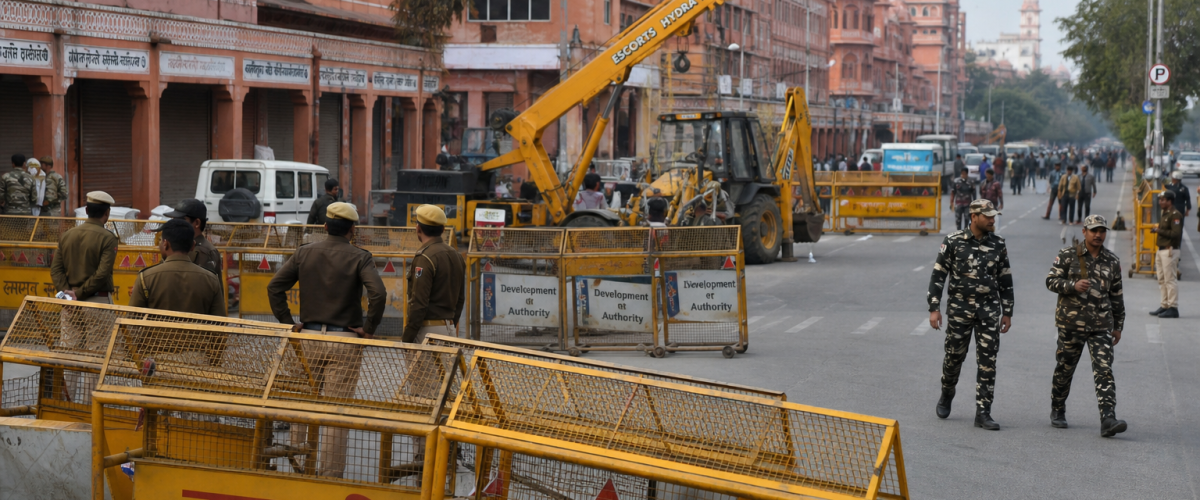
Authorities in Jaipur launched a massive demolition drive on Sunday, 8 June 2026, razing five religious structures — including the Noorani Mosque — near the Nandpuri Underpass in the Malviya Nagar area. The operation, carried out as part of a long-planned road widening project, was accompanied by an unprecedented security deployment and a complete suspension of internet services across the city until midnight on 9 June.
More than 3,000 police personnel were stationed across Jaipur to maintain law and order during the demolition. Streetlights in the immediate vicinity of the Nandpuri Underpass were switched off, and officers were posted on rooftops of residential buildings in the area. Bulk SMS services, internet messaging, and all social media platforms were blocked to prevent the spread of rumours and potential communal tensions.
Why the Demolitions Were Carried Out
The Jaipur Development Authority (JDA) had issued notices to the structures months earlier as part of a road widening project aimed at improving connectivity between Nandpuri and Jagatpura. Officials said that the chronic traffic congestion near the Nandpuri Underpass had affected an estimated 50 residential colonies whose residents relied on the stretch for daily commutes.
According to JDA officials, the demolitions would enable a direct route from Nandpuri to Jagatpura, significantly easing the bottleneck that has frustrated commuters for years. “Once the widening is complete, approximately 50 colonies will gain direct connectivity, and the persistent traffic jams near the underpass will be eliminated,” a senior JDA official said in a statement.
The five structures removed included both mosques and temples, along with a mazar (shrine) and a satsang bhavan (prayer hall). Authorities emphasised that the drive was not targeted at any single community but was part of a broader civic infrastructure initiative. All structures that fell within the planned road alignment were identified for removal regardless of their religious affiliation.
Massive Security Apparatus
The scale of the security deployment reflected the sensitivity of demolishing religious structures in a city with a diverse population. In addition to the 3,000 police personnel, the administration deployed rapid response teams and stationed magistrates in the area to handle any disturbances.
The decision to suspend internet services across the entire city drew criticism from civil liberties groups, who argued that a blanket shutdown was disproportionate. However, district officials defended the move, stating that it was a precautionary measure designed to prevent the circulation of inflammatory content and misinformation on social media during the demolition.
A similar approach was used in Delhi’s recent crackdown on 94 illegal structures, where authorities adopted a zero-tolerance approach to unauthorised constructions following a series of tragic fires. However, the Jaipur operation stood apart due to its explicit targeting of religious structures and the accompanying internet blackout.
Reactions and Political Response
The demolitions triggered a range of reactions across the political spectrum. Local community leaders from both Hindu and Muslim groups expressed mixed sentiments. Some acknowledged the necessity of the road widening project but criticised the manner in which it was executed, particularly the overnight timing and the switching off of streetlights.
Opposition parties in Rajasthan accused the state government of using heavy-handed tactics. “A road can be widened without turning an entire city into a fortress,” said a senior Congress leader. “Shutting down the internet for an entire metropolitan area because of a civic project sets a dangerous precedent.”
The Rajasthan government, led by Chief Minister Bhajan Lal Sharma of the BJP, defended the operation as transparent and necessary. Officials pointed out that the Jaipur High Court had previously upheld the JDA’s authority to remove encroachments on public land for infrastructure projects, and that all affected parties had been given adequate notice and time to relocate.
The state has seen significant attention recently over issues ranging from civic safety to the alarming number of farmer deaths from pesticide exposure reported in the Rajasthan Assembly.
Internet Shutdown: Legal and Social Implications
India has faced growing scrutiny over its frequent use of internet shutdowns, which rights organisations argue violate freedom of expression and access to information. According to the Software Freedom Law Centre, India has led the world in internet shutdowns for several consecutive years, with Rajasthan being among the states that resort to this measure most frequently.
The Supreme Court of India has previously ruled that internet access is a fundamental right under Article 19 of the Constitution and that any restrictions must be proportionate and time-bound. The 36-hour shutdown in Jaipur, while shorter than some previous instances, nonetheless affected businesses, emergency communication, and the daily lives of millions of residents.
Essential government and emergency services were exempted from the shutdown, according to the district administration’s order.
Looking Ahead
With the demolitions completed, the JDA is expected to begin the road widening construction in the coming weeks. Officials said that the expanded road would accommodate four lanes of traffic in each direction and include improved pedestrian infrastructure. Investigations into whether any irregularities in the allocation of funds for the project exist are not currently underway, but civic watchdogs have called for full transparency in the tendering and construction process.
Internet services are expected to be restored across Jaipur by midnight on 9 June, after which the administration will review whether any further precautionary measures are necessary.