Delhi Demolishes 94 Illegal Structures and Seals 114 Properties in Post-Fire Crackdown Under Zero-Tolerance Policy

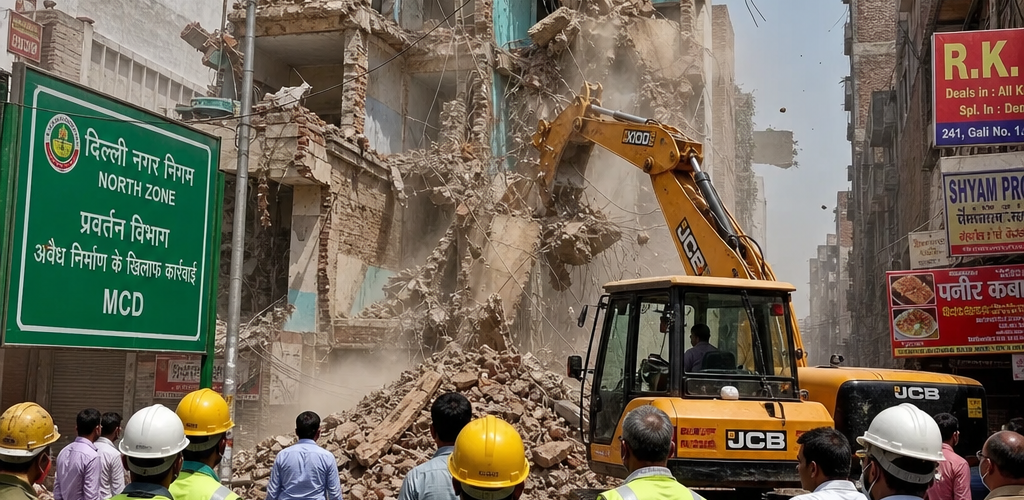
Days after the devastating Hauz Rani hotel fire that claimed 21 lives, the Delhi government and Municipal Corporation of Delhi have launched one of the most aggressive enforcement drives the capital has seen in years. Since June 1, authorities have demolished 94 illegal structures and sealed 114 properties across the city, inspecting 124 establishments for regulatory violations.
The Enforcement Campaign in Numbers
Chief Minister Rekha Gupta announced the actions on Saturday as part of a “zero-tolerance policy” against illegal constructions, encroachments, and fire safety violations. The numbers reveal the scale of non-compliance that had been allowed to fester across Delhi’s commercial and residential neighbourhoods.
Between June 1 and 6, the MCD alone issued 84 show-cause notices, 41 sealing notices, and 33 demolition orders. In south Delhi — the epicentre of the Hauz Rani tragedy — 41 demolition and sealing actions targeted areas including Said-ul-Azaib, Khirki Extension, Savitri Nagar, Khanpur, Sainik Farms, and Gautam Nagar. These properties were running illegal B&Bs, guesthouses, and basement libraries without requisite safety clearances.
District-Level Breakdown
Saturday’s inspections revealed widespread irregularities across every district. In South district, authorities sealed 11 premises and issued 19 show-cause notices. North West district saw three unauthorised buildings demolished outright. In New Delhi and Central districts, sealing and closure notices were served. One particularly concerning case in Old Delhi involved a property that had a fire no-objection certificate but no sanctioned building plan — a situation referred to MCD for further action.
The inconsistencies are telling. A fire NOC without a building plan suggests a systemic failure where clearances are granted without cross-verification — the same kind of regulatory gap that turned the Hauz Rani building into a death trap. The hotel there was approved for six rooms under Delhi’s bed-and-breakfast policy but was reportedly running 25 rooms, including some in the basement, with sealed windows and a single exit point.
Structural Reforms Announced
Beyond demolitions, the government has outlined several long-term reforms. CM Gupta has directed the Delhi Development Authority to intensify anti-encroachment campaigns. Architects found facilitating unauthorised constructions face blacklisting — a significant deterrent in a city where a handful of architectural firms handle the bulk of commercial building approvals.
Two new systems are being developed. The first is a third-party insurance mechanism that would link insurance coverage to compliance with structural and fire safety norms. This addresses a fundamental incentive problem: currently, building owners face limited financial consequences for safety violations until a tragedy occurs. The second is a digital fire response tracking system designed to record the entire timeline of fire emergencies, from first alert to final resolution.
Why the Crackdown Matters — and Where It Falls Short
Any experienced urban planner will tell you that post-tragedy crackdowns are the easiest part of enforcement. The real test is whether these actions survive beyond the news cycle. Delhi has a long history of demolition drives that follow major incidents — the Uphaar cinema fire in 1997, the Anaj Mandi factory fire in 2019, the Mundka warehouse fire in 2022 — each followed by intense action that gradually subsides.
The 13 committees formed under district magistrates represent a promising structural change, but their effectiveness will depend on sustained political will and, crucially, on tackling the nexus between property owners, local officials, and political representatives that enables illegal construction in the first place.
For now, Delhi’s residents living in or near illegally constructed buildings can expect continued disruption as the crackdown proceeds. The government has signalled that this drive will expand, with MCD conducting a comprehensive survey to identify additional illegal commercial and residential properties across all zones.
The 21 lives lost in Hauz Rani — including 10 Indians, nine African nationals, and two citizens of Turkmenistan — cannot be recovered. Whether their deaths mark a genuine turning point in Delhi’s approach to building safety or become another forgotten chapter in the city’s recurring tragedy will depend on what happens in the months and years ahead, long after the bulldozers have moved on.
A Pattern of Reactive Enforcement
The history of demolition drives in Delhi follows a depressingly predictable pattern. A tragedy occurs — a fire, a building collapse, a stampede in an overcrowded venue. Outrage follows, accompanied by media coverage that exposes the regulatory failures that enabled the disaster. The government launches a crackdown. Demolitions happen, properties are sealed, officials make stern statements. Then, gradually, the momentum dissipates, and the cycle of non-compliance resumes.
The Uphaar cinema fire of 1997, which killed 59 people, led to sweeping fire safety inspections across Delhi’s commercial establishments. The Anaj Mandi factory fire of December 2019, which killed 43 workers sleeping in an illegal manufacturing unit, triggered another round of enforcement. The Mundka warehouse fire of May 2022 killed 27 people and prompted yet another crackdown. In each case, the initial enforcement action was aggressive but time-limited.
What distinguishes the current drive — at least in its early stages — is the scale of the coordinated response. Thirteen district-level committees, three major agencies working in parallel, and a stated intention to create systemic reforms through insurance linkage and digital tracking suggest an attempt to build enforcement infrastructure that survives beyond the news cycle. Whether that ambition translates into sustained action remains the critical question.
The Human Cost of Delayed Action
For the families of the 21 people who died in the Hauz Rani fire — including migrant workers from African countries who came to Delhi seeking economic opportunity — the crackdown arrives too late. The building they were staying in was a known violation. Its operation beyond permitted capacity was visible to anyone who cared to look. The sealed windows and single exit point were physical features, not secrets.
The uncomfortable truth is that illegal construction in Delhi exists because it is profitable for a wide ecosystem of stakeholders — from building owners who maximize rental income, to architects who file misleading plans, to officials who approve clearances without site verification, to politicians who protect constituents from enforcement in exchange for electoral support. Disrupting that ecosystem requires sustained political will that extends beyond the shock of any single tragedy.