Tamil Nadu and West Bengal Assembly Elections 2026: Record Voter Turnout, TVK’s Vijay Factor, and the Battles That Will Shape Indian Politics

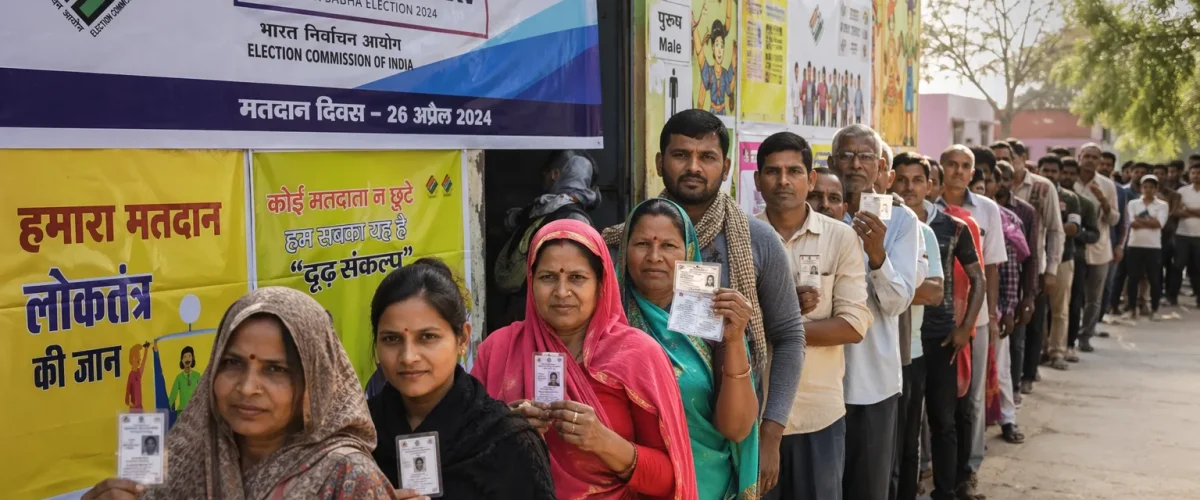
India’s democratic machinery shifted into high gear on 23 April 2026 as two of the country’s most politically charged states — Tamil Nadu and West Bengal — went to the polls in elections that are already rewriting records for voter participation, disrupting established party dynamics, and setting the stage for a verdict that could reshape the national political landscape. With counting scheduled for 4 May, the week ahead will be dominated by exit poll debates, swing-seat analysis, and speculation about coalition arithmetic. For those tracking social trends shaping India in 2026, these elections are as much a cultural moment as a political one — driven by youth mobilisation, social media campaigning, and new political entrants who are challenging the old guard.
Tamil Nadu: DMK vs AIADMK With Vijay’s TVK as the Wild Card
All 234 Assembly constituencies in Tamil Nadu voted in a single phase on 23 April 2026, with provisional data from the Election Commission showing voter turnout crossing 85 per cent by 5 pm — with several constituencies in the southern and western regions breaching the 90 per cent mark. The turnout is the highest in more than a decade, surpassing the 81.09 per cent recorded during the 2021 Assembly elections, and points to an electorate that is deeply engaged with this contest.
The core fight remains between the ruling Dravida Munnetra Kazhagam-led alliance, headed by Chief Minister M.K. Stalin, and the All India Anna Dravida Munnetra Kazhagam-led front. However, this election is far more complicated than the traditional DMK-versus-AIADMK binary. Actor Vijay’s Tamilaga Vettri Kazhagam, contesting its first-ever state election, has fielded candidates in all 234 seats and is projected by multiple surveys to win between 8 and 15 seats — enough to play a kingmaker role if the contest is close.
A Lok Poll survey published by The Economic Times projected a comfortable DMK-led win with 181 to 189 seats and a 40.1 per cent vote share, while the AIADMK bloc was projected at 38 to 42 seats. However, CNN-News18’s Vote Tracker, based on VoteVibe data, suggested a much tighter race with AIADMK at 41 per cent vote share against DMK’s 39 per cent. The divergence between surveys reflects the uncertainty that Vijay’s TVK introduces — its impact is uneven across regions and age groups, and where it splits votes will determine whether this is a comfortable DMK retention or a dramatic upset.
Key issues driving voter sentiment include the DMK government’s welfare schemes, rising cost of living, water scarcity in southern districts, and the ongoing debate over state autonomy versus central government interference. The BJP, contesting as part of the AIADMK-led alliance, is hoping to significantly improve on its 2021 showing and establish itself as a viable third force in Tamil politics. For those following India’s census and demographic shifts, the Tamil Nadu results will also provide important data on urban-rural divides and youth voting patterns.
West Bengal Phase 1: TMC vs BJP in a 152-Seat Showdown
West Bengal’s first phase of Assembly elections covered 152 of the state’s 294 constituencies across 16 districts, with approximately 3.6 crore voters eligible to cast their ballots. The voter turnout was nothing short of extraordinary — provisional data showed 89.93 per cent participation by 5 pm, with Dakshin Dinajpur district leading at 81.49 per cent by 3 pm alone. The second phase covering the remaining 142 seats is scheduled for 29 April.
The contest in Bengal is a fierce two-way battle between Chief Minister Mamata Banerjee’s Trinamool Congress and the Bharatiya Janata Party, which is mounting its strongest-ever challenge in the state. At least 80 seats in Phase 1 are considered closely contested, making this one of the tightest electoral battles Bengal has seen in decades. The Congress-Left alliance is present in pockets but is not expected to be a decisive factor in most constituencies.
The political temperature has been elevated by controversies over voter list revisions, with opposition parties alleging irregularities, and by a charged campaign season that saw Prime Minister Narendra Modi rally in Nadia district on the eve of polling. At a rally in Krishnanagar, Modi urged voters to wave the flag of BJP-NDA victory and predicted celebrations on 4 May. Mamata Banerjee, meanwhile, claimed that early turnout patterns indicated a clear TMC advantage.
Incidents of political tensions were reported during polling, including an attack on BJP MLA Agnimitra Paul’s car, underscoring the charged atmosphere. The Election Commission deployed significant security forces across all 152 constituencies, with particular focus on districts bordering Bangladesh where infiltration concerns have been a recurring campaign theme.
What Makes These Elections Nationally Significant
The combined results from Tamil Nadu and West Bengal will send 528 MLAs to state legislatures, making this the largest simultaneous electoral exercise outside of a general election. The outcomes carry national implications for several reasons. In Tamil Nadu, a strong DMK performance would consolidate the INDIA bloc’s hold on the south, while a surprise AIADMK-BJP showing would give the ruling NDA a foothold it has long sought. In West Bengal, a BJP breakthrough would fundamentally alter the party’s eastern strategy and strengthen its 2029 general election calculations.
The record voter turnout in both states is itself a story worth examining. Political analysts note that high turnout in India historically correlates with anti-incumbency sentiment — voters who feel strongly about change are more likely to make the effort to reach polling stations. However, this is not always the case, and strong welfare scheme beneficiaries can also drive turnout. The next 11 days before counting day will see intense analysis of booth-level data, with both ruling and opposition parties claiming the high turnout favours them. Those interested in how political events affect Indian markets should note that election-related uncertainty has historically driven short-term volatility.
The Road to Counting Day: 4 May 2026
With Tamil Nadu’s single-phase voting complete and West Bengal’s second phase on 29 April, the full picture will emerge on 4 May when the Election Commission begins counting. Exit polls are expected to be released after 29 April once all phases conclude, and the intervening period will see intense media speculation. Betting markets, while not legal in India, already show interesting patterns that suggest both states remain competitive.
What is clear is that Indian democracy in 2026 is vibrant, participatory, and unpredictable. The emergence of new political forces like TVK, the unprecedented voter mobilisation, and the deeply personal nature of the campaigns in both states all point to an electorate that is demanding accountability, weighing development against identity, and exercising its franchise with record enthusiasm. Whatever the outcomes, 23 April 2026 will be remembered as a day when India’s voters spoke louder than ever before.