Vijay Delivers First Address as Tamil Nadu Chief Minister: Promises White Paper on DMK-Era Corruption and Vows Only One Power Centre

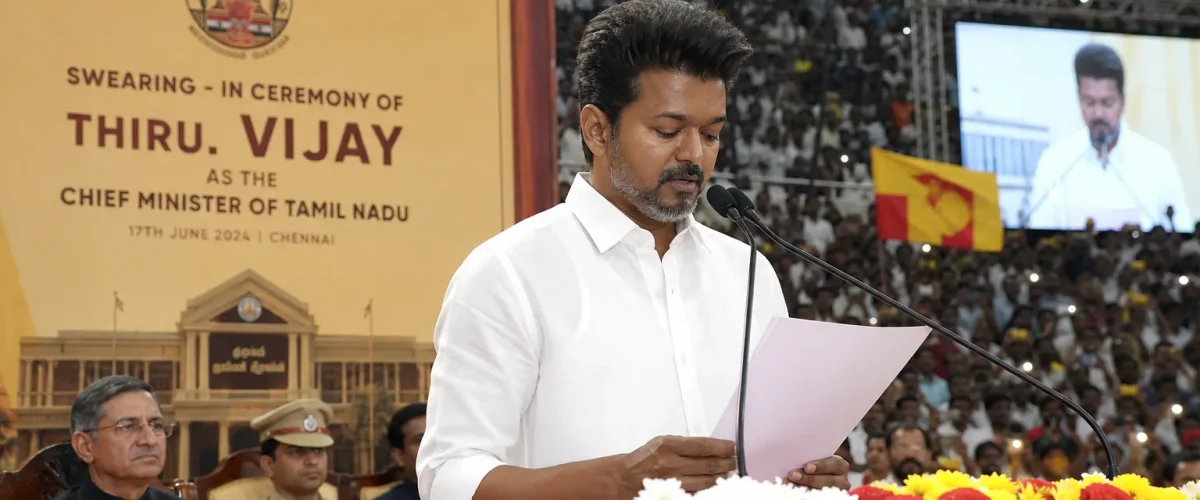
Chennai witnessed a historic political moment on Sunday morning as C Joseph Vijay, the 51-year-old superstar-turned-politician and president of the Tamilaga Vettri Kazhagam (TVK), was sworn in as the 13th Chief Minister of Tamil Nadu at a packed Jawaharlal Nehru Indoor Stadium. Governor Rajendra Vishwanath Arlekar administered the oath of office to Vijay and nine cabinet ministers in a ceremony attended by thousands of cheering supporters, Congress leader Rahul Gandhi, and actor Trisha Krishnan.
The swearing-in caps a remarkable five-day political negotiation in which Vijay, whose party won 108 of 234 assembly seats in last month’s elections, stitched together a coalition crossing the magic majority mark of 118. The alliance includes five Congress MLAs, two each from the Viduthalai Chiruthaigal Katchi (VCK), Communist Party of India (CPI), and Communist Party of India (Marxist) (CPI-M), and two from the Indian Union Muslim League (IUML), giving the coalition a total of 121 seats.
Maiden Speech: ‘I Am Not a Divine Messenger’
In what was arguably the most closely watched political debut in Tamil Nadu in decades, Vijay delivered a powerful maiden address that struck an emotional yet firm tone. He began by positioning himself as a people’s leader rather than a messianic figure, saying: “My dear people, my own family — I am not some divine messenger or a supernatural being. I am one of you.”
The statement was seen as a deliberate attempt to separate his political persona from the cult of personality that often surrounds Tamil cinema icons who enter politics. Political commentators noted the contrast with the legacies of M.G. Ramachandran and J. Jayalalithaa, both of whom cultivated larger-than-life images during their tenures.
Vijay then issued what many analysts consider the most significant declaration of his nascent political career: “There will be no power centre other than me. I will be the only centre of power.” The comment was directed at speculation about whether coalition partners, particularly Congress, might exert undue influence on the first-time chief minister. It was also interpreted as a message to party insiders that factional politics would not be tolerated.
White Paper on DMK-Era Corruption
The most headline-grabbing policy announcement from Vijay’s first speech was his promise to release a white paper on the financial dealings and alleged corruption during the DMK government led by M.K. Stalin. The DMK, which governed Tamil Nadu from 2021 to 2026, faced persistent allegations of irregularities in infrastructure projects, sand mining contracts, and public procurement.
Vijay framed the white paper as a transparency measure, saying the people of Tamil Nadu deserve to know how their money was spent over the past five years. He added: “We will publish a detailed white paper within 100 days. Every rupee will be accounted for. If there are irregularities, those responsible will face the law.”
The announcement drew immediate pushback from DMK leaders, who dismissed it as political theatrics. Former Chief Minister M.K. Stalin, speaking to reporters, called the promise a diversionary tactic and challenged Vijay to focus on governance rather than vendetta. However, political observers noted that the white paper strategy mirrors similar exercises carried out by newly elected governments in states like Telangana and Himachal Pradesh in recent years, where they have served as effective tools for establishing political narratives early in a term.
A Lean Nine-Member Cabinet
Vijay opted for a compact nine-member cabinet, with portfolio assignments expected to be formalised shortly. The cabinet includes:
- N. Anand (Thiyagarayanagar) — a first-time MLA and close confidant of Vijay
- Aadhav Arjuna (Villivakkam) — a social media strategist credited with TVK’s digital campaign
- K.A. Sengottaiyan (Gobichettipalayam) — the most experienced minister, formerly with AIADMK, expected to handle PWD
- K.G. Arunraj (Tiruchengode)
- P. Venkataramanan (Mylapore)
- CTR Nirmal Kumar (Thiruparankundram)
- Rajmohan (Egmore)
- T.K. Prabhu (Karaikudi)
- S. Keerthana (Sivakasi) — the only woman in the cabinet
Notably, Vijay retained the Home (Police) and Public Administration portfolios for himself, signalling his intent to maintain direct control over law enforcement and bureaucratic appointments. K.A. Sengottaiyan, who brings administrative experience from his stint as Education Minister under the AIADMK government, is widely expected to be assigned the Public Works Department (PWD).
The compact cabinet size surprised many observers who expected Vijay to accommodate more coalition partners. However, analysts suggest this reflects his “one power centre” philosophy and a desire to expand the cabinet later based on performance and loyalty assessments.
Coalition Dynamics and the Trust Vote
Governor Arlekar has directed the new government to seek a floor test by May 13, giving Vijay just three days to demonstrate his majority on the assembly floor. While the coalition’s 121-seat strength comfortably exceeds the halfway mark, the political landscape remains fluid.
The DMK-AIADMK alliance that formed to block Vijay’s government ultimately failed to prevent the TVK from reaching the majority mark, but opposition leaders have hinted at possible defections and horse-trading attempts before the trust vote. Congress, which played a crucial role in securing the coalition through its five seats, flew its MLAs to Hyderabad on Friday night amid fears of poaching.
Political analysts have compared Vijay’s path to power with the broader trend of political disruptions across Indian states, including the recent changes in West Bengal and Bihar that have reshaped the national political map. Whether the actor-turned-CM can translate cinematic charisma into effective governance remains the central question.
What Lies Ahead
Vijay’s immediate priorities include the economic challenges facing Tamil Nadu, including managing the state’s fiscal deficit, completing stalled infrastructure projects, and addressing unemployment among the state’s large youth population — the very demographic that powered TVK’s electoral success.
The new chief minister also faces the delicate task of managing coalition expectations while maintaining his declared independence. With Congress, the Left parties, VCK, and IUML all having contributed to his majority, balancing their demands against his own party’s agenda will be a critical test of his political acumen in the weeks and months ahead.
For Tamil Nadu’s 80 million residents, the ceremony on Sunday morning marked more than just a change of government — it signalled the arrival of a new kind of political leadership in a state long defined by its larger-than-life chief ministers. Whether Vijay can match their legacies while charting his own course will define the next chapter in the state’s storied political history.

- Indian Army Gets New Chief as General Dwivedi Hands Over Command Amid Push for Indigenous Defence Tech - July 1, 2026
- Ayodhya Ram Temple Donation Scandal Deepens as Trustees Resign and SIT Arrests Eight - June 29, 2026
- Bengal Seven Weeks On: Modi’s Historic Win and the Questions That Won’t Go Away - June 28, 2026