India Adds Record 51 GW Renewable Energy in FY26 as Solar Capacity Crosses 150 GW and Total Reaches 275 GW

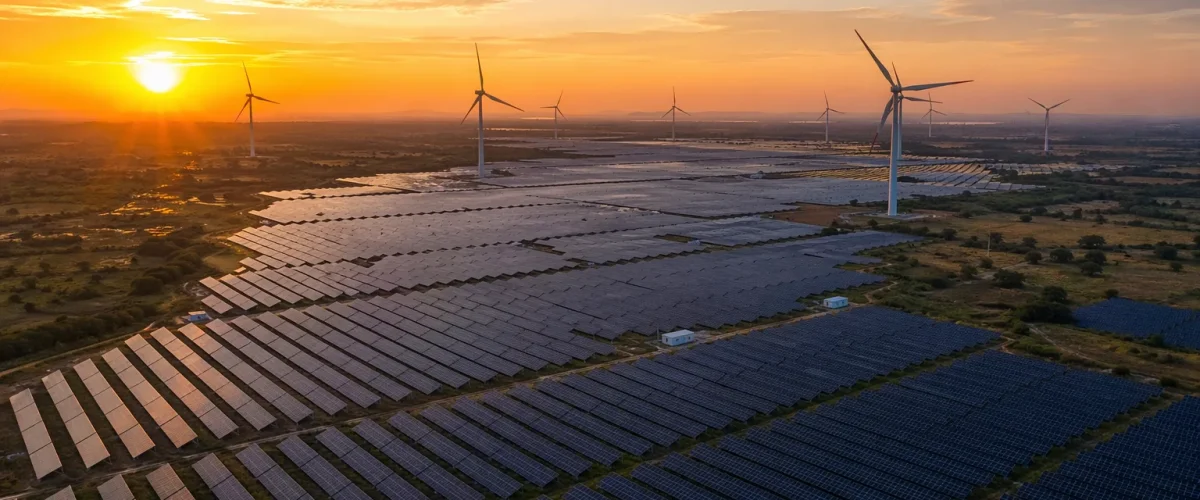
India has achieved a landmark milestone in its clean energy transition by adding approximately 51 gigawatts of renewable energy capacity in the financial year ending March 2026 — the highest annual addition in the country’s history and a figure that catapults India into the ranks of the world’s three largest solar power markets. According to data compiled by JMK Research and the Ministry of New and Renewable Energy, India’s total installed renewable energy capacity now stands at 275 GW as of 31 March 2026, with solar energy alone accounting for 150.26 GW — more than 55 per cent of the total. For anyone tracking environmental developments in India, this record-breaking year represents a decisive acceleration in the country’s journey toward its 500 GW non-fossil fuel target by 2030.
The Numbers Behind the Record: Solar and Wind Lead the Charge
The FY26 figures reveal the scale of India’s renewable expansion. Solar installations reached approximately 44.6 GW — an 87.2 per cent increase compared to the previous year. Within this, ground-mounted utility-scale solar contributed around 34.8 GW, marking a staggering 106 per cent year-on-year increase. This surge is attributed primarily to the completion of projects initiated under the Ministry of New and Renewable Energy’s ambitious 50 GW annual bidding trajectory that began in 2023.
Wind energy, long the quieter sibling of solar in India’s renewable family, also posted strong numbers. Approximately 6 GW of new wind capacity was installed in FY26, representing a 45.6 per cent increase over FY25. This brings India’s cumulative wind capacity to approximately 55 GW. The remaining additions came from small hydro, biomass, and waste-to-energy projects. Renewable energy’s share in India’s total installed power capacity continues to climb and now represents a meaningful portion of the country’s energy mix, though coal still dominates actual electricity generation due to intermittency and storage challenges.
PM Surya Ghar Scheme Drives Rooftop Solar Revolution
One of the most encouraging developments in FY26 was the explosive growth in rooftop solar, driven largely by the PM Surya Ghar Muft Bijli Yojana — the government’s flagship programme that provides subsidies to residential households for installing rooftop solar panels. Approximately 8.7 GW of rooftop solar was installed in FY26, a 69 per cent year-on-year increase. The scheme, which aims to cover one crore households with rooftop solar by 2027, has been instrumental in bringing solar energy to individual homes rather than just large commercial and industrial consumers.
Under the scheme, households receive a subsidy of up to Rs 78,000 for systems up to 3 kW, with the promise of 300 units of free electricity per month. As of April 2026, over 32 lakh applications have been approved, and the programme is operational across all states. The scheme has been particularly successful in Gujarat, Rajasthan, Maharashtra, and Karnataka, where state-level top-ups and streamlined approvals have accelerated adoption. The growth in rooftop solar also aligns with broader trends in India’s climate action strategy, which emphasises decentralised energy production alongside utility-scale projects.
India Becomes Third-Largest Solar Market Globally
With 150 GW of installed solar capacity, India has now overtaken several major economies to become the third-largest country by solar photovoltaic capacity, behind only China and the United States. This is a remarkable achievement for a country that had less than 3 GW of solar capacity as recently as 2014. The acceleration has been driven by falling module prices, competitive auctions that have brought solar tariffs to record lows, and strong government policy support including production-linked incentive schemes for domestic solar module manufacturing.
India’s solar manufacturing ecosystem is also maturing. The government’s PLI scheme for solar modules has attracted investments from companies like Adani Solar, Tata Power Solar, Vikram Solar, and Waaree Energies. Domestic module manufacturing capacity is expected to reach 60 GW by 2027, reducing dependence on Chinese imports which currently account for approximately 80 per cent of modules used in Indian projects. The connection between India’s renewable energy ambitions and its broader manufacturing push is evident — the same companies driving India’s electric vehicle revolution are also investing in clean energy supply chains.
Challenges Remain: Storage, Grid Integration, and the 2030 Target
Despite the record installations, significant challenges remain in India’s path to 500 GW by 2030. Grid integration of variable renewable energy sources requires substantial investment in battery energy storage systems, which are currently being tendered at scale but face cost and supply chain constraints. India has tendered approximately 15 GWh of battery storage in FY26, but actual commissioning has been slower than planned.
Transmission infrastructure is another bottleneck. Many of India’s best solar and wind resource zones are in remote areas — Rajasthan, Gujarat, and Ladakh for solar; Tamil Nadu, Karnataka, and Gujarat for wind — and connecting these to demand centres requires new high-voltage transmission corridors. The Green Energy Corridor programme is expanding but faces land acquisition and right-of-way challenges.
Curtailment is an emerging concern in states with high renewable penetration. During peak solar hours, some states now have more renewable energy generation than demand, leading to the paradoxical situation of solar plants being asked to reduce output. This underscores the urgent need for storage and demand-side management solutions. Financial health of distribution companies remains a concern as well, though the Revamped Distribution Sector Scheme has made progress in reducing aggregate technical and commercial losses.
Looking Ahead: Can India Hit 500 GW by 2030?
To reach its 500 GW non-fossil fuel target by 2030, India needs to add approximately 56 GW per year for the next four years. The FY26 figure of 51 GW suggests this is achievable but leaves little room for shortfalls. The pipeline is robust — over 120 GW of solar and wind projects are under various stages of development — but execution risks remain around land availability, financing, and supply chain disruptions. The favourable interest rate environment is helping project financing, but global factors such as polysilicon price fluctuations and shipping costs can impact project economics.
What is beyond doubt is that FY26 has established a new baseline for India’s renewable ambitions. A country that installed 51 GW in a single year has demonstrated that it possesses the policy framework, institutional capacity, and market appetite to sustain this pace. The 150 GW solar milestone, in particular, represents a transformation of India’s energy identity — from one of the world’s largest fossil fuel consumers to a genuine clean energy superpower in the making.