Mission Sudarshan Chakra Gets Fresh Push: Rajnath Singh Unveils India’s Multi-Layer Missile Defence Roadmap

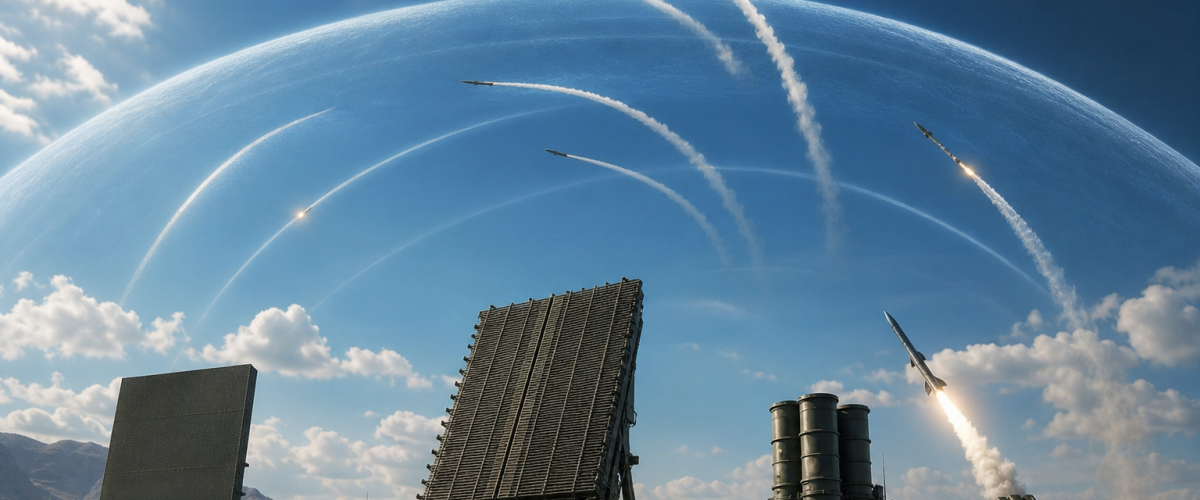
Defence Minister Rajnath Singh on Friday unveiled the latest progress under Mission Sudarshan Chakra, India’s ambitious programme to build a comprehensive multi-layer missile defence and aerial offensive capability by 2035. Speaking at a high-level review meeting in New Delhi, Singh described the mission as India’s “ultimate shield and sword” against evolving aerial threats in an increasingly volatile global security environment.
First announced by Prime Minister Narendra Modi on Independence Day 2025, Mission Sudarshan Chakra aims to integrate India’s air defence, ballistic missile defence (BMD), and offensive aerial strike capabilities into a unified command-and-control architecture. The mission draws heavily from lessons learned during Operation Sindoor and ongoing global conflicts, including the Russia-Ukraine war and the US-Iran confrontation.
What Is Mission Sudarshan Chakra?
At its core, Mission Sudarshan Chakra is designed to create a seamless, multi-tiered defence umbrella capable of neutralising threats ranging from cruise missiles and ballistic missiles to hypersonic glide vehicles, armed drones, and swarming unmanned aerial systems. The mission envisions fusing cyber, cognitive, and aerospace domains into what defence officials have termed a “kavach” — a cohesive protective shield.
The programme encompasses several critical components: advanced early warning radar systems, layered interceptor missile batteries (short, medium, and long-range), electronic warfare suites for jamming and cyber operations, directed-energy weapons research, and an indigenous command-and-control network powered by artificial intelligence for real-time threat assessment and response coordination.
Related: Will Gaganyaan Fly in 2027? Inside ISRO’s Human Spaceflight Race and India’s 300-Startup Space Boom
India-Israel Strategic Partnership as Catalyst
A key element of Mission Sudarshan Chakra is India’s deepening Special Strategic Partnership with Israel, which has emerged as a critical technology and operational partner. Israel’s battle-tested air defence systems, including the Iron Dome, David’s Sling, and Arrow systems, provide a proven template for the kind of layered defence architecture India seeks to build.
Defence analysts at the Institute for Defence Studies and Analyses (IDSA) have noted that the India-Israel partnership has “the potential to be a strategic catalyst” for the mission. Joint development programmes are already underway for medium-range surface-to-air missile systems (MRSAM) and advanced radar technologies. India is also evaluating Israeli expertise in counter-drone warfare, an area of growing importance given the proliferation of armed UAVs in conflict zones worldwide.
Why Now? Lessons From Global Conflicts
The urgency behind Mission Sudarshan Chakra has been amplified by recent conflicts that have exposed vulnerabilities in traditional air defence paradigms. The Russia-Ukraine war demonstrated the devastating effectiveness of drone swarms, cruise missiles, and hypersonic weapons against unprepared defences. Similarly, the ongoing US-Iran conflict has highlighted the challenges of defending against ballistic missile barrages and the importance of integrated early warning systems.
Closer to home, India’s own experience during Operation Sindoor — the precision strikes against terrorist infrastructure — underscored the need for both offensive capability and defensive resilience. Military strategists have argued that India’s future deterrence posture must be able to handle simultaneous threats from multiple adversaries, a scenario that demands nothing less than a comprehensive, technology-driven defence architecture.
Indigenous Development and Self-Reliance
In line with the government’s Atmanirbhar Bharat defence manufacturing push, a significant portion of Mission Sudarshan Chakra’s components are being developed indigenously. The Defence Research and Development Organisation (DRDO) is leading the development of advanced interceptor missiles, including the Phase-2 BMD system capable of engaging targets at altitudes above 150 kilometres.
DRDO has also been testing the Prithvi Air Defence (PAD) and Advanced Air Defence (AAD) interceptor systems, which form the backbone of India’s two-tier BMD architecture. The organisation is simultaneously working on solid-fuel propulsion systems for faster reaction interceptors and advanced seeker technologies for improved target discrimination in cluttered environments.
Private sector participation has also accelerated, with companies like Bharat Electronics Limited, Larsen & Toubro, and Tata Advanced Systems winning contracts for radar sub-systems, missile launchers, and communication networks. The government has allocated an estimated ₹2.5 lakh crore over the mission’s 10-year timeline, making it one of India’s largest defence programmes ever.
AI and Cyber Integration
Perhaps the most ambitious aspect of Mission Sudarshan Chakra is its emphasis on artificial intelligence and cyber warfare integration. The mission envisions an AI-powered battle management system capable of processing sensor data from hundreds of radar stations, satellites, and surveillance platforms to generate a unified threat picture in real time.
This AI backbone would enable autonomous decision-making for initial threat classification and interceptor assignment, reducing the critical response time window from minutes to seconds. Given that modern hypersonic threats can travel at speeds exceeding Mach 10, this reduction in reaction time could be the difference between successful interception and catastrophic failure.
Timeline and Challenges
Singh reiterated that the mission is on track to achieve initial operational capability by 2030, with full operational status targeted for 2035. However, challenges remain. The complexity of integrating systems from multiple vendors and partner nations, the need for massive infrastructure upgrades at military installations across the country, and the continuous evolution of threat technologies all present significant hurdles.
Budget sustainability is another concern. While the current allocation is substantial, defence analysts warn that the true cost of maintaining a multi-layer defence system over its operational lifetime could far exceed initial projections. The government will need to balance Mission Sudarshan Chakra’s requirements against other pressing defence modernisation needs, including naval expansion and the Mountain Strike Corps programme.
Nevertheless, the consensus among defence experts is clear: in an era of hypersonic weapons, drone swarms, and cyber warfare, Mission Sudarshan Chakra is not merely desirable — it is essential for India’s national security. As Rajnath Singh put it, “The threats of tomorrow demand the shields of today.”
Also Read
- Russia Launches Largest Nuclear Military Exercises in Years Mobilizing 65000 Troops and 200 Missile Launchers as NATO Tensions Escalate
- India Fast-Tracks Rs 27000 Crore Military Satellite Constellation With 52 Satellites for Round-the-Clock Defence Surveillance Across Indo-Pacific
- India to Receive Fourth S-400 Triumph Missile Defence System From Russia by May-End as Defence Readiness Gets Major Boost
- India Plans 55-Satellite Military Constellation for Round-the-Clock Defence Surveillance
- India’s Space Economy Crosses $13 Billion: ISRO Commercial Launches Agnikul Skyroot and 200 Startups Fuel India’s New Space Race

- Indian Army Gets New Chief as General Dwivedi Hands Over Command Amid Push for Indigenous Defence Tech - July 1, 2026
- Ayodhya Ram Temple Donation Scandal Deepens as Trustees Resign and SIT Arrests Eight - June 29, 2026
- Bengal Seven Weeks On: Modi’s Historic Win and the Questions That Won’t Go Away - June 28, 2026