India’s Healthtech Revolution Accelerates: 39 New Startups and Rising VC Interest Are Reshaping Healthcare Delivery

India’s health technology ecosystem is experiencing a decisive evolution in 2026, moving beyond the consumer telemedicine apps that defined its first phase into a sophisticated, supply-side-driven transformation of healthcare delivery. With 39 new healthtech startups founded in just the first half of 2025 and approximately 30 per cent of healthtech venture capital now flowing into MedTech and diagnostics rather than pure telemedicine, the sector is building the infrastructure for a healthcare system that is more accessible, affordable, and clinically effective than anything India has previously achieved.
The Structural Shift: From Consumer Apps to Clinical Infrastructure
The most significant trend in Indian healthtech is the pivot from patient-facing digital health apps toward supply-side innovation in device manufacturing, AI-enabled clinical workflows, and hospital system integrations. While platforms like Practo, PharmEasy, and MediBuddy continue to serve millions of consumers, the new wave of innovation is targeting the healthcare delivery infrastructure itself.
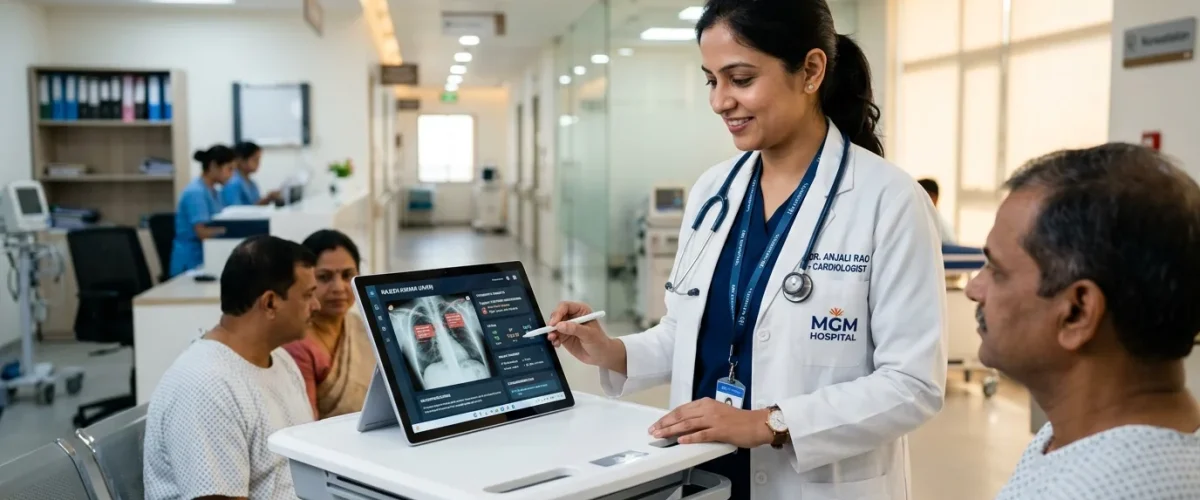
AI-powered diagnostic tools are leading this transformation. Qure.ai, whose AI solutions for chest X-ray and CT scan interpretation have been deployed in over 90 countries, represents the gold standard for Indian healthtech companies building globally competitive clinical AI. Niramai’s AI-driven breast cancer screening technology, which uses thermal imaging and machine learning to detect tumours at early stages, has gained regulatory approval in multiple markets and is being deployed across Indian screening programmes.
SigTuple’s AI-powered peripheral blood smear analysis and 5C Network’s radiology AI platform exemplify the depth of clinical AI development happening in India—solutions that augment physician capabilities, reduce diagnostic errors, and dramatically increase the throughput of diagnostic centres that serve millions of patients annually.
The MedTech Manufacturing Push: Make in India Meets Healthcare
India’s healthtech story increasingly intersects with its manufacturing ambitions. The government’s Production-Linked Incentive (PLI) scheme for medical devices, combined with faster IVD (in-vitro diagnostics) approval processes, has catalysed a wave of domestic medical device startups. Companies developing locally manufactured diagnostic kits, surgical instruments, imaging equipment, and wearable health monitors are building an ecosystem that reduces India’s dependence on imported medical devices—which currently account for over 80 per cent of the market.
The economic logic is compelling. India’s medical device market is projected to reach $65 billion by 2030, and even modest localisation of manufacturing could create a significant domestic industry while improving healthcare affordability. Startups in this space are combining Indian engineering talent with global clinical standards to create products that are not only cost-competitive but clinically equivalent to or superior to imported alternatives.
The Ayushman Bharat Digital Mission: The Government’s Platform Play
The Ayushman Bharat Digital Mission (ABDM) has emerged as the foundational digital health infrastructure upon which India’s healthtech ecosystem is being built. As of late 2025, more than 834 million citizens hold ABHA digital health IDs, with approximately 438,000 health facilities and 738,000 healthcare professionals registered on the platform. Over 787 million digital health records have been linked, creating the world’s largest unified health information system.
ABDM’s sandbox model has been particularly catalytic for startups. Any health facility, insurer, laboratory, or digital health provider can integrate once with ABDM’s standardised APIs and seamlessly connect with every other ABDM-enabled entity. This dramatically reduces the cost and complexity of digital health interoperability—a custom API integration that would typically cost at least $2,500 per vendor is replaced by a single certified connection.
For healthtech startups, ABDM provides access to a massive, interoperable health data ecosystem that enables innovative applications in population health analytics, personalised medicine, insurance claims automation, and clinical decision support. This digital health infrastructure development parallels other technology transformation initiatives discussed in our analysis of India’s AI ecosystem and structural technology challenges.
Telehealth 2.0: Beyond Video Consultations
India’s telehealth sector is evolving beyond basic video consultations toward more comprehensive remote care delivery models. Hybrid care platforms that combine digital triage, remote monitoring, scheduled video consultations, and in-person visits when necessary are emerging as the next evolution of telemedicine.
Remote patient monitoring, enabled by affordable wearable devices and IoT-connected health sensors, is creating new care models for chronic disease management. Patients with diabetes, hypertension, and cardiac conditions can be monitored continuously, with AI algorithms alerting healthcare providers when vital signs indicate deterioration—enabling proactive intervention before acute episodes require expensive emergency care.
Mental health platforms have been a particularly fast-growing telehealth segment. Services like YourDOST, Amaha (formerly InnerHour), and MindPeers have seen significant demand growth as awareness of mental health issues increases and stigma gradually reduces. The accessibility of digital mental health services—available from home, often at lower cost than in-person therapy—has been particularly impactful for populations in smaller cities and rural areas where mental health professionals are scarce.
Healthtech Funding: Quality Over Quantity
Investment in Indian healthtech has become more sophisticated and specialised. According to Bain & Company, approximately 30 per cent of healthtech venture capital now flows into MedTech and diagnostics, reflecting investor recognition that supply-side innovation offers more defensible business models and larger addressable markets than pure consumer digital health plays.
Seed and Series A rounds for healthtech startups have shown particular strength in 2026, with investors attracted by the combination of India’s vast healthcare market, favourable regulatory developments, and the availability of clinical talent and engineering expertise. The funding patterns mirror the broader discipline in India’s startup ecosystem, where investors are prioritising companies with clear unit economics and regulatory moats, as analysed in our coverage of the $228 million funding week in March 2026.
Global Competitiveness: India as a Healthtech Export Hub
Indian healthtech companies are increasingly targeting global markets, leveraging India’s cost advantages in software development and clinical validation to create solutions that are competitive in developed markets. AI diagnostic tools developed and validated in India’s high-volume hospital systems benefit from exposure to diverse patient populations and disease patterns, making them more robust and generalisable than tools trained on data from single-market healthcare systems.
The World Economic Forum has highlighted India’s digital health infrastructure as a model for other emerging economies, noting that ABDM’s approach to interoperable, consent-based health data sharing could be replicated by countries seeking to digitise their own healthcare systems. This recognition positions Indian healthtech companies as natural partners for digital health initiatives across Asia, Africa, and Latin America.
Challenges: Regulation, Adoption, and the Last Mile
Despite the optimism, Indian healthtech faces significant challenges. Regulatory frameworks for AI-based diagnostic tools, digital therapeutics, and health data privacy are still evolving, creating uncertainty for companies developing cutting-edge solutions. The pace of technology development often exceeds the regulatory system’s ability to evaluate and approve new products, creating bottlenecks that delay market access.
Healthcare provider adoption remains uneven. While urban hospitals and diagnostic chains are embracing digital tools, the vast network of primary health centres, district hospitals, and independent practitioners—where the majority of Indians receive care—faces barriers including limited internet connectivity, low digital literacy among staff, and resistance to workflow changes.
The last-mile challenge—reaching the 600 million Indians in rural areas with quality healthcare—remains the sector’s defining opportunity and its most formidable challenge. Technology alone cannot bridge this gap; it requires simultaneous investment in physical infrastructure, human resource development, and community health worker networks that can serve as conduits between digital health systems and the populations they aim to serve.