UPI Turns Ten and India Now Handles Nearly Half the World’s Real-Time Payments

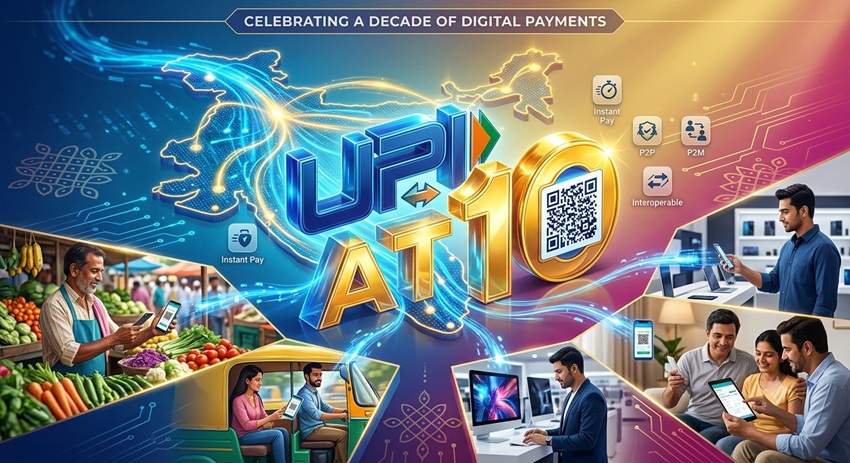
From 373 transactions in its first month to 24,162 crore in FY 2025-26, UPI’s growth is without parallel in global fintech. The harder question now is what the next decade looks like.
There is a useful piece of context that rarely appears in celebrations of UPI’s tenth anniversary: in April 2016, the platform recorded exactly 373 transactions in its first month. Last financial year, it processed around 24,162 crore. That is not growth. That is transformation at a scale the financial world has rarely seen.
The Unified Payments Interface, launched on 11 April 2016 by the National Payments Corporation of India under the regulatory oversight of the Reserve Bank of India, has completed its first decade as something considerably more significant than a domestic payment rail. It is now, by transaction volume, the world’s largest real-time payments platform — and India, a country where cash was overwhelmingly dominant barely a generation ago, accounts for nearly 49 per cent of all real-time payment transactions globally. That figure was cited by the International Monetary Fund in its June 2025 report.
The scale of what UPI has achieved in value terms is equally striking. Transaction value rose from ₹0.07 lakh crore in FY 2016-17 to approximately ₹314 lakh crore in FY 2025-26 — a more than 4,000-fold increase. Daily transactions now average about 66 crore, with a daily value of nearly ₹0.86 lakh crore. March 2026 set the record for monthly volume, recording 2,264 crore transactions worth ₹29.53 lakh crore. The number of banks participating on the platform grew from just 21 at launch to 703 by March 2026, spanning public sector, private, cooperative, payment and small finance banks.
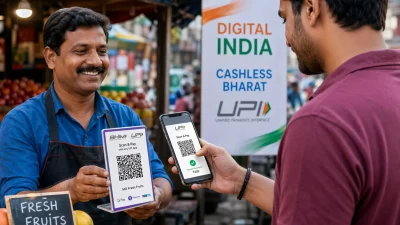
The reach of UPI into daily Indian life is reflected in what people are actually using it for. Person-to-Merchant (P2M) transactions account for 63 per cent of total volume — street vendors, grocery shops, petrol pumps, utility payments — driven largely by small-ticket retail. Eighty-six per cent of merchant payments are below ₹500, underlining UPI’s core role in digitising the informal economy rather than simply servicing high-value urban transactions. Person-to-Person (P2P) transfers account for 71 per cent of total transaction value, reflecting growing trust for larger transfers, including those previously handled exclusively by banks or cash.
UPI now commands approximately 85 per cent of India’s total digital payment volume. The platform is dominated by two applications — PhonePe holds roughly 48 per cent market share; Google Pay, approximately 37 per cent — with Paytm accounting for a further 8 per cent. The concentration raises questions about competitive dynamics and systemic dependencies, though NPCI has periodically signalled an interest in preventing any single player from commanding an excessive share of the market.
The RBI introduced mandatory two-factor authentication for digital payments from 1 April 2026, adding biometrics, PINs, or secure tokens alongside OTPs in response to rising instances of cyber fraud. The measure was broadly welcomed by security researchers, though some industry players noted the additional friction could slow adoption among older and lower-literacy users who have only recently come onto digital platforms.
Internationally, UPI has expanded beyond India’s borders, linking with payment infrastructure in the UAE, Singapore, France, Bhutan, Nepal, Sri Lanka, Mauritius, and Qatar. This international footprint reduces remittance costs for the Indian diaspora and enables cross-border payments for tourists and business travellers in a way that traditional banking pipelines never could.
The second decade of UPI will be harder than the first. The easy growth — converting cash-paying urban consumers to digital — is largely done. The more demanding challenge now is deepening penetration into rural populations with limited smartphone access, integrating UPI more deeply into credit products for underserved segments, and managing the security architecture of a platform so systemically important that any disruption would have economy-wide consequences. NPCI has projected 1 billion daily transactions by 2026-27. Whether that number is achieved on schedule or not, the trajectory is clear. India built something the world is still trying to replicate.