Chernobyl 40th Anniversary: IAEA Signs Energy Reconstruction Deal With Ukraine as World Marks Four Decades Since Nuclear Disaster

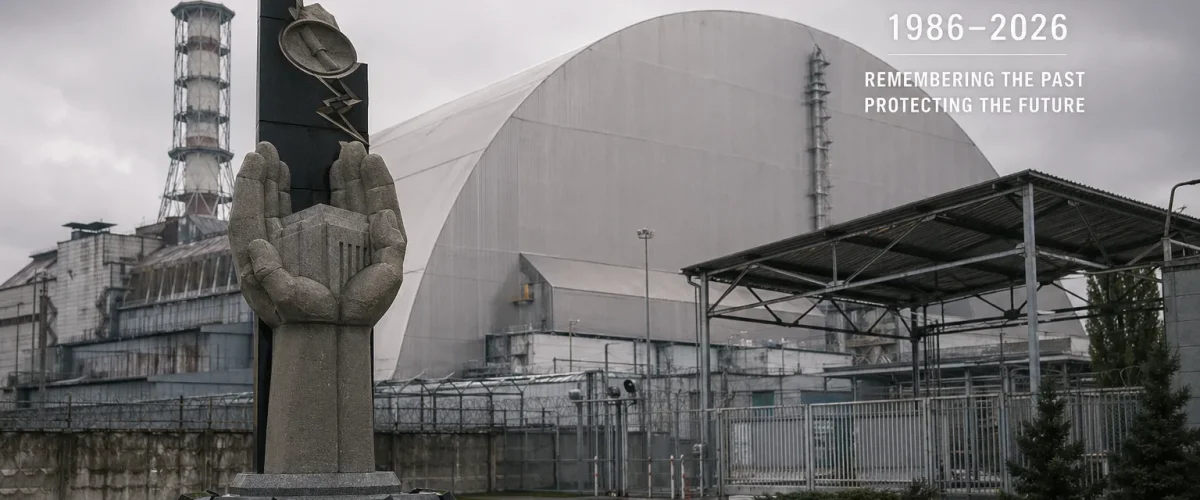
The International Atomic Energy Agency (IAEA) signed an agreement with Ukraine’s Ministry of Energy on 26 April 2026 to support the country’s energy sector reconstruction, marking 40 years since the catastrophic nuclear disaster at the Chernobyl Nuclear Power Plant. IAEA Director General Rafael Mariano Grossi and Ukraine’s Energy Minister formalised the deal in Kyiv, affirming that nuclear energy remains central to Ukraine’s recovery despite the trauma of the world’s worst nuclear accident.
What Does the IAEA-Ukraine Energy Deal Cover?
The agreement encompasses a broad programme of support for Ukraine’s battered energy infrastructure, which has sustained massive damage from Russian attacks since the full-scale invasion began in February 2022. Grossi stated on social media platform X: “Ukraine’s energy sector is central to the country’s recovery and future.”
The deal focuses on several key areas. First, nuclear energy expansion, including support for the deployment of Small Modular Reactors (SMRs) that could provide distributed, resilient power generation across the country. Second, reconstruction of the electrical grid and substations critical for nuclear safety — without which even operational nuclear plants cannot distribute power to the population. Third, support for nuclear research and applications beyond power generation, including medical isotope production and food safety irradiation.
Ukraine currently operates four nuclear power stations with 15 reactors (excluding the occupied Zaporizhzhia plant), which together generated approximately 55 per cent of the country’s electricity before the war. The conflict has severely disrupted operations, with repeated Russian missile strikes on transmission lines and substations causing rolling blackouts across the country. The IAEA’s support is intended to help Ukraine rebuild these critical systems while planning for future energy security.
Remembering 26 April 1986: The Chernobyl Disaster
On 26 April 1986, Reactor Number 4 at the Chernobyl Nuclear Power Plant in northern Ukraine (then the Ukrainian Soviet Socialist Republic) suffered a catastrophic explosion during a safety test. The blast and subsequent fire released approximately 400 times more radioactive material than the atomic bomb dropped on Hiroshima, contaminating vast areas of Ukraine, Belarus, and Russia, and sending a radioactive plume across much of Europe.
The immediate death toll was relatively small — 31 people died from acute radiation syndrome within months of the explosion, mostly plant workers and firefighters — but the long-term health consequences have been staggering. The World Health Organisation estimates that up to 4,000 additional cancer deaths may ultimately be attributable to Chernobyl radiation exposure, while some studies suggest the figure could be significantly higher.
An estimated 350,000 people were permanently evacuated from the contaminated Exclusion Zone surrounding the plant, creating ghost towns such as Pripyat that remain abandoned to this day. The economic cost to the Soviet Union and its successor states has been estimated at hundreds of billions of dollars, and the cleanup effort continues four decades later.
The 800,000 Liquidators: Heroes of the Cleanup
Perhaps the most poignant legacy of Chernobyl is the story of the “liquidators” — approximately 800,000 soldiers, firemen, miners, helicopter pilots, and engineers who were conscripted to contain the leaking radiation in the weeks and months after the explosion. These men and women worked with minimal protective equipment, often using little more than shovels and their bare hands, to clear radioactive debris, build a concrete sarcophagus over the destroyed reactor, and decontaminate surrounding areas.
Many liquidators received radiation doses far exceeding safe limits. Tens of thousands have subsequently died from cancers, cardiovascular disease, and other radiation-related illnesses, while survivors continue to suffer chronic health problems. Their sacrifice has been commemorated at memorial events in Kyiv, Minsk, and Moscow, and Chernobyl Children International — one of several charities supporting affected communities — has organised exhibitions and events to mark the 40th anniversary.
Chernobyl’s Impact on Global Nuclear Policy
The Chernobyl disaster fundamentally reshaped global attitudes toward nuclear energy. It led directly to the creation of the IAEA’s Convention on Nuclear Safety in 1994, established new international standards for reactor design and emergency response, and prompted a wave of reactor shutdowns across Europe — most notably in Italy, which abandoned nuclear power entirely in a 1987 referendum.
Germany accelerated its nuclear phase-out after the 2011 Fukushima disaster in Japan, finally shutting its last three reactors in April 2023. However, the global energy crisis triggered by the Russia-Ukraine conflict has paradoxically renewed interest in nuclear power as a low-carbon, reliable energy source. Countries including the UK, France, Poland, and even some that had previously rejected nuclear energy are now investing in new reactor programmes, including SMRs.
India, which operates 23 nuclear reactors and has ambitious plans for expansion, has studied the lessons of Chernobyl closely. The Nuclear Power Corporation of India Limited (NPCIL) maintains strict safety protocols based on post-Chernobyl international standards, and India’s indigenous reactor designs incorporate multiple redundant safety systems. Related to India’s broader science ambitions, the country is also building a 55-satellite military constellation for defence surveillance.
Chernobyl Today: The New Safe Confinement
The most visible symbol of Chernobyl’s transformation is the New Safe Confinement (NSC), a massive arched steel structure that was completed in 2016 and slid into place over the deteriorating original sarcophagus. Funded by over 40 nations at a cost of approximately 1.5 billion euros, the NSC is designed to contain radiation for at least 100 years while allowing for the eventual dismantlement and decontamination of the destroyed reactor.
The Chernobyl Exclusion Zone has also become an unexpected wildlife sanctuary, with populations of wolves, lynx, European bison, and Przewalski’s horses thriving in the absence of human habitation. Scientists continue to study the area to understand the long-term effects of chronic low-level radiation exposure on ecosystems.
Also Read: Skyroot Aerospace’s Vikram-1 rocket nears historic launch from Sriharikota
Also Read: FBI investigates mysterious deaths of US scientists with top-secret clearances
Also Read: India adds record 51 GW renewable energy in FY26
Also Read: Nvidia and Yotta to deploy $2 billion AI supercluster in India