India Tears Into Pakistan at UN Security Council Over ‘Fitna al-Hindustan’ — Calls It ‘Organised Factory of Hate’

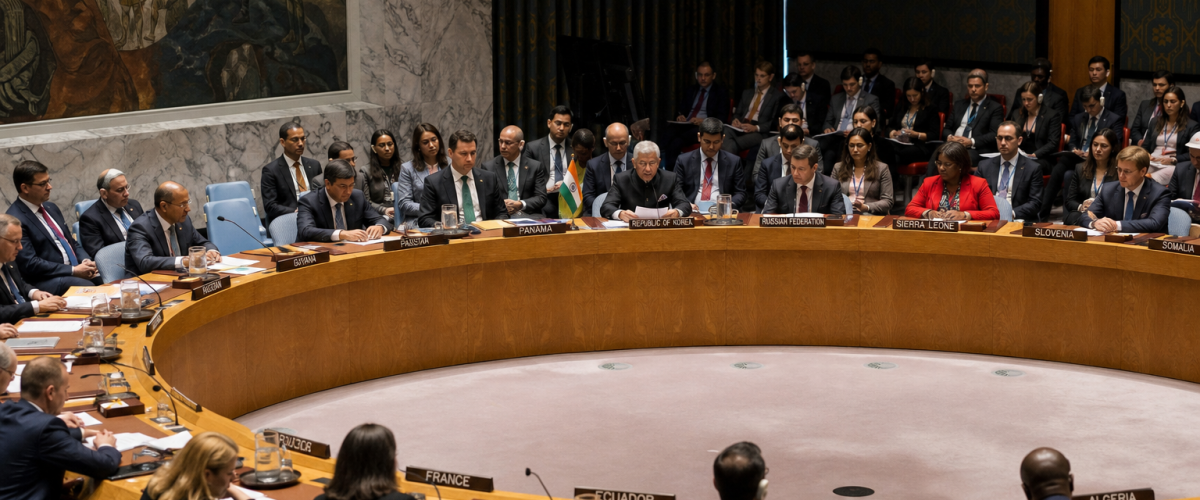
India launched a blistering diplomatic attack on Pakistan at the United Nations Security Council on Monday, June 9, 2026, accusing Islamabad of running an “organised factory of hate” through its newly coined “Fitna al-Hindustan” narrative. India’s Permanent Representative to the UN, Ambassador Harish Parvathaneni, dismantled Pakistan’s claims point by point during a Security Council meeting on the situation in Afghanistan, delivering one of the strongest diplomatic rebuttals in recent memory.
What Is ‘Fitna al-Hindustan’?
The term “Fitna al-Hindustan” — roughly translated as “the Indian conspiracy” or “sedition from Hindustan” — was coined by Pakistan last year when it designated several militant organisations active within its own borders under that umbrella label. Islamabad alleged that these groups, primarily operating in Balochistan and the tribal areas, were acting at India’s behest to destabilise Pakistan.
Pakistan’s government issued official notifications directing all government agencies to refer to these groups using the “Fitna al-Hindustan” label, effectively attempting to rebrand its domestic insurgency problem as an Indian intelligence operation. However, Islamabad provided no credible evidence to support these sweeping allegations.
The move was widely seen by international analysts as an attempt by Pakistan’s military-political establishment to deflect attention from its own failure to address domestic militancy, while simultaneously maintaining the narrative of an external threat from India — a strategy that has been a cornerstone of Pakistani domestic politics for decades.
India’s Devastating Response
Ambassador Parvathaneni’s response at the Security Council was measured in tone but devastating in substance. He systematically deconstructed Pakistan’s narrative, exposing the logical inconsistencies and political motivations behind the “Fitna al-Hindustan” label.
“Pakistan coming up with official notifications, directing its government agencies to start referring to groups inside its own borders as ‘Fitna al-Hindustan,’ is nothing but officially sponsored misinformation and disinformation dressed in religious terminology,” Parvathaneni told the assembled delegates.
He characterised the campaign as “an organised factory of hate” designed to keep Pakistan’s population focused on perceived external threats rather than addressing the country’s domestic political, economic, and governance challenges.
“Let me be clear: renaming your domestic insurgents does not change their origin. Putting an Indian label on Pakistani militants does not make them Indian agents. It merely exposes the desperation of those who have run out of credible explanations for their own failures,” the Indian envoy added.
Afghanistan Context
The exchange took place during a Security Council session focused on Afghanistan, where the situation remains precarious nearly five years after the Taliban’s return to power. India used the opportunity to highlight the broader pattern of Pakistan’s approach to militancy and terrorism in the region.
Parvathaneni reminded the Council of Pakistan’s documented history of supporting militant groups as instruments of state policy, from the Afghan Taliban to groups operating in Kashmir. He argued that the “Fitna al-Hindustan” narrative was merely the latest iteration of this long-standing strategy.
“Let me reiterate: dressing up a massacre as a military operation does not absolve the perpetrator. Killing, maiming, and orphaning civilians is not counter-terrorism,” the Indian ambassador said, in a pointed reference to Pakistan’s military operations in Balochistan, which have been criticised by international human rights organisations for their impact on civilian populations.
International Reaction
India’s forceful intervention at the Security Council was noted by several diplomats and observers. Western nations, while typically cautious about taking sides in India-Pakistan disputes at the UN, have privately expressed scepticism about the “Fitna al-Hindustan” narrative, viewing it as lacking evidentiary support.
The United States, which maintains complex relationships with both India and Pakistan, did not directly address the bilateral exchange but reaffirmed its commitment to “evidence-based assessment of security threats in the region.”
Pakistan’s representative at the Security Council responded by reiterating Islamabad’s position that India was engaged in “covert operations” within Pakistani territory. However, the response was notably less detailed than India’s intervention and relied primarily on repeating previous allegations without presenting new evidence.
Broader Diplomatic Significance
The UN exchange reflects the evolving dynamics of India-Pakistan relations at multilateral forums. India has increasingly adopted a more assertive diplomatic posture in recent years, moving away from its traditional restraint at international platforms to directly confront what it views as Pakistani misinformation campaigns.
This shift has been particularly evident since India’s successful campaign for non-permanent membership of the UN Security Council and its growing diplomatic weight in forums like the G20, the Quad, and the Shanghai Cooperation Organisation.
“India’s diplomacy has evolved significantly. New Delhi is no longer content to let allegations go unchallenged. The approach now is to respond promptly, factually, and forcefully,” said Dr. Srinath Raghavan, a professor of international relations and strategic affairs.
The Information War
Beyond the diplomatic sparring, the “Fitna al-Hindustan” episode highlights the growing importance of information warfare in international relations. Pakistan’s attempt to rebrand its domestic militancy problem using a catchy, religiously charged label represents a sophisticated — if ultimately transparent — effort to shape narratives in its favour.
India’s counter-strategy, as demonstrated at the Security Council, focuses on exposing the lack of evidence behind such claims while drawing attention to Pakistan’s well-documented history of using militant proxies as instruments of state policy.
As the situation in Afghanistan continues to evolve and regional security dynamics shift, the India-Pakistan rivalry at multilateral forums is likely to intensify. Monday’s exchange at the Security Council was a clear signal from New Delhi that it intends to contest every narrative that it views as designed to undermine India’s interests or misrepresent the ground reality in the region.
Also Read
- India vs Afghanistan One-Off Test Begins in New Chandigarh as Manav Suthar Makes Debut and India Elect to Bat First
- Virat Kohli Ruled Out of India vs Afghanistan ODI Series with Hamstring Injury Sustained During IPL 2026 Final
- India vs Afghanistan Cricket Tour June 2026 Full Schedule Squads and Preview as Shubman Gill Leads Team in One Test and Three ODIs
- Iran Fires Missiles at Israel After IDF Strikes on Beirut
- Indian Embassy Issues Urgent Advisory: ‘Leave Iran Immediately’
The question remains whether the international community will look beyond rhetorical labels and demand evidence-based accountability from all parties involved in the complex security landscape of South Asia.

- Indian Army Gets New Chief as General Dwivedi Hands Over Command Amid Push for Indigenous Defence Tech - July 1, 2026
- Ayodhya Ram Temple Donation Scandal Deepens as Trustees Resign and SIT Arrests Eight - June 29, 2026
- Bengal Seven Weeks On: Modi’s Historic Win and the Questions That Won’t Go Away - June 28, 2026