Telangana RTC Strike Turns Deadly as Driver Dies After Self-Immolation in Warangal: 60 Lakh Commuters Stranded as 6,000 Buses Stay Off Roads

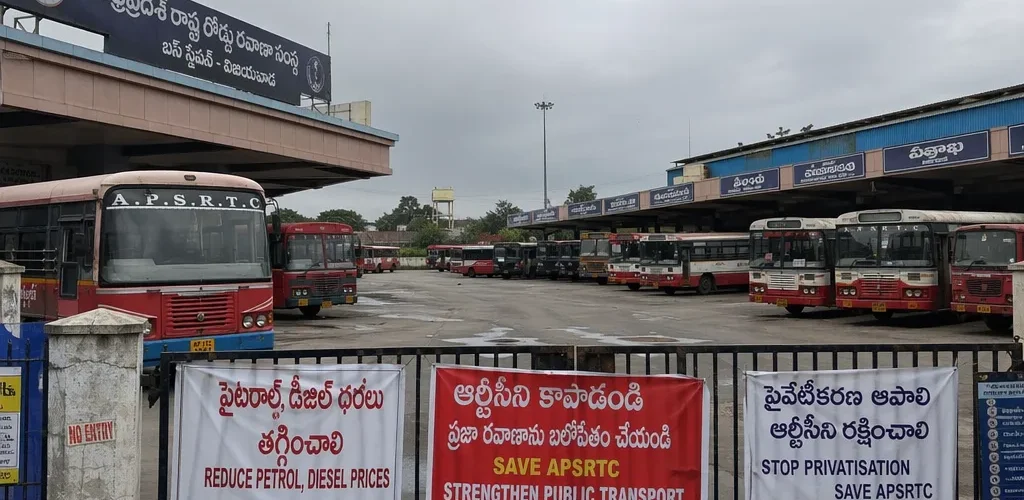
The indefinite strike by Telangana State Road Transport Corporation (TGSRTC) employees took a tragic and fiery turn on Thursday, April 24, 2026, when a bus driver identified as Shankar Goud of Narsampet depot in Warangal district set himself ablaze during the protest and later succumbed to his injuries. Two other RTC employees also attempted to take their own lives in separate incidents on the same day, pushing the state government into crisis mode. The strike, which began on April 22, has already paralysed public transport across Telangana, with more than 6,000 buses taken off the roads and an estimated 60 lakh daily commuters left stranded. Chief Minister Revanth Reddy has directed ministers to hold immediate talks with union leaders in an attempt to resolve the crisis.
The Tragedy: Shankar Goud’s Death and Two More Suicide Attempts
Shankar Goud, a driver posted at the Narsampet depot in Warangal, poured petrol on himself and set himself ablaze during the strike action, reportedly anguished over what workers described as the government’s indifferent attitude toward their demands. Co-workers at the scene rushed to his rescue and managed to douse the flames, but Goud had already suffered approximately 70 per cent burns.
He was immediately shifted to MGM Hospital in Warangal, and as his condition turned critical, arrangements were made to transfer him to DRDO Apollo Hospital at Kanchanbagh in Hyderabad. However, Shankar Goud succumbed to his injuries before reaching the hospital, turning the labour dispute into a deeply emotional crisis for the striking workers and their families.
On the same day, two other RTC employees also attempted to end their lives. D Linga Reddy, approximately 50 years old, and another worker attempted self-harm at separate locations. Both were rescued and hospitalised, with their conditions reported as stable. These incidents have intensified the emotional charge of the strike and placed enormous pressure on the Telangana government to respond.
Why RTC Employees Are Striking: 32 Demands
The Joint Action Committee (JAC) representing TGSRTC employees submitted a list of 32 demands to the state government and RTC management, with the primary demand being the merger of TGSRTC with the state government — effectively making RTC employees government servants with all corresponding benefits.
The key demands include:
Merger with state government: The centrepiece demand. If accepted, approximately 49,000 RTC employees would become state government employees, gaining job security, pension benefits, and salary parity with other government workers.
Labour union elections: Employees are demanding democratic elections for labour unions within the RTC, which have not been held for several years.
Salary and benefits parity: RTC workers demand that their salaries and benefits be brought at par with state government employees, who receive significantly higher compensation for comparable roles.
Wage revision implementation: Long-pending wage revisions that were promised but never implemented form a major grievance.
PF and CCS dues: Clearance of outstanding provident fund contributions and Credit Cooperative Society payments that have been delayed for months.
JAC general secretary Thomas Reddy stated that the strike was called after both the government and RTC management failed to respond to a strike notice issued on March 13 — giving more than five weeks’ notice before industrial action began.
Impact on Commuters: 60 Lakh People Affected Daily
The TGSRTC operates approximately 6,000 to 6,500 buses daily, carrying more than 60 lakh passengers across Telangana’s 33 districts. The complete withdrawal of these services has created a transportation emergency, particularly for:
Daily wage workers and labourers who depend on affordable RTC buses to reach work sites in cities like Hyderabad, Warangal, and Karimnagar from surrounding rural and semi-urban areas.
Students preparing for examinations and attending coaching classes, many of whom rely exclusively on RTC services for their daily commute.
Hospital patients and elderly citizens who need public transport to access healthcare facilities, particularly in districts where private transport options are limited.
Auto-rickshaw and private cab operators have reportedly raised fares by 200 to 300 per cent in many areas, exploiting the supply shortage. State authorities have warned against fare gouging, but enforcement has been limited given the scale of the disruption.
The Indian Railways has increased the frequency of certain services in Telangana to partially absorb the demand, but rail connectivity cannot substitute for the extensive bus network that reaches small towns and villages across the state.
Government Response: Talks Initiated Under Pressure
Transport Minister Ponnam Prabhakar had earlier urged employees to reconsider the strike, stating that the merger proposal was “under review by a committee” and assuring that the government was committed to addressing genuine grievances. However, the government’s initial response was criticised by union leaders as insufficient and lacking urgency.
Following Shankar Goud’s death, Chief Minister Revanth Reddy directed ministers to hold immediate talks with union representatives. The government has offered to constitute a high-level committee to examine the merger demand and expedite the pending wage revision, though union leaders have expressed scepticism about committee-based approaches that they say have produced no results in the past.
Opposition parties, including the BRS (formerly TRS), have seized on the crisis to attack the Congress-led Telangana government, accusing it of neglecting workers’ welfare despite promises made during the 2023 election campaign. BRS leaders have demanded immediate intervention by the Chief Minister and compensation for Shankar Goud’s family.
The RTC Merger Debate: History and Complexity
The demand to merge state transport corporations with state governments has a long and contentious history across India. Telangana’s RTC employees point to the precedent set by Himachal Pradesh, where the state transport corporation was merged with the government, giving employees government servant status.
However, the financial implications of such a merger in Telangana would be substantial. Making 49,000 RTC employees government servants would add an estimated Rs 8,000 to 10,000 crore annually to the state’s salary and pension bill, according to government estimates. Critics argue that the TGSRTC’s finances — already strained by operational losses — cannot sustain the salary levels that government employment would mandate.
Supporters of the merger counter that RTC employees perform essential public services under difficult conditions — long hours, safety risks, and relatively low pay — and deserve the security and benefits that government employment provides. They note that the revenue generated by Telangana’s growing economy should be sufficient to absorb the additional cost.
Looking Ahead: Resolution or Escalation?
The death of Shankar Goud has fundamentally changed the dynamics of the strike. What began as an industrial dispute is now a human tragedy with political ramifications. The government faces a difficult balancing act: yielding too quickly could set costly precedents, while continued delay risks further tragedy and public backlash.
Union leaders have stated that they are willing to negotiate but will not call off the strike until concrete commitments — not committees — are offered on the merger and wage revision demands. With each passing day, the economic and human cost of the strike grows, putting pressure on both sides to find a resolution before the crisis deepens further.
For Telangana’s 60 lakh daily bus commuters, the resolution cannot come soon enough. The strike has exposed the fragility of public transport systems that millions depend on, and the human cost of neglecting the workers who keep those systems running.