India’s Millet Recipe Revolution Reaches Peak as Government Push Meets Social Media Creativity in 2026

India’s millet recipe revolution has reached its peak in 2026 as the combined force of government subsidies, viral social media content and rising health consciousness transforms ragi, jowar and bajra from forgotten grains into mainstream kitchen staples. Data from the Food Corporation of India shows that millet consumption has increased 78 per cent since the International Year of Millets in 2023, with urban households now accounting for 45 per cent of all purchases.
The trend is reshaping India’s food industry from farm to table. Quick-service restaurants, cloud kitchens and packaged food brands are all racing to add millet-based items to their menus, while Instagram and YouTube have become the primary platforms where home cooks share innovative recipes that blend traditional knowledge with contemporary cooking techniques. This movement sits alongside the seven viral wellness diet trends dominating Indian kitchens that have collectively shifted how Indian families approach nutrition.
Government Push Brings Millets into Every Ration Shop
The central government’s decision to include millets in the Public Distribution System from January 2026 has been the single biggest catalyst for mass adoption. Under the revamped National Food Security Act provisions, families below the poverty line can now purchase ragi, jowar and bajra at Rs 2 per kilogram — the same subsidised rate as rice and wheat.
The Ministry of Agriculture reports that millet procurement reached 8.5 lakh metric tonnes in the 2025-26 rabi season, a threefold increase over the previous year. Rajasthan, Karnataka, Maharashtra and Andhra Pradesh are the leading producing states, with farmer incomes in millet-growing regions rising an average of 22 per cent due to guaranteed minimum support prices.
State governments have amplified the push with their own programmes. Karnataka’s “Ragi Mudde for All” initiative provides free ragi flour to anganwadi centres and government school mid-day meal programmes. Rajasthan has introduced bajra into its public hospital menus, citing studies that link millet consumption to improved diabetic management.
Social Media Turns Millets Into Viral Kitchen Content
If government policy created the supply, social media created the demand. Millet recipes are among the fastest-growing food content categories on Instagram, with the hashtag #MilletRecipes accumulating over 850 million views across platforms in Q1 2026 alone.
Creators like Chef Ranveer Brar, Tarla Dalal’s digital team and a wave of home cook influencers have published thousands of millet recipe videos ranging from ragi chocolate cake to jowar pizza base and bajra khichdi risotto. The cross-cultural fusion approach has been particularly effective at attracting younger audiences who might resist traditional preparations.
YouTube food creator Kabita’s Kitchen, which has 35 million subscribers, reports that her millet recipe playlist is now her second most-watched category after paneer dishes. The recipes emphasise simplicity and accessibility — most use five to seven ingredients and take under 30 minutes to prepare. The digital food trend mirrors the broader India’s street food revolution going digital where technology and tradition are merging in India’s food landscape.
Five Millet Recipes Trending in Indian Kitchens Right Now
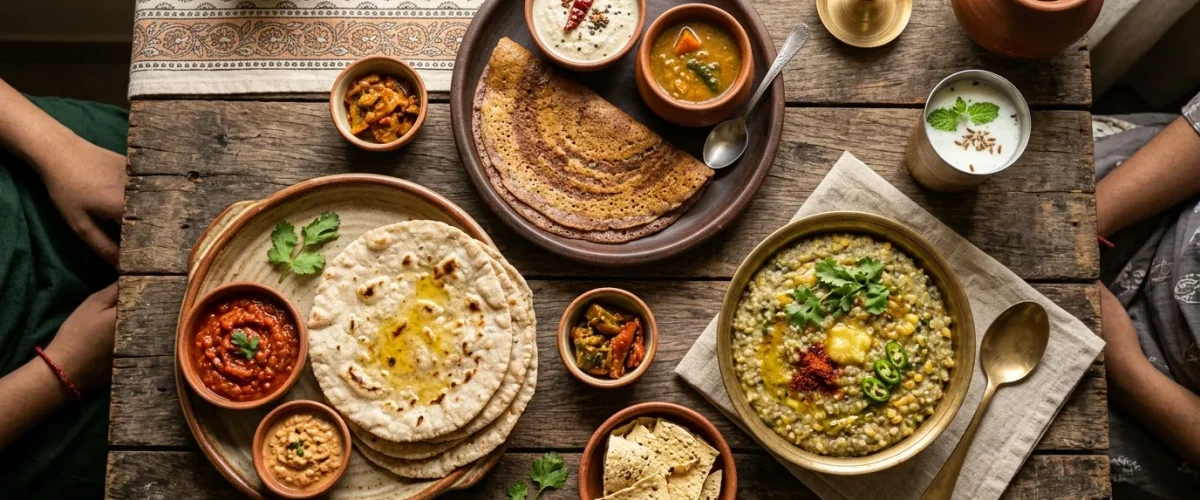
Among the hundreds of millet recipes circulating online, five have emerged as clear favourites in Indian kitchens this spring. Ragi dosa tops the list — a protein-rich alternative to the traditional rice-and-urad batter dosa that requires no fermentation. Made by simply mixing ragi flour with water, salt and cumin, it can be ready in under 10 minutes.
Jowar upma has become a popular breakfast replacement for semolina upma, particularly in South Indian households. The recipe uses cracked jowar cooked with mustard seeds, curry leaves, vegetables and a squeeze of lemon. Nutritionists praise it for its high fibre content and low glycaemic index.
Bajra khichdi — the Rajasthani comfort food — has found a pan-India audience through food bloggers who position it as a healing one-pot meal. Foxtail millet pulao and little millet lemon rice round out the top five, both popular as quick lunch options that pack well for office tiffins.
The emphasis on health connects directly to health and diet trends in India where readers increasingly seek nutritional guidance alongside recipes.
Food Industry Rides the Millet Wave
Corporate India has moved aggressively to capitalise on the millet trend. ITC’s Aashirvaad brand launched a dedicated millet flour range in six variants that is now available in 500,000 retail outlets. Nestlé India reformulated its Maggi Atta Noodles to include 30 per cent millet content, a move that boosted sales by 18 per cent in the first quarter.
In the restaurant segment, millet-focused eateries have multiplied. Bengaluru-based chain Millet Express now operates 45 outlets across five cities, serving a menu entirely built around ragi, jowar, kodo and barnyard millet. Mumbai’s fine-dining scene has also embraced the grain — Masala Library by Jiggs Kalra introduced a tasting menu where every course features a different millet preparation.
The packaged food market for millet-based products is valued at Rs 1,200 crore in 2026, up from Rs 320 crore in 2023. Products range from millet cookies and crackers to millet-based baby food and ready-to-eat millet upma cups. Meanwhile, regional Indian cuisines conquering urban menus nationwide are driving demand for traditional ingredients through premium urban channels, further supporting the millet ecosystem.
Can the Millet Boom Sustain Itself
While the numbers are impressive, experts caution that sustaining the millet revolution will require continued investment in processing infrastructure, cold chain logistics and consumer education. India currently processes only 15 per cent of its millet harvest into value-added products, compared to over 60 per cent for wheat and rice.
Taste remains a barrier for some consumers. Millets have a naturally earthy flavour and denser texture that can be unfamiliar to palates accustomed to refined wheat and polished rice. Recipe innovation and product development will be crucial in bridging this gap. For the latest Food and Recipes coverage and trends that are reshaping the Indian kitchen, millets are a story that shows no signs of slowing down.

- Fentanyl Vaccine Breakthrough: Scripps Research Develops Shot That Blocks Deadly Overdoses Before They Reach the Brain - June 13, 2026
- Nipah Virus Returns to Kerala — First Case of 2026 Confirmed, State Declares High Alert - June 12, 2026
- Jill Biden Reveals She Wanted to Keep PM Modi’s 7.5-Carat Diamond Gift but Returned It After State Department Valued It at $20,000 - June 8, 2026