Sensex Hits All-Time High of 96,500 as FII Inflows Surge and India Becomes World’s Fourth-Largest Stock Market

India Crosses a Historic Market Capitalisation Milestone
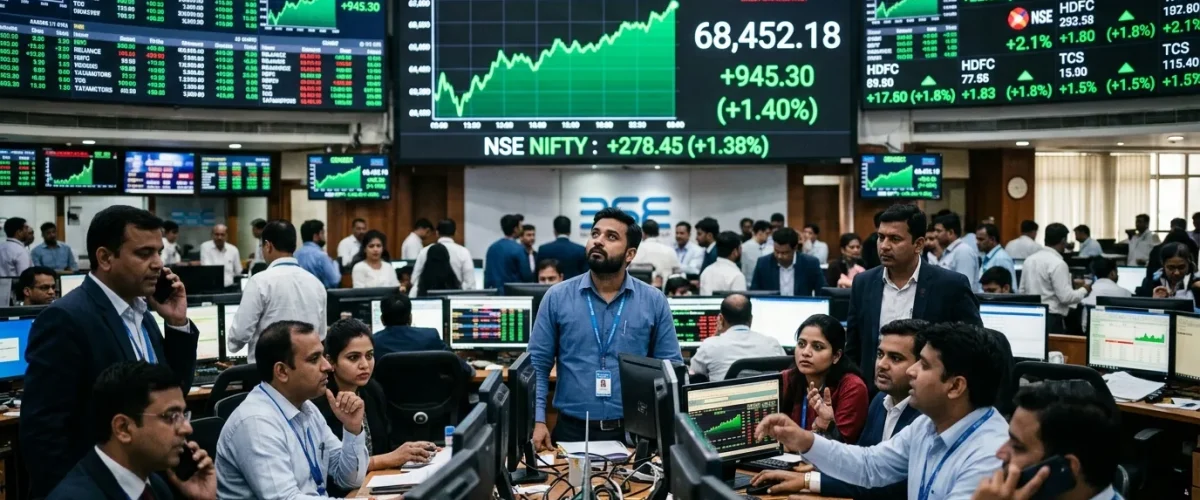
The BSE Sensex breached 96,500 for the first time on 28 March 2026, closing at 96,537 — a gain of 487 points for the session and capping a remarkable 2,400-point rally over the preceding three weeks. The broader Nifty 50 index settled at 29,210, also a record. More significantly, India’s total stock market capitalisation crossed USD 5.8 trillion, overtaking Hong Kong to become the world’s fourth-largest equity market behind only the United States, China and Japan.
The milestone, once considered a distant aspiration, was achieved through a confluence of strong corporate earnings, surging foreign institutional investor (FII) inflows and a macroeconomic environment that continues to favour India relative to other emerging markets.
FII Inflows Drive the March Rally
Foreign institutional investors poured a net USD 6.2 billion into Indian equities in March 2026, the highest monthly inflow since December 2020. The reversal is striking: FIIs had been net sellers for much of 2024 and early 2025, withdrawing over USD 18 billion as US Treasury yields rose and China’s economic reopening diverted capital. The return reflects a structural reassessment of India’s growth prospects.
“India is the only major economy delivering 7-plus per cent GDP growth with single-digit inflation and a stable currency,” noted Mark Mobius, the veteran emerging markets investor, in a Bloomberg interview. “For global allocators, India is no longer an alternative — it is a core holding.” The positive sentiment aligns with India’s economic growth outlook, which continues to outpace most global peers.
The FII buying has been concentrated in sectors with strong earnings visibility: banking and financial services (35 per cent of inflows), information technology (22 per cent), capital goods and infrastructure (18 per cent) and consumer staples (12 per cent). Mid-cap and small-cap indices, which had underperformed since October 2025, also participated in the rally, with the Nifty Midcap 100 gaining 8.3 per cent in March.
Corporate Earnings: The Foundation of the Rally
The Q3 FY2026 earnings season (October-December 2025) delivered robust results across most sectors. Nifty 50 companies reported aggregate profit growth of 18.2 per cent year-on-year, the strongest quarter in three years. Banking sector profits surged 24 per cent, led by HDFC Bank, ICICI Bank and State Bank of India, which benefited from strong loan growth and improving asset quality.
The IT sector surprised positively after two years of muted growth. TCS, Infosys and HCLTech all beat consensus estimates, driven by AI-related deal wins and a recovery in discretionary technology spending by US and European clients. The AI theme has been a particular tailwind, with Indian IT firms positioning themselves as implementation partners for global enterprises deploying generative AI solutions.
Reliance Industries, India’s largest company by market capitalisation, delivered record quarterly revenue of Rs 2.7 lakh crore, driven by the integration of its JioStar media platform and strong retail expansion. The stock has gained 18 per cent year-to-date, single-handedly contributing over 1,500 points to the Sensex rally.
Domestic Investors: The Unsung Heroes
While FII inflows grab headlines, the structural support for Indian equities comes from domestic investors. Systematic Investment Plan (SIP) flows into mutual funds crossed Rs 25,000 crore per month for the first time in February 2026, up from Rs 18,000 crore a year earlier. The total number of demat accounts in India now exceeds 180 million, having doubled in just three years.
This domestic investor base provides a crucial buffer against FII volatility. During the FII sell-off of mid-2024, domestic mutual funds absorbed the selling pressure, preventing a deeper market correction. The growing maturity of Indian retail investors — evidenced by increasing allocations to large-cap index funds over speculative small-caps — is a positive development for market stability. For those looking to navigate this landscape, personal finance and investment strategies remain essential reading.
Sector Spotlight: Infrastructure and Green Energy
The infrastructure and green energy sectors have emerged as market darlings in 2026. Larsen & Toubro, the country’s largest infrastructure company, reported an order book of Rs 5.2 lakh crore at the end of Q3, its highest ever. The stock has gained 32 per cent year-to-date, outperforming the broader market.
Green energy stocks have also surged. Adani Green Energy, NTPC Green and Tata Power’s renewable arm have collectively gained 25-40 per cent as India accelerated its clean energy installations to 22 GW in FY2026, the fastest pace globally. The government’s target of 500 GW of non-fossil fuel capacity by 2030 implies sustained capital expenditure, making the sector a multi-year growth story.
The real estate sector, supported by strong housing demand in urban India, has been another outperformer. DLF, Godrej Properties and Oberoi Realty have reached 52-week highs, driven by record new launches and improving sentiment in India’s real estate market. The sector’s weight in the Nifty 50 has increased from 1.2 per cent to 2.5 per cent over the past year.
Risks on the Horizon
Despite the euphoria, market strategists point to several risks. Valuations are stretched: the Nifty 50 trades at a price-to-earnings ratio of 23.4x, a 15 per cent premium to its 10-year average. Any disappointment in Q4 FY2026 earnings could trigger profit-booking, particularly in the mid-cap and small-cap space where valuations are even more demanding.
Globally, the US Federal Reserve’s interest rate trajectory remains uncertain. While markets are pricing in two rate cuts in 2026, persistently sticky inflation in the US could delay easing, potentially strengthening the dollar and reversing FII flows. The rupee, which has appreciated to Rs 83.50 per dollar from Rs 85 at the start of the year, could face pressure if the dollar strengthens.
Geopolitical risks — including US-China trade tensions, the Middle East conflict and supply chain disruptions — remain wildcards. However, India’s relative insulation from these risks, combined with its domestic consumption-driven growth model, makes it a natural beneficiary of “de-risking” strategies adopted by global investors. The major Indian company developments across sectors reflect this structural advantage.
The Path to Sensex 100,000
With the Sensex at 96,500, the psychological 100,000 mark is within touching distance. Morgan Stanley, Goldman Sachs and Motilal Oswal have all published targets above this level, with some projecting 110,000 by March 2027. The consensus view is that India’s structural growth story — favourable demographics, robust startup funding trends, infrastructure investment and digital transformation — justifies premium valuations relative to global peers.
For investors, the message is clear: India’s stock market is no longer just a growth story — it is becoming a structural allocation in global portfolios. The journey to Sensex 100,000, whether it takes weeks or months, appears to be a matter of when, not if.