Passenger Opens Emergency Exit and Jumps From Moving Air Arabia Flight at Chennai Airport After Vomiting Twice During Sharjah-Chennai Journey

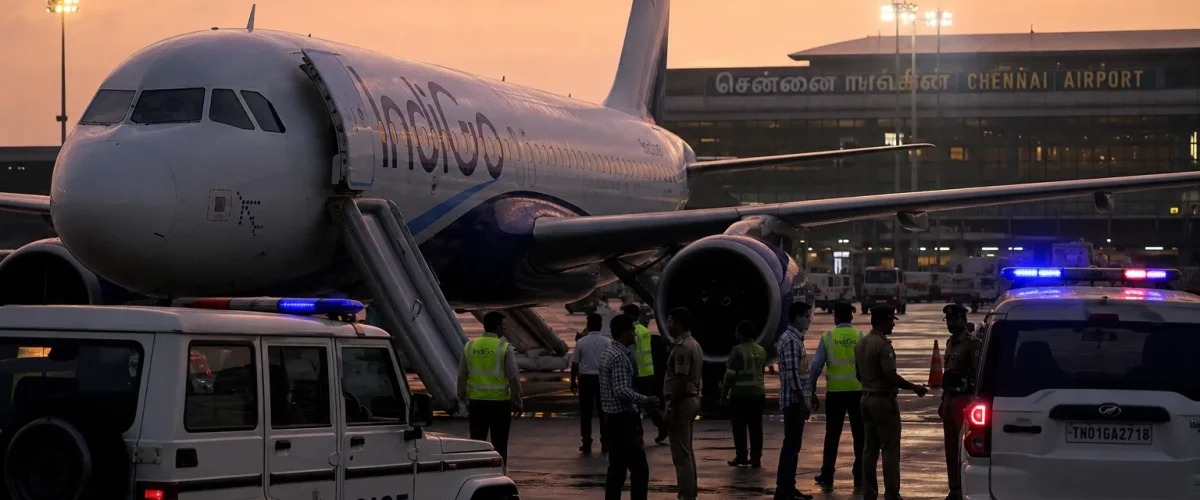
Air Arabia Passenger Opens Emergency Exit Door While Aircraft Taxis at Chennai Airport
Panic erupted among 231 passengers aboard an Air Arabia flight from Sharjah when a 34-year-old male passenger from Pudukkottai, Tamil Nadu, opened one of the aircraft’s emergency exit doors and jumped out while the plane was still moving along the taxiway at Chennai International Airport early on Sunday morning, 3 May 2026. The pilot immediately brought the aircraft to a halt and alerted airport authorities, triggering a major security response involving armed Central Industrial Security Force (CISF) personnel and bomb disposal experts.
According to preliminary reports from airport officials, the passenger had been visibly unwell during the flight. “He complained of a vomiting sensation and is believed to have vomited twice on board,” an official told media, indicating that his deteriorating physical condition may have contributed to his erratic actions. The incident occurred shortly after the aircraft touched down on the runway and was taxiing along the designated path connecting the runway to the terminal building.
How the Incident Unfolded
The Air Arabia flight, carrying 231 passengers from Sharjah to Chennai, landed safely at Chennai International Airport in the early morning hours. As the aircraft moved slowly along the taxiway toward its assigned gate, the passenger — seated near one of the emergency exit rows — suddenly pulled the handle and opened the door. On modern commercial aircraft, emergency exit doors on certain rows can be physically opened by passengers when the aircraft is on the ground and the cabin pressure has equalised, unlike at cruising altitude where the pressure differential makes it virtually impossible.
The passenger then jumped from the aircraft onto the taxiway, landing on the tarmac below. The pilot, upon being alerted by cabin crew, immediately applied the brakes and radioed the Air Traffic Control (ATC) tower to report the security breach. Operations at the taxiway were temporarily disrupted as emergency protocols were activated.
Responding swiftly, CISF personnel — including armed officers from the airport security team and bomb disposal specialists — rushed to the location where the aircraft had stopped. Security teams boarded the aircraft to ensure there was no further threat and to reassure the shaken passengers. The man was apprehended on the tarmac, and the pilot filed a formal complaint with the authorities regarding the unprecedented security incident.
Passenger Arrested and Under Assessment
The passenger was arrested by CISF personnel and taken into custody for questioning. Officials are investigating the circumstances surrounding his actions, including his mental state at the time of the incident. Medical teams have been called in to assess his condition, and airport authorities are examining whether he was under the influence of any substances or suffering from a medical episode that impaired his judgment.
Under Indian aviation law, interfering with aircraft operations, tampering with emergency equipment, or endangering the safety of passengers and crew is a serious criminal offence. The Bureau of Civil Aviation Security (BCAS), which oversees aviation security in India, is expected to conduct its own investigation alongside the police inquiry. Air Arabia is also expected to file charges under the relevant provisions of the Aircraft Act and the Indian Penal Code.
This incident recalls other aviation scares at Indian airports, including a recent engine fire during takeoff at Delhi Airport involving a SWISS Air flight. While that incident involved mechanical failure, today’s event highlights the ongoing challenge of managing passenger behaviour on commercial flights, particularly when individuals are unwell or in distress.
Safety Implications and Aviation Protocols
Aviation safety experts have noted that while the incident could have been far more dangerous — had the aircraft been moving at higher speed or had other passengers panicked and attempted to follow — the relatively low taxiing speed likely prevented serious physical injury to the passenger. Emergency exit doors on most commercial aircraft are designed to be operable from inside the cabin to allow evacuation during emergencies, which inherently creates the possibility of misuse during non-emergency situations.
Airlines and airport authorities worldwide have grappled with the challenge of passengers opening emergency exits at inappropriate times. In recent years, there have been multiple incidents globally where passengers — often confused, intoxicated, or suffering from medical episodes — have opened emergency doors during taxiing or even attempted to do so mid-flight.
Indian aviation authorities have responded by increasing crew training on managing unruly or distressed passengers, installing better warning signage near emergency exits, and imposing strict penalties on offenders. The Directorate General of Civil Aviation (DGCA) has a no-fly list for passengers who endanger flight safety, and the individual involved in today’s incident could face being added to this list in addition to criminal charges.
Impact on Airport Operations
The incident caused a brief disruption to taxiway operations at Chennai International Airport, one of South India’s busiest aviation hubs. Other aircraft were held on the runway and at gates while security teams secured the area around the Air Arabia flight. Normal operations resumed within approximately 45 minutes after the passenger was detained and the aircraft was cleared to proceed to its gate.
Passengers aboard the flight described scenes of confusion and alarm when they heard the emergency exit being opened and saw the man jump. Several passengers on social media described the experience as “terrifying” and praised the crew for their quick response in calming passengers and coordinating with ground security. Air Arabia issued a brief statement confirming that an incident had occurred and that the safety of all passengers and crew was ensured.
India’s rapidly growing aviation sector, which has seen a massive increase in domestic and international air travel, faces the dual challenge of expanding capacity while maintaining rigorous safety standards. The Chennai airport incident serves as a reminder that even routine flights can encounter unexpected situations, and the importance of robust emergency alert and response systems cannot be overstated — whether in the air, on the ground, or at sea.