56 Killed in Uttar Pradesh After Devastating Storm and Heavy Rain Lash Nine Districts Including Prayagraj Bhadohi and Fatehpur

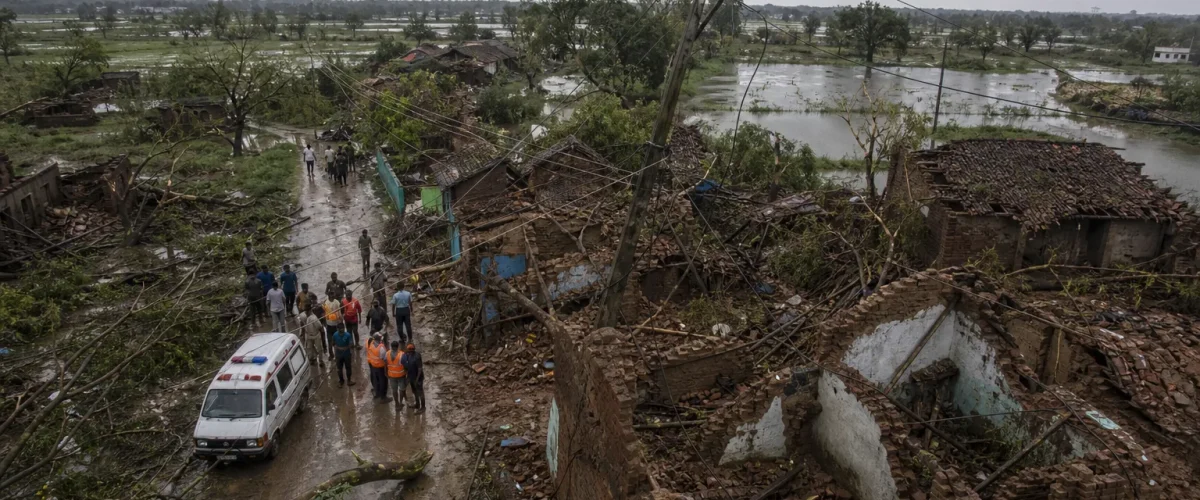
At least 56 people were killed on Wednesday, 14 May 2026, after a powerful storm accompanied by heavy rain and lightning strikes tore through multiple districts of Uttar Pradesh, uprooting trees, toppling electricity poles, damaging homes and leaving a trail of devastation in one of the deadliest weather events to hit the state this year. The storm struck during the late afternoon and evening hours, catching residents off guard across at least nine districts, with the worst damage reported in Prayagraj, Bhadohi, Fatehpur, Unnao, Kanpur Dehat, Budaun, Chandauli and Sonbhadra.
According to reports received from district administrations and news agencies, Prayagraj and Bhadohi each recorded 16 deaths — the highest toll of any single district. Fatehpur reported nine fatalities, Budaun five, Unnao four, Kanpur Dehat three, Chandauli two and Sonbhadra one. However, the state government has not yet released a consolidated casualty figure, and officials acknowledged that the final toll could rise as rescue and survey teams reach more remote areas of the affected regions.
Chief Minister Yogi Adityanath Orders Immediate Relief
Chief Minister Yogi Adityanath expressed deep condolences to the bereaved families and immediately issued directives for comprehensive relief and compensation to all victims. In a statement issued by the Chief Minister’s Office (CMO), Adityanath ordered that the task of delivering relief to the victims must be completed within 24 hours. He directed district magistrates of all affected districts to personally visit the sites of destruction and ensure that every possible form of assistance reaches the affected families without delay.
The Chief Minister also instructed officials from the disaster management authority, the public works department, the power distribution companies and the health department to coordinate their response and restore essential services — particularly electricity and road access — as quickly as possible. Revenue department teams were tasked with conducting rapid damage assessments to determine the extent of crop losses, property damage and infrastructure destruction caused by the storm.
A senior state government officer, speaking on condition of anonymity, told reporters: “We are in the process of gathering consolidated figures from all districts. Once we have a complete picture, the state government will announce compensation in accordance with the State Disaster Response Fund norms.” Under current state disaster relief guidelines, the families of those killed in natural disasters are entitled to ex gratia payments of Rs 4 lakh each, while compensation for damaged houses and crops is assessed on a case-by-case basis.
District-Wise Breakdown of the Devastation
In Prayagraj, the storm struck with particular ferocity in the rural areas of the district, where poorly constructed houses and temporary shelters bore the brunt of the high-speed winds. Several victims were killed when walls collapsed on them, while others died from falling trees and electricity poles. Lightning strikes accounted for a significant number of deaths in the district, as many agricultural labourers were working in open fields when the storm hit. The Prayagraj district magistrate said emergency teams had been deployed to all affected villages and that a relief camp had been set up at a local school to provide shelter, food and medical aid to displaced families.
Bhadohi, a district in eastern Uttar Pradesh known for its carpet weaving industry, also recorded 16 deaths. Local officials reported that several of the fatalities occurred in the towns of Gopiganj and Aurai, where the winds were clocked at speeds exceeding 80 kilometres per hour. Power supply was disrupted across large parts of the district as numerous electricity poles were snapped by the storm, plunging villages into darkness and complicating rescue operations.
Fatehpur, located between Prayagraj and Kanpur, reported nine deaths and extensive damage to standing crops, particularly wheat that was still being harvested in some areas. The district magistrate said that most of the casualties occurred due to wall collapses and falling trees, and that compensation would be disbursed to affected families within 72 hours. In Budaun, five people were killed and dozens of homes were damaged, with officials reporting that a mother and her young son were among the victims after their mud house collapsed during the storm.
Infrastructure Damage and Power Outages
Beyond the tragic loss of life, the storm caused massive infrastructure damage across the affected belt. In Prayagraj and surrounding areas, dozens of trees were uprooted, blocking major roads and railway tracks. The Indian Meteorological Department (IMD), which had issued a yellow alert for parts of eastern UP earlier in the day, said the storm was triggered by a convergence of warm moist air from the Bay of Bengal and a western disturbance that intensified convective activity over the Indo-Gangetic plains.
Railway services in the region were briefly affected, with several trains on the Prayagraj-Varanasi and Lucknow-Prayagraj routes delayed by 30 minutes to over an hour due to fallen trees on the tracks. The Northern Railway division deployed emergency restoration teams to clear the debris, and services were gradually normalised by late evening. Road transport was also disrupted, with the Prayagraj-Fatehpur state highway and several district roads blocked by uprooted trees and tangled electricity wires, forcing diversions and adding hours to commute times.
The Uttar Pradesh Power Corporation Limited (UPPCL) reported that power supply was disrupted in over 500 villages across the affected districts, with Bhadohi, Prayagraj, Fatehpur and Unnao being the worst hit. Restoration work began overnight, but officials said it would take at least 48 hours to fully restore power in all areas, as many of the downed poles would need to be replaced rather than simply re-erected. In several villages, temporary generators were deployed to ensure power supply to hospitals and essential services.
Rising Pattern of Extreme Weather Events
The deadly storm is the latest in a series of extreme weather events that have battered Uttar Pradesh and other parts of northern India in recent weeks. Earlier this month, a severe heatwave pushed temperatures past 47 degrees Celsius in several parts of the country, while unseasonal hailstorms disrupted operations at Delhi’s IGI Airport on 6 May, delaying over 500 flights. Climate scientists have repeatedly warned that such extreme weather events — characterised by sudden, intense storms followed by periods of extreme heat — are becoming more frequent and severe due to climate change and the disruption of normal monsoon patterns.
The IMD has forecast continued unsettled weather over parts of eastern Uttar Pradesh, Bihar and Jharkhand over the next 48 hours, with isolated thunderstorms, gusty winds and lightning expected in several districts. Authorities have issued advisories urging residents to stay indoors during storm warnings, avoid open fields, and keep away from trees, electricity poles and other tall structures during inclement weather. The National Disaster Response Force (NDRF) has placed additional teams on standby in Lucknow, Prayagraj and Varanasi to respond to any further emergencies.
For the families of the 56 victims, the immediate priority remains the disbursal of compensation and the restoration of essential services. Opposition parties, including the Samajwadi Party and the Congress, have demanded that the state government declare the affected districts as disaster zones and provide enhanced relief packages that go beyond the standard SDRF norms. The SP’s state president said the government must also invest in early warning systems and storm-resistant infrastructure to prevent such tragedies from recurring.

- Fentanyl Vaccine Breakthrough: Scripps Research Develops Shot That Blocks Deadly Overdoses Before They Reach the Brain - June 13, 2026
- Nipah Virus Returns to Kerala — First Case of 2026 Confirmed, State Declares High Alert - June 12, 2026
- Jill Biden Reveals She Wanted to Keep PM Modi’s 7.5-Carat Diamond Gift but Returned It After State Department Valued It at $20,000 - June 8, 2026