Delhi Rains and Hailstorm Cause Chaos at IGI Airport: Over 500 Flights Delayed and 10 Cancelled on Tuesday

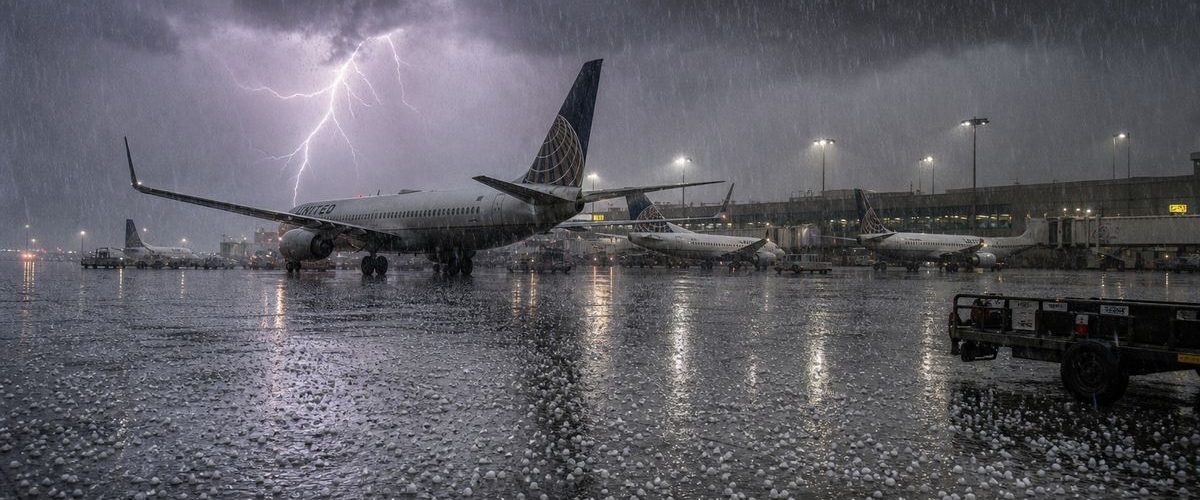
A sudden and violent spell of rain, accompanied by hailstorm and gusty winds, lashed parts of Delhi on Tuesday afternoon, bringing the Indira Gandhi International (IGI) Airport to a near standstill and causing widespread disruption to air travel across the country. According to data from the flight tracking website Flightradar24, over 500 flights — including both arrivals and departures — were delayed, with an average delay of approximately 30 minutes. At least 10 flights were cancelled and five were diverted to nearby airports during the worst of the weather.
What Caused the Disruption
The weather event struck with little warning. Around 1 PM on Tuesday, dark clouds rapidly gathered over South-West Delhi, and within minutes, areas around the airport — particularly parts of Dwarka, Palam, and Najafgarh — were hit by heavy rainfall accompanied by hailstones as large as one centimetre in diameter. Gusty winds reaching speeds of 50-60 kilometres per hour were recorded at the airport’s weather station between 1:30 PM and 3:00 PM.
“Five flights were diverted between 2 PM and 3:30 PM as gusty winds, rain, and hail were recorded around the airport,” said an airport official who spoke on condition of anonymity. “The diversions were to Jaipur and Lucknow. Normal operations resumed gradually after 4 PM, but the cascading delays continued well into the evening.”
The disruption was compounded by 10 flight cancellations that were unrelated to the weather. These cancellations — six arrivals from Dubai, Abu Dhabi, Kuwait, and Baghdad, and four departures to the same destinations — were linked to security concerns following a recent escalation in the Middle East conflict, where drone attacks in the Gulf region prompted airlines to temporarily suspend certain routes.
Passenger Chaos at Terminal 3
The combination of weather delays and Middle East cancellations created scenes of chaos at IGI Airport’s Terminal 3, the primary international terminal. Hundreds of passengers were stranded, with departure boards showing cascading delays of two to four hours on many domestic routes.
Social media was flooded with images and videos from frustrated travellers. Several passengers reported being stuck on the tarmac for over an hour after landing, unable to deplane due to safety protocols during the hailstorm. Others shared videos of hailstones pounding aircraft windows while parked at the gate.
“I was on an IndiGo flight from Mumbai that was supposed to land at 1:45 PM. We circled Delhi for 40 minutes and then were diverted to Jaipur. We finally reached Delhi by bus at 7 PM,” said Priya Kapoor, a management consultant travelling for work. “There was zero communication from the airline for the first two hours.”
Airlines including IndiGo, Air India, Vistara, SpiceJet, and Akasa Air issued travel advisories throughout the afternoon, advising passengers to check flight status before heading to the airport. IndiGo, India’s largest domestic carrier, was most affected, with over 200 of its flights experiencing delays.
IMD Weather Forecast for Wednesday
The India Meteorological Department (IMD) has not issued any colour-coded alert for Delhi on Wednesday, May 6, but has forecast “thundery development towards late evening” due to a prevailing western disturbance passing over North-West India. The disturbance is expected to withdraw by Thursday, after which temperatures are likely to rise again, with the mercury expected to touch 41-42°C by the weekend.
“The western disturbance that caused Tuesday’s weather is weakening,” said Dr Mahesh Palawat, a senior meteorologist. “There may be some cloudy spells and isolated thunder on Wednesday evening, but nothing as intense as Tuesday. By Friday, Delhi will return to its usual pre-monsoon heat.”
The IMD noted that Tuesday’s rainfall — approximately 18 mm recorded at the Safdarjung observatory — was unusual for early May but not unprecedented. Delhi has been experiencing erratic weather patterns this season, with a combination of heat waves and sudden storms that climate scientists attribute to broader atmospheric instability.
Infrastructure and Road Disruptions
The rain and hailstorm caused significant disruptions beyond the airport. Several key road stretches in South and West Delhi were waterlogged within minutes of the downpour, leading to traffic jams lasting two to three hours on arterial roads including the Delhi-Gurgaon Expressway, NH-48, and the Outer Ring Road near Palam.
The Municipal Corporation of Delhi reported that fallen trees blocked roads in at least eight locations, including stretches near INA Market, Vasant Kunj, and Janakpuri. Power outages were reported in parts of Dwarka, Najafgarh, and Mahipalpur, affecting thousands of residents. Delhi’s electricity distribution companies (discoms) said power was restored to most areas by late evening.
The Delhi Traffic Police deployed additional personnel and issued real-time advisories on social media, urging commuters to avoid waterlogged stretches. Auto-rickshaw and taxi fares surged on app-based platforms, with some passengers reporting prices three to four times the normal rate during peak disruption.
Aviation Impact: A Growing Concern
The incident has once again highlighted the vulnerability of India’s busiest airport to weather disruptions. IGI Airport, which handles over 70 million passengers annually, has experienced multiple weather-related shutdowns in recent years, raising questions about infrastructure resilience and the need for better systems to manage cascading delays.
Aviation experts have called for investments in advanced weather radar systems at major Indian airports, improved passenger communication protocols, and designated holding areas for stranded travellers. The recent emergency exit incident at Chennai Airport has already put aviation safety under scrutiny, and Tuesday’s chaos adds to growing concerns about India’s ability to handle disruptions at its increasingly crowded airports.
“We need category IIIB ILS (Instrument Landing System) capability at all major Indian airports, not just Delhi,” said Captain Amit Banerjee (retd), a former airline pilot. “We also need better ground infrastructure — covered walkways, additional gates, and real-time communication systems that keep passengers informed during delays.”
Road Ahead
For the thousands of passengers affected by Tuesday’s disruption, the primary concern remains rescheduling and compensation. Under DGCA guidelines, airlines are required to provide meals, accommodation, and alternate arrangements for passengers affected by delays exceeding certain thresholds, though enforcement of these rules has been inconsistent.
As Delhi braces for the onset of the pre-monsoon season and the monsoon itself, both the airport authority and airlines will need to prepare for an extended period of weather-related disruptions. For a city that serves as India’s primary aviation hub, the stakes could not be higher for maintaining reliable air connectivity and passenger safety across the increasingly unpredictable weather season.