Trump and Xi Hold High-Stakes Talks at Great Hall of the People in Beijing as Taiwan Warning and Trade Progress Dominate Superpower Summit

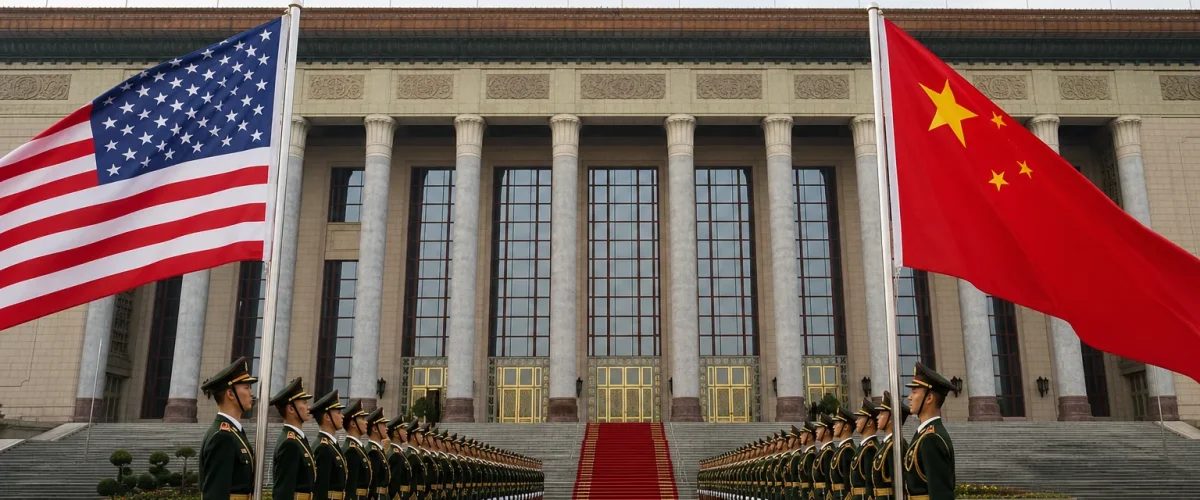
Chinese President Xi Jinping welcomed US President Donald Trump with a formal handshake at the imposing Great Hall of the People in Beijing on Thursday, 14 May 2026, for what Trump described as possibly the “biggest summit ever” — a two-day engagement between the world’s two largest economies at a moment of extraordinary global tension. The summit opened with a pomp-filled reception featuring an honour guard and throngs of children excitedly waving flowers and flags, a traditional Chinese diplomatic gesture reserved for the most significant state visits.
In his opening remarks, which were open to media, Xi told Trump that stable relations between the United States and China benefit the entire world. “When we cooperate, both sides benefit; when we confront each other, both sides suffer,” the Chinese leader said, setting a cooperative tone for talks that would cover some of the thorniest issues in global geopolitics — including Taiwan, the Iran war, trade tariffs and the future of US-China economic relations.
Xi Issues Stark Taiwan Warning
Perhaps the most consequential moment of the summit’s opening session was Xi Jinping’s pointed warning about Taiwan. According to an official readout from China’s Ministry of Foreign Affairs, Xi told Trump that Taiwan was “the most important issue in US-China relations” and that if handled poorly, it could lead to conflict and “an extremely dangerous situation.” The Chinese leader’s remarks were widely interpreted as a direct signal that Beijing views any expansion of US arms sales to Taiwan or increased US political engagement with the island as potential triggers for military escalation.
Trump did not respond publicly when a reporter later asked whether he had discussed Taiwan with Xi. The omission was noted by diplomatic observers, who said it likely reflected the Trump administration’s strategy of avoiding public commitments on Taiwan while seeking Chinese cooperation on other priority issues — particularly trade and Iran. The US delegation, which includes Secretary of State Marco Rubio — the first sitting US Secretary of State sanctioned by China — did not brief media on the substance of the Taiwan discussion.
Taiwan has long been the most sensitive issue in US-China relations. Beijing considers the democratically governed island a breakaway province that must eventually be reunified with the mainland, by force if necessary. The United States, while officially adhering to a “One China” policy, has continued to arm Taiwan and maintain unofficial diplomatic ties, a stance that Beijing views as provocative and destabilising. Trump’s arrival in Beijing on Wednesday had already generated intense diplomatic scrutiny given the presence of Rubio, who was sanctioned by China in 2020 over his vocal criticism of Beijing’s treatment of Uyghur Muslims in Xinjiang.
Trade Progress Amid Tariff War Backdrop
On the economic front, Xi struck a notably positive tone. He told Trump that negotiations between US and Chinese economic and trade teams in South Korea on Wednesday had reached “overall balanced and positive outcomes,” according to the Chinese readout. The South Korea negotiations had aimed to maintain the trade truce struck between Trump and Xi last October and establish mechanisms to support future trade and investment, officials with knowledge of the matter said.
The long-simmering trade war between the two countries has been one of the defining economic conflicts of the decade. Trump’s sweeping tariffs imposed last year triggered tit-for-tat levies that exceeded 100 per cent on some categories of goods, disrupting supply chains, raising consumer prices and straining relations between the world’s two biggest trading partners. The summit is seen as a critical opportunity to de-escalate trade tensions and potentially reach new agreements on market access, technology transfer and investment protections.
Trump arrived for the summit on Air Force One late Wednesday accompanied by top American CEOs, including Nvidia’s Jensen Huang and Tesla’s Elon Musk — symbols of the business deals the US president hopes to secure during the visit. The presence of tech industry leaders underscores the importance of semiconductor trade and artificial intelligence cooperation in the broader US-China economic relationship. Both countries have imposed restrictions on technology exports to each other, and any agreement to ease these restrictions would have significant implications for the global economy.
Iran War Looms Over Talks
The ongoing US-Iran war, now in its 11th week, was also expected to feature prominently in the summit discussions. The conflict has disrupted global energy markets, sent crude oil prices above $100 per barrel, and created a humanitarian crisis in the Gulf region. China, which has maintained diplomatic ties with Iran and has urged de-escalation, is seen as a potential mediator — although Beijing has been careful not to antagonise Washington by appearing to side with Tehran.
Analysts said the summit provided an opportunity for Trump to seek Chinese support — or at least non-interference — in US efforts to impose a new security framework in the Gulf region. In return, China may push for relief from US trade restrictions and a commitment to reduce tariffs. The outcome of the Iran discussions could have significant implications for global energy prices and financial markets, which have been roiled by the conflict for months.
State Banquet and Temple of Heaven Visit
The two leaders were scheduled to conclude Thursday’s session with a state banquet at the Great Hall of the People, followed by Trump’s visit on Friday to the historic Temple of Heaven — a UNESCO World Heritage site where China’s emperors once prayed for good harvests. The visit to the Temple of Heaven is both a diplomatic courtesy and a symbolic gesture, signalling the high regard in which the Chinese government holds the visit.
The summit has drawn intense global media coverage, with hundreds of international journalists based in Beijing for the event. Security in the capital has been tightened significantly, with road closures and additional police deployments around Tiananmen Square, the Great Hall and the diplomatic quarter. Chinese state media broadcast the reception ceremony live, emphasising the warmth of the welcome and the importance of the visit for China’s international standing and diplomatic relationships.
For India, the Trump-Xi summit carries particular significance. New Delhi is carefully watching whether any agreements on trade, technology or geopolitical influence in the Indo-Pacific could affect India’s strategic interests. The BRICS Foreign Ministers meeting, currently underway in New Delhi under External Affairs Minister S. Jaishankar’s chairmanship, provides India with a parallel platform to engage with key global powers — including Russia and Iran — on the same issues being discussed in Beijing. The convergence of these two high-stakes diplomatic events on the same day underscores the complexity and interconnectedness of the current global geopolitical landscape.

- Indian Army Gets New Chief as General Dwivedi Hands Over Command Amid Push for Indigenous Defence Tech - July 1, 2026
- Ayodhya Ram Temple Donation Scandal Deepens as Trustees Resign and SIT Arrests Eight - June 29, 2026
- Bengal Seven Weeks On: Modi’s Historic Win and the Questions That Won’t Go Away - June 28, 2026