Uttar Pradesh Storm Death Toll Rises to 111 as Devastation Spreads Across 26 Districts With Winds Exceeding 100 Kilometres Per Hour

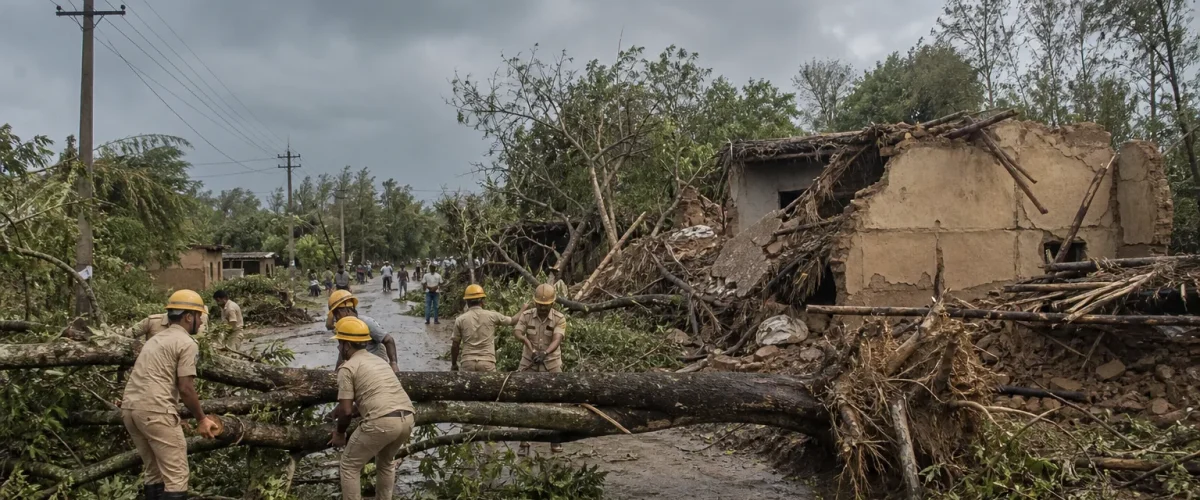
The death toll from the devastating storms that swept across Uttar Pradesh on Tuesday, 13 May 2026, has risen sharply to 111, with 72 people injured, 170 livestock lost and over 227 houses damaged across 26 districts, according to the state Relief Commissioner’s office. The updated figures, released on Friday, represent a significant increase from the initial reports that had put the toll at 56, as more districts reported casualties and rescue teams reached remote areas that had been cut off by the destruction.
Speaking to media, Revenue Secretary and Relief Commissioner Dr Hrishikesh Bhaskar Yashod confirmed that a comprehensive review meeting had been conducted with district authorities regarding storm and lightning-related incidents reported over the previous 36 hours. “So far, information regarding the deaths of 111 people has been received from 26 districts,” he said. “Of these, 107 people died after being trapped under debris and fallen trees, while four deaths were caused directly by lightning strikes.”
District-Wise Breakdown: Prayagraj and Mirzapur Worst Hit
The most deaths were reported in Prayagraj, where the toll has risen to 21 — up from the initial 16 reported on Wednesday. Mirzapur, which had not featured prominently in earlier reports, emerged as the second-worst affected district with 19 deaths, many caused by collapsing mud walls and uprooted trees in rural areas. Sant Ravidas Nagar (formerly Bhadohi), one of the first districts to report mass casualties, recorded 16 deaths, while Fatehpur’s toll stands at 11.
Pratapgarh reported five deaths, Badaun five — including two young girls who died when their home’s walls collapsed during the storm — and Sonbhadra three. The remaining casualties were spread across 19 other districts, including Unnao, Kanpur Dehat, Chandauli, Jaunpur, Varanasi, Sultanpur, Azamgarh, Gorakhpur and Lucknow. Officials acknowledged that the final toll could rise further as survey teams complete their assessments in the most remote areas.
Winds Exceeding 100 km/h and the Perfect Storm
Officials said the exceptionally high death toll resulted from a lethal combination of extremely high wind speeds, fragile rural infrastructure, widespread lightning exposure and the timing of the weather event. The Indian Meteorological Department (IMD) recorded wind speeds exceeding 100 kilometres per hour in several districts — far above the threshold that can uproot trees, tear tin roofs from buildings and topple poorly constructed walls.
The storm struck during the late afternoon and early evening hours, when many agricultural labourers and daily wage workers were still in open fields or returning home from work. The timing meant maximum exposure to lightning strikes and falling debris, particularly in districts like Prayagraj, Mirzapur and Fatehpur where seasonal agricultural activity was at its peak. The IMD had forecast unsettled pre-monsoon weather across the Indo-Gangetic plains, but the intensity and geographic spread of the storm exceeded most predictions.
Hailstorms accompanied the wind and rain in several districts, adding to the destruction of crops and property. Farmers in Fatehpur reported extensive damage to standing wheat harvests, while in Badaun, hailstones damaged vegetable fields and fruit orchards that had been approaching harvest. The agricultural losses are expected to compound the economic impact on rural communities that were already under pressure from rising fuel and input costs.
Chief Minister Yogi Orders Accelerated Relief
Chief Minister Yogi Adityanath has taken cognisance of the scale of devastation and directed officials to immediately intensify relief operations in all affected areas. The CM ordered that compensation to the families of those killed must be disbursed within 24 hours of verification, with each family entitled to an ex gratia payment of Rs 4 lakh under State Disaster Response Fund (SDRF) norms. He also directed district magistrates of all 26 affected districts to personally visit the worst-hit areas and ensure that no victim family is left without assistance.
The Chief Minister instructed officials from the disaster management authority, public works department, power distribution companies and health department to coordinate their response and restore essential services as quickly as possible. Revenue department teams were tasked with conducting rapid damage assessments to determine the extent of crop losses, property damage and infrastructure destruction.
“The state government is committed to standing with every affected family,” a statement from the CMO said. “All necessary resources are being mobilised to ensure that relief reaches every village and every household that has suffered loss.” The government has also announced that injured persons receiving treatment at government hospitals will have their medical expenses covered by the state.
Power Supply Disrupted in Over 2,000 Villages
The storm caused massive infrastructure damage across the affected belt. The Uttar Pradesh Power Corporation Limited (UPPCL) reported that power supply was disrupted in over 2,000 villages across 26 districts, with Prayagraj, Mirzapur, Bhadohi, Fatehpur and Unnao being the worst hit. Hundreds of electricity poles were snapped by the high-speed winds, and restoration work has been hampered by blocked roads and tangled debris.
Railway services in the region were also affected, with several trains on the Prayagraj-Varanasi and Lucknow-Prayagraj routes delayed by 30 minutes to over two hours due to fallen trees on the tracks. The Northern Railway division deployed emergency restoration teams, and services were gradually normalised, though some disruption continued into Thursday.
Road transport was disrupted across multiple highways and district roads, with the Prayagraj-Fatehpur state highway and several connecting roads blocked by uprooted trees, collapsed structures and tangled electricity wires. State highway authority teams and National Disaster Response Force (NDRF) personnel have been deployed to clear the debris and restore connectivity.
Climate Scientists Warn of Increasing Frequency
Climate scientists have pointed to the UP storm as further evidence of the increasing frequency and intensity of extreme weather events linked to climate change. “The pre-monsoon season has always brought storms to the Indo-Gangetic plains, but what we are seeing now — wind speeds exceeding 100 km/h over such a wide area, combined with hailstorms and intense lightning — represents an escalation that is consistent with climate change projections,” said Dr Roxy Mathew Koll, a climate scientist at the Indian Institute of Tropical Meteorology.
Earlier this month, unseasonal hailstorms disrupted operations at Delhi’s IGI Airport on 6 May, delaying over 500 flights. A severe heatwave had pushed temperatures past 47 degrees Celsius in several parts of the country just days before the storm struck, highlighting the whiplash pattern of extreme heat followed by violent storms that scientists say is becoming more common.
The IMD has forecast continued unsettled weather over parts of eastern Uttar Pradesh, Bihar and Jharkhand over the next 48 hours, with isolated thunderstorms, gusty winds and lightning expected. Authorities have issued advisories urging residents to stay indoors during storm warnings, avoid open fields, and keep away from trees, electricity poles and other tall structures during inclement weather.
For the families of the 111 victims, the focus now shifts to receiving the promised compensation and rebuilding their lives. Opposition parties, including the Samajwadi Party and Congress, have demanded that the state government declare the affected districts as disaster zones and provide enhanced relief packages. The SP’s state president criticised the government for what he called an “inadequate” early warning system that failed to alert rural communities to the severity of the incoming storm.

- Fentanyl Vaccine Breakthrough: Scripps Research Develops Shot That Blocks Deadly Overdoses Before They Reach the Brain - June 13, 2026
- Nipah Virus Returns to Kerala — First Case of 2026 Confirmed, State Declares High Alert - June 12, 2026
- Jill Biden Reveals She Wanted to Keep PM Modi’s 7.5-Carat Diamond Gift but Returned It After State Department Valued It at $20,000 - June 8, 2026