Maharashtra’s Alphonso Mango Trade Devastated by Heatwave, El Niño and Iran War — King of Mangoes Faces Worst Season in Decades

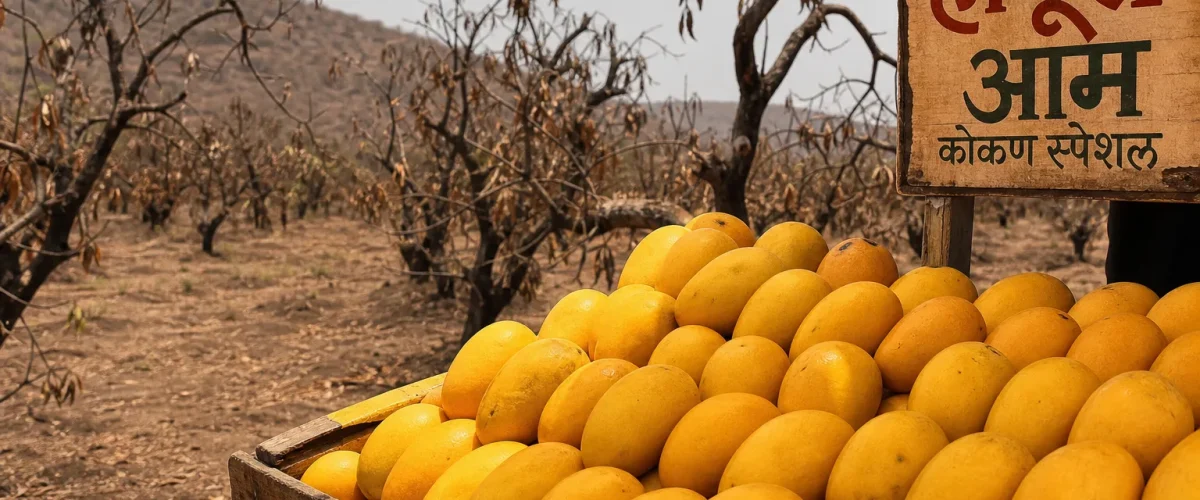
Maharashtra’s legendary Alphonso mango — revered as the “King of Mangoes” and prized by gourmets around the world for its rich, creamy flavour and intoxicating aroma — is facing what industry officials are calling the worst season in at least two decades. A devastating combination of extreme heat, El Niño-linked weather disruptions, and supply chain chaos triggered by the Iran war has battered the state’s mango trade from orchard to export dock, sending prices soaring while availability has plummeted across Mumbai’s markets and international destinations.
According to officials at the Konkan Horticulture Office, Alphonso production in Maharashtra’s Ratnagiri and Sindhudurg districts — the heartland of Alphonso cultivation — has declined by an estimated 40-50% compared to a normal season. What little fruit has made it to market is smaller, less uniform, and in many cases, prematurely ripened due to the extreme temperatures, reducing both quality and shelf life.
How the Heatwave Destroyed the Crop
The Alphonso mango tree is a temperamental crop that requires a precise sequence of weather conditions to produce a good harvest. The tree needs cool nights during the flowering period (December-January), moderate temperatures during fruit setting (February-March), and warm but not extreme conditions during the ripening phase (April-May). This year, the weather delivered none of that.
The heatwave that has been gripping India since early May has been particularly destructive during the critical ripening phase. Temperatures in the Konkan region — normally moderated by the proximity to the Arabian Sea — crossed 40°C on multiple days in May, causing fruit to ripen prematurely, develop internal browning, and in many cases, simply drop from trees before reaching marketable maturity.
“The mangoes are ripening three weeks ahead of schedule,” said Vijay Patil, a third-generation Alphonso grower in Devgad, Sindhudurg. “When they ripen too fast, the sugar content doesn’t develop properly, the colour is uneven, and the flesh can be fibrous instead of smooth. These mangoes can’t be sold as premium Alphonso — they go to the pulp factories at a fraction of the price.”
El Niño’s Long Shadow
While the immediate heat damage is the most visible impact, the roots of this season’s crisis stretch back several months. El Niño conditions that developed in 2025 disrupted the northeast monsoon that the Konkan region depends on for soil moisture during the critical October-December period. Below-normal rainfall left the soil dry and stressed the trees during the flowering phase, leading to poor fruit setting.
“The flowering this year was only about 60% of normal,” explained Dr. V.S. Sawant, Director of the Dr. Balasaheb Sawant Konkan Krishi Vidyapeeth. “When flowering is poor, no amount of good weather during ripening can compensate. The production loss was locked in months ago — the heatwave just made a bad situation catastrophic.”
Adding to the problem, unseasonal rain in early April damaged many of the fruits that had successfully set, causing fungal infections and fruit drop. Farmers report that the disease burden this season has been unusually high, requiring additional pesticide applications that further eat into already slim profit margins.
The Iran War’s Supply Chain Impact
Even for Alphonso mangoes that successfully make it through the growing and harvesting process, getting them to market has become more expensive and uncertain due to the supply chain disruptions caused by the Iran war. The closure of the Strait of Hormuz has rerouted international shipping, adding days to transit times and significantly increasing freight costs.
For Alphonso exports — which traditionally go to the Middle East, United Kingdom, United States, and Southeast Asia — the increased shipping costs and transit times are particularly problematic given the fruit’s limited shelf life of 7-10 days after ripening. Several exporters report that consignments to the UAE and Gulf states have been delayed or cancelled entirely due to route disruptions.
“Shipping a container of Alphonso to Dubai used to take 4-5 days and cost about Rs 1.5 lakh,” said Ramesh Kale, a Ratnagiri-based exporter. “Now it’s taking 10-12 days via alternative routes and costing Rs 3.5 lakh. By the time the mangoes reach, half the shelf life is gone. Many international orders have simply been cancelled.”
Prices Soar in Domestic Markets
The combination of reduced production and higher logistics costs has sent retail prices for Alphonso mangoes skyrocketing in domestic markets. In Mumbai’s Crawford Market and Vashi APMC — the two largest wholesale mango markets in the country — premium Ratnagiri Alphonso mangoes are selling at Rs 800-1,200 per dozen, compared to Rs 500-700 per dozen in a normal season.
At retail level, supermarkets and fruit shops across Mumbai are pricing Alphonso at Rs 500-800 per kilogram, making them unaffordable for many middle-class consumers who traditionally buy the fruit in bulk during the season.
“Alphonso was always expensive, but this year it’s become a luxury item,” said a fruit vendor at Dadar Market. “My regular customers who used to buy 2-3 dozen at a time are now buying half a dozen, just to taste. Some have switched to Kesar or Badami varieties, which are cheaper.”
Impact on Farmers and Rural Economy
For the thousands of farming families in Ratnagiri and Sindhudurg who depend on the annual Alphonso season for their primary income, this year’s crop failure is devastating. While higher prices partially offset lower volumes for some growers, many small farmers who sell at the farm gate to middlemen are receiving little benefit from the retail price surge.
“The growers are getting Rs 300-400 per dozen, while the consumer pays Rs 1,000,” said Swapnil Devlekar, a farmer activist in Ratnagiri. “The middlemen and urban retailers are making all the money. The farmer, who lost 40% of his crop to heat, is barely covering his costs.”
The broader rural economy of the Konkan region, which includes associated businesses like packaging, transportation, pulp processing, and tourism, is also feeling the impact. Mango tourism — a growing industry where urban visitors come to the Konkan during mango season to visit orchards and participate in harvesting — has seen significantly reduced footfall due to the extreme heat.
Climate Adaptation: The Long-Term Challenge
Agricultural scientists say the current crisis is a preview of what could become the new normal for Alphonso cultivation if climate change continues unchecked. Rising temperatures, increasingly erratic monsoons, and more frequent extreme weather events are all projected to become more common in the Konkan region over the coming decades.
“We need to develop heat-tolerant rootstocks, improve irrigation infrastructure, and explore protected cultivation techniques like shade nets,” said Dr. Sawant. “The traditional approach of rain-fed Alphonso cultivation is becoming increasingly risky. We need a fundamental rethinking of how this crop is grown.”
Some progressive farmers have already begun investing in drip irrigation, mulching, and tree-thinning techniques that reduce heat stress. However, the majority of small farmers in the region lack the capital and technical knowledge to adopt these practices. Government subsidies for climate adaptation in horticulture exist but are often slow to reach farmers and insufficient in scale.
As Mumbai’s mango lovers pay premium prices for a diminished crop, and as farmers in the Konkan worry about their livelihoods, the Alphonso mango crisis of 2026 serves as a vivid reminder that climate change is not a distant threat — it is here, now, and it is reshaping one of India’s most beloved cultural traditions.
Related Articles
- Sensex Drops Over 150 Points as US Renews Strikes on Iran — Brent Crude Rises and FIIs Pull Back
- Tamil Nadu CM Vijay Announces Farm Loan Waiver Worth Rs 2,044 Crore Benefiting 14.2 Lakh Farmers
- Supreme Court Raps NTA Over NEET-UG 2026 Cancellation — Says Agency Has Not Learnt Its Lesson from 2024 Paper Leak
Explore more: Food & Recipes