India and US Resume High-Level Trade Talks in New Delhi — Interim Bilateral Trade Deal Nearly Finalised Says Piyush Goyal

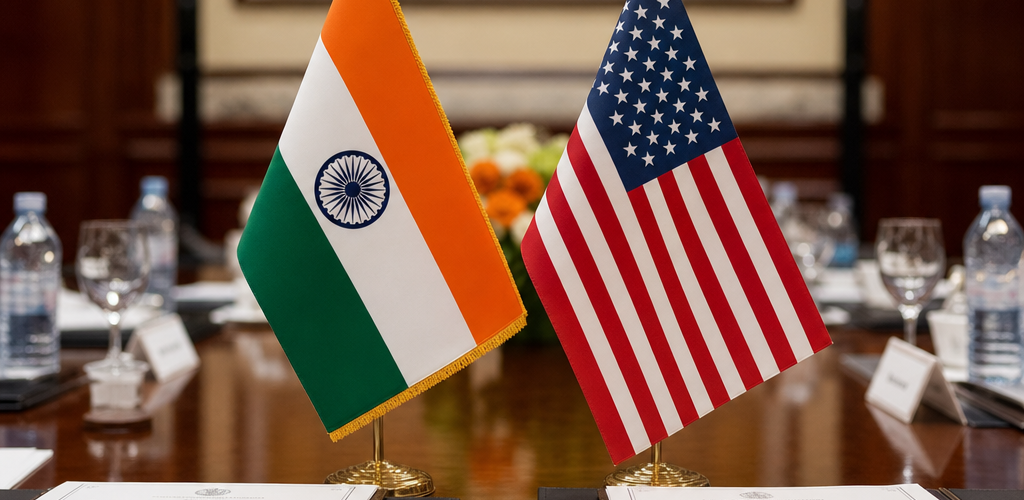
India and the United States have resumed high-level trade negotiations in New Delhi, with chief negotiators from both countries meeting from June 1 to 4 to finalise the details of an interim bilateral trade agreement that Commerce and Industry Minister Piyush Goyal said is now largely ready. The four-day talks represent a critical moment in the India-US economic relationship, as both nations race to convert the framework agreement signed in February 2026 into a binding legal text that would provide preferential market access for businesses on both sides.
What Has Been Agreed So Far
India and the United States issued a joint statement on February 7, 2026, finalising the framework of the first phase of the Bilateral Trade Agreement, also referred to as an interim trade agreement. Under this framework, President Trump agreed to reduce the reciprocal tariff on India from 25 percent to 18 percent, in recognition of India’s commitment to stop purchasing Russian Federation oil and to align with the US on addressing systemic trade imbalances.
The February framework included India’s commitment to eliminate or reduce tariffs on all US industrial goods and a wide range of agricultural products, including dried distillers’ grains, red sorghum, tree nuts, fresh and processed fruits, soybean oil, wine and spirits, and additional products. In return, the US agreed to work with India on resolving remaining tariff and non-tariff barriers through the broader BTA framework.
Commerce Minister Goyal stated on June 1 that “large parts” of the proposed trade agreement have been finalised, with both sides working through a few remaining details. He added that the deal would take into account the legal changes in the US tariff structure — a reference to the various tariff actions and modifications that the Trump administration has implemented since the February framework was agreed.
The Negotiating Teams
India’s delegation is being led by Darpan Jain, Additional Secretary in the Department of Commerce, who has served as New Delhi’s chief negotiator for the bilateral trade talks. The US team is led by Brendan Lynch, the designated chief negotiator for the India trade file. The four-day session is expected to cover the detailed legal text of the interim agreement, specific tariff reduction schedules, rules of origin provisions, and implementation timelines.
The two sides are also expected to advance discussions on the broader Bilateral Trade Agreement, which would go beyond the interim pact to cover areas including non-tariff measures, customs and trade facilitation, investment promotion, services, intellectual property, labour and environment standards, government procurement, and trade-distorting practices by state-owned enterprises.
Complications from New Tariff Proposals
The trade talks are taking place against the backdrop of a significant new development — the USTR’s proposal to impose additional 12.5 percent tariffs on India and 59 other countries over alleged failures to enforce forced labour import bans. This proposal, which emerged on June 3, could complicate the ongoing negotiations by introducing demands that go beyond the scope of the original trade framework.
Indian officials have privately expressed concern that the forced labour tariff proposal may be used as a negotiating tactic to extract additional concessions in the trade talks. The timing — announced just as negotiators from both sides are sitting across the table — has been seen by some trade analysts as a deliberate pressure tactic by the US side. However, it could also backfire by creating a hostile negotiating environment that makes it harder to close the remaining gaps in the interim agreement.
What the Deal Would Mean for Indian Businesses
If finalised, the interim trade agreement would be the first comprehensive trade pact between India and the United States, two economies whose bilateral trade exceeds $200 billion annually. For Indian businesses, the primary benefit would be more predictable and lower tariff rates for exports to the US, which is India’s largest export market. Key sectors that stand to gain include pharmaceuticals, information technology services, textiles, gems and jewellery, and chemicals.
For American companies, the deal would provide improved market access for agricultural products, manufactured goods, and potentially services in a market of 1.4 billion consumers. The agricultural provisions are particularly important for US farm interests, which have long sought greater access to the Indian market for products ranging from almonds and apples to dairy and poultry.
Industry bodies on both sides have urged their governments to move quickly toward finalisation. The Confederation of Indian Industry noted that “regulatory certainty and predictable trade rules are essential for businesses planning long-term investments” and that the interim agreement would provide a foundation for deeper economic integration. US business groups, including the US-India Business Council, have similarly advocated for a swift conclusion to the talks.
Timeline and Next Steps
If the current round of negotiations is successful in resolving the remaining details, the legal text of the interim agreement would need to undergo review by legal teams on both sides before it can be formally signed. On the Indian side, the agreement would require approval from the Union Cabinet. On the US side, the administration’s authority to implement tariff changes has been the subject of legal challenges, though the Supreme Court has largely upheld the executive branch’s trade authority.
Trade observers suggest that both sides have strong incentives to finalise the deal before the end of the current US political cycle, as bilateral trade agreements are often among the first casualties of changes in political leadership. The interim agreement would also serve as a confidence-building measure that could pave the way for the more ambitious comprehensive BTA, which is expected to take several years to negotiate fully.
The economic relationship between India and the US has deepened significantly in recent years, driven by growing technology partnerships, defence cooperation, and people-to-people ties. A successful trade agreement would add an economic foundation to this multidimensional relationship and potentially position India as a key partner in US efforts to diversify supply chains away from China.

- India and US Resume High-Level Trade Talks in New Delhi — Interim Bilateral Trade Deal Nearly Finalised Says Piyush Goyal - June 3, 2026
- India and US Resume High-Level Trade Talks in New Delhi — Interim Bilateral Trade Deal Nearly Finalised Says Piyush Goyal - June 3, 2026
- RBI MPC Meeting Begins on June 3 — Repo Rate Hold at 5.25 Percent Expected as Governor Malhotra to Announce Decision on June 5 - June 3, 2026