India Begins Receiving Fourth S-400 ‘Sudarshan’ Air Defence Squadron from Russia — Fifth Unit Expected by November

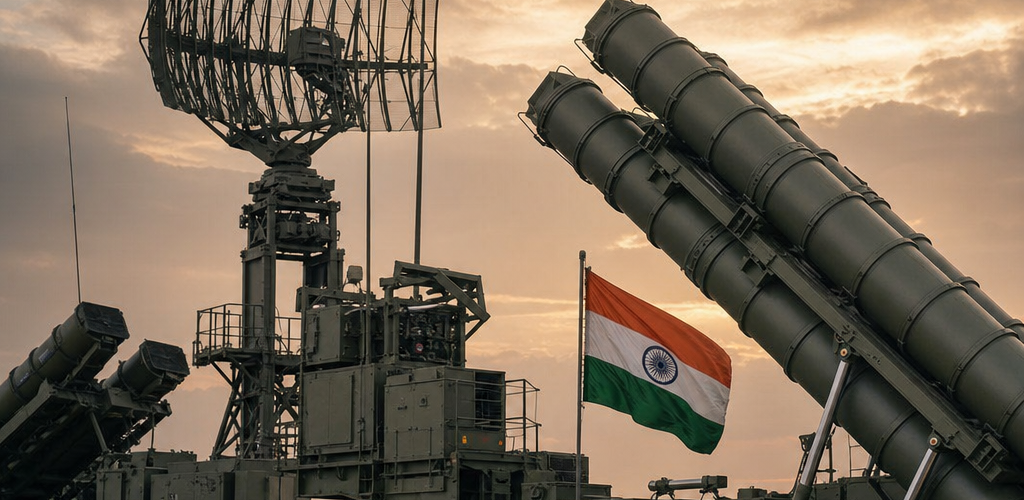
India has begun receiving the fourth squadron of the Russian-made S-400 Triumf air defence missile system, marking a significant milestone in one of the country’s largest defence procurement programmes. The system, now designated “Sudarshan” by the Indian Air Force (IAF), arrived via sea route with the first batch of components delivered in recent weeks.
What Has Been Delivered
Defence sources confirmed that the first consignment of the fourth S-400 squadron reached Indian shores in late May, with additional shipments expected through June and July. Full deployment will follow once all system components — including the 91N6E Big Bird acquisition radar, 92N6E Grave Stone engagement radar, and multiple launcher units — have been assembled and tested at the designated site.
The delivery is part of India’s $5.43 billion (approximately Rs 40,000 crore) contract with Russia’s Almaz-Antey, signed during the October 2018 bilateral summit between Prime Minister Narendra Modi and President Vladimir Putin. The deal covers five complete S-400 squadrons, each comprising a command post, radar systems, and multiple transporter erector launchers (TELs) carrying 48N6E3 and 40N6E long-range missiles.
India had already deployed three operational S-400 squadrons along its western and northern sectors. These units saw their first real-world operational test during the May 2025 India-Pakistan standoff following Operation Sindoor, where the system reportedly played a role in India’s air defence posture.
Why the Delays and How They Were Resolved
The original delivery timeline called for all five squadrons to be operational by 2024. The Russia-Ukraine war, which began in February 2022, disrupted production schedules at Almaz-Antey’s manufacturing facilities. International sanctions on Russian defence exports also complicated logistics, particularly regarding payment mechanisms and shipping insurance.
India and Russia worked around these constraints through rupee-ruble payment channels and alternative shipping routes. The fourth squadron’s arrival via sea — rather than the air freight used for some earlier deliveries — reflects both the normalization of the supply chain and the sheer volume of equipment involved. A single S-400 squadron includes dozens of heavy vehicles and hundreds of tonnes of specialized equipment.
The fifth and final squadron is expected to arrive by November 2026, completing the original contract. Sources in the defence establishment indicated that India is satisfied with the delivery pace, noting that both governments have treated the S-400 programme as a strategic priority insulated from broader geopolitical pressures.
India Wants Five More Squadrons
In a signal of confidence in the system’s capabilities, the Defence Acquisition Council (DAC) — chaired by Defence Minister Rajnath Singh — has approved the Acceptance of Necessity (AoN) for a comprehensive annual maintenance contract for the existing S-400 fleet. More significantly, the DAC has also given preliminary approval for the procurement of five additional S-400 squadrons.
If the follow-on order materialises, it would represent an investment of roughly $6 billion and extend India’s S-400 deployment to 10 squadrons — enough to create a continuous air defence umbrella across the country’s western front, northern borders with China, and key strategic installations in central India.
The decision to expand the S-400 fleet comes after the system’s operational performance during the 2025 tensions impressed military planners. While specific details remain classified, defence analysts note that the S-400’s ability to track and engage multiple targets simultaneously at ranges up to 400 kilometres gives India a layered defence capability that no other system in its inventory can match.
Strategic Implications for India’s Air Defence
The S-400 represents the backbone of India’s integrated air defence architecture. Each squadron can simultaneously track up to 300 targets and engage 36 of them, across an altitude range from just 10 metres above ground to 30 kilometres in the stratosphere. The system’s ability to detect and destroy aircraft, cruise missiles, and short-range ballistic missiles makes it a multi-threat solution.
Three squadrons are currently deployed to cover the Pakistan border (with one unit covering the critical Punjab-Rajasthan sector) and the northern border with China in Ladakh and the Northeast. The fourth squadron is expected to be deployed in a location that closes gaps in the existing coverage — likely either central India to protect strategic assets or the western seaboard for maritime air defence.
The 114 Rafale fighter jet deal with France, which India advanced with a Letter of Request in May, will complement the S-400 by providing offensive air superiority. Together, the two platforms create a defence-offence combination that significantly raises the cost of any air campaign against Indian territory.
The CAATSA Question
India’s S-400 purchase has been a source of friction with the United States, which threatened sanctions under the Countering America’s Adversaries Through Sanctions Act (CAATSA). Washington ultimately granted India an informal waiver, recognizing that the bilateral strategic partnership was more valuable than punishing a defence purchase from Russia.
The potential follow-on order for five more squadrons could reopen this diplomatic conversation. However, with the US currently focused on the Iran conflict and broader Middle Eastern priorities, and with India’s role as a strategic counterweight to China becoming more important to American planners, most analysts believe Washington will again look the other way.
For India, the calculus is straightforward. The S-400 works, it has been tested operationally, and no Western alternative offers equivalent capability at a comparable price point. The Sudarshan has earned its name — and India wants more of them.