Singapore Blocks 14 Anti-Indian Social Media Posts Likely Originating From China-Based Platform

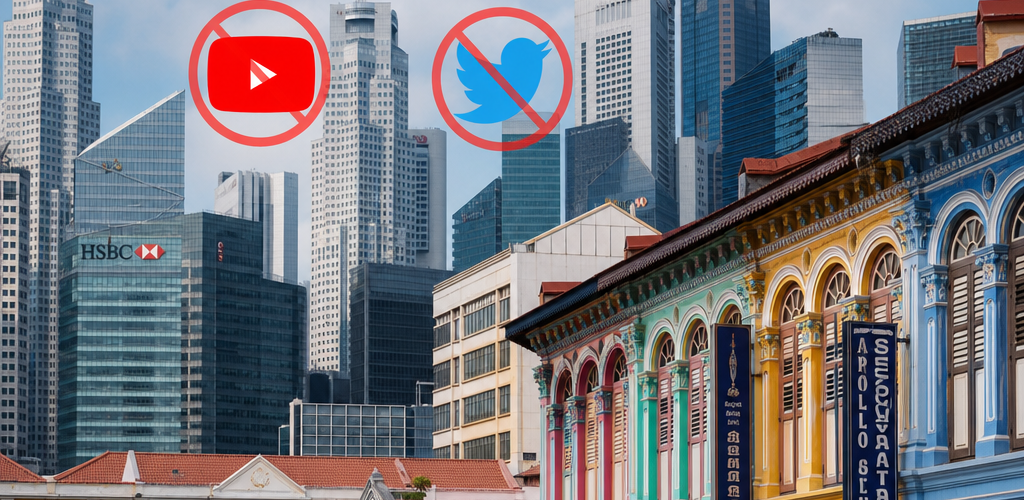
Singapore has ordered three major social media platforms — YouTube, Facebook, and X — to block access to 14 posts that targeted the Indian community and attempted to undermine the city-state’s carefully maintained model of multiculturalism. The Ministry of Home Affairs confirmed on June 6 that investigations traced the content to a platform based in China.
What the Posts Contained
The flagged posts used selectively edited images and footage from crowded streets in Little India and from Indian devotees at a religious festival on Pagoda Street to advance the claim that Singapore is being “overrun” by Indians. All 14 posts were primarily written in Chinese, suggesting they were designed for consumption within Chinese-speaking communities both in Singapore and abroad.
The content followed a familiar information manipulation playbook: take real footage out of context, attach an inflammatory narrative, and distribute it across multiple platforms to create the impression of a grassroots concern. In this case, the narrative exploited genuine demographic sensitivities in a country where ethnic balance is a foundational pillar of national policy. Singapore’s population comprises roughly 74 per cent Chinese, 13 per cent Malay, and 9 per cent Indian residents, with quotas governing ethnic composition in public housing blocks.
Legal Action Taken
The MHA assessed, together with the Singapore Police Force, that the posts are likely to constitute an offence under Section 298A of the Penal Code — specifically, knowingly promoting feelings of enmity, hatred, or ill-will between different groups on grounds of race, or committing an act prejudicial to the maintenance of harmony between racial groups.
Police issued disabling directions under the Online Criminal Harms Act (OCHA), which requires platforms to take all reasonable steps to disable access by Singapore users to the flagged content. The OCHA, enacted in 2023, gives Singapore authorities significant power to compel platforms to act against content deemed harmful to public order, even when it originates from overseas.
The China Connection
While the MHA stopped short of attributing the campaign directly to the Chinese government, the identification of a China-based platform as the likely origin point is significant. Singapore has been navigating an increasingly complex relationship with Beijing, balancing deep economic ties against concerns about information operations that could exploit ethnic fault lines.
This is not the first time Chinese-language content has targeted Indian communities in Southeast Asia. Similar campaigns have surfaced in Malaysia and Australia, often amplified by accounts that exhibit coordinated, inauthentic behaviour — a hallmark of state-sponsored or state-adjacent information operations.
What makes the Singapore case particularly notable is the speed and decisiveness of the government’s response. Within days of detection, authorities completed their assessment, identified the origin, and issued binding orders to three of the world’s largest platforms. This stands in contrast to the months-long deliberations that characterise content moderation disputes in larger democracies.
Implications for India
For India, the episode serves as both a validation and a warning. Singapore’s willingness to protect the Indian community from targeted disinformation is a positive signal for the large Indian diaspora in the city-state. However, the incident also highlights how India’s global image can be weaponised in information campaigns that exploit local ethnic tensions in third countries.
India’s Ministry of External Affairs has not yet issued an official response, but diplomatic sources indicated that the matter has been noted. India and Singapore upgraded their bilateral relationship to a Comprehensive Strategic Partnership in 2024, and issues affecting the Indian community in Singapore receive regular attention in diplomatic exchanges.
The broader lesson for governments globally is that anti-immigrant sentiment can be manufactured and amplified from abroad, particularly in diverse societies where ethnic balance is a sensitive topic. Singapore’s response — swift identification, legal action, and transparent public communication — offers a template that other countries may seek to adapt.
Pattern of Foreign Information Operations
The Singapore case fits into a broader pattern of foreign-origin information operations that exploit ethnic sensitivities in multicultural societies. Researchers at the Oxford Internet Institute and Stanford Internet Observatory have documented multiple instances of Chinese-language social media campaigns that target Indian communities across Southeast Asia, using similar techniques of selective imagery, inflammatory framing, and cross-platform amplification.
Also read: International Labour Day 2026: History, India’s Workers’ Rights Journey, and Why May 1 Still Matters
In Malaysia, where ethnic Indians comprise about 7 per cent of the population, similar content has circulated on Chinese-language platforms alleging Indian economic dominance and cultural encroachment. In Australia, anti-Indian content has appeared on forums and social media, often during periods of diplomatic tension. The common thread is that these campaigns emerge from platforms or accounts with characteristics consistent with coordinated, inauthentic behaviour — multiple accounts posting identical content within narrow time windows, artificial engagement patterns, and rapid cross-platform distribution.
Whether these operations are directly state-sponsored, conducted by state-adjacent entities, or represent commercially motivated clickbait operations that exploit ethnic tensions for engagement remains a matter of debate among researchers. Singapore’s assessment that the content “most likely originated from a platform based in China” carefully avoids attributing intent to the Chinese government while establishing the geographic origin.
Singapore’s Legal Framework
Singapore’s response was enabled by its Online Criminal Harms Act, enacted in 2023, which gives authorities the power to compel platforms to disable access to content that constitutes or facilitates criminal offences — including offences related to racial and religious harmony. The OCHA is one of the most powerful content moderation tools available to any democratic government, and its application in this case demonstrates the law’s intended scope.
Critics of the OCHA have argued that it gives the government excessive power to censor online speech, with insufficient judicial oversight. Supporters counter that in a small, multi-ethnic country where racial harmony is an existential concern, the speed of intervention is as important as the principle of free expression. The blocking of these 14 posts is unlikely to generate significant domestic opposition given that the content targeted a specific community and was traced to a foreign origin.