Massive Solar Storm Hits Earth — Northern Lights Expected Over Kashmir, Ladakh and Uttarakhand Tonight

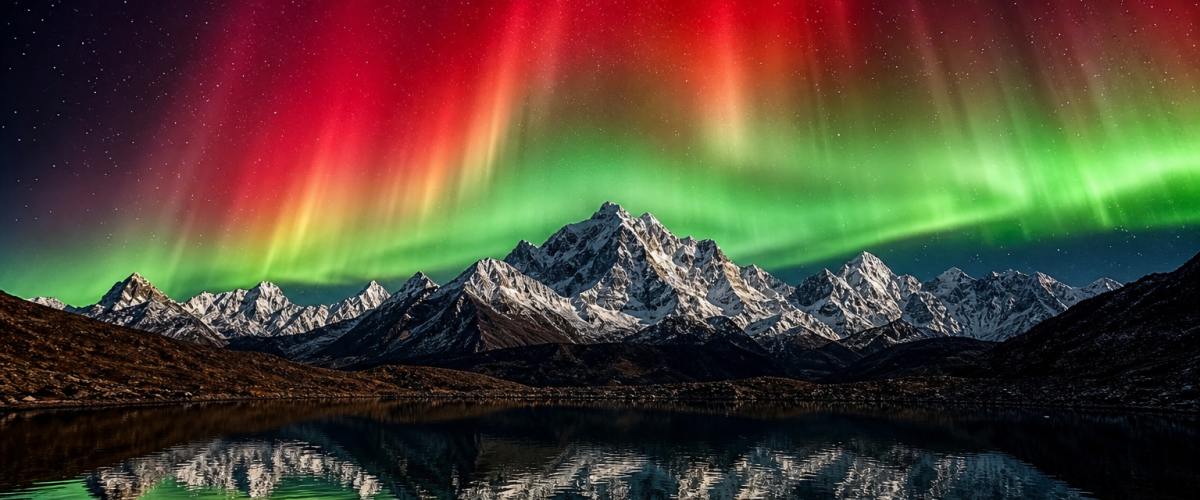
In a rare celestial spectacle, a massive solar storm is set to strike Earth on the night of June 8-9, 2026, bringing with it the possibility of aurora borealis — the famed Northern Lights — being visible from parts of northern India, including Kashmir, Ladakh, and the upper Himalayas of Uttarakhand. NASA and the India Meteorological Department’s Space Weather Centre have issued alerts as the storm, classified as a G3 (strong) geomagnetic event, is expected to peak between 11:30 PM IST on June 8 and 2:30 AM IST on June 9.
What Triggered the Solar Storm?
The solar storm was triggered by a massive coronal mass ejection (CME) from the Sun, which occurred on June 5-6. A CME is a significant release of plasma and accompanying magnetic field from the Sun’s corona, often associated with solar flares and filament eruptions. When directed toward Earth, the charged particles from a CME interact with Earth’s magnetic field, causing geomagnetic disturbances.
The current CME was classified as a full-halo event, meaning it was directed squarely at Earth. Solar astronomers tracked the ejected material as it traveled through interplanetary space at speeds exceeding 800 kilometres per second, covering the 150-million-kilometre distance between the Sun and Earth in approximately 48-52 hours.
“This is one of the most significant solar events we’ve observed in this solar cycle,” said Dr. Dibyendu Nandi, a solar physicist at the Indian Institute of Science Education and Research (IISER) Kolkata. “The CME’s Earth-directed trajectory and its speed make it likely to produce strong geomagnetic effects.”
Where in India Can You See Auroras?
Typically, auroras are visible only at high latitudes — in Nordic countries, northern Canada, and Antarctica. However, during strong geomagnetic storms, the auroral oval expands equatorward, making the phenomenon visible at unusually low latitudes.
For this event, scientists have identified several locations in India where aurora sightings are possible:
Ladakh: The Pangong Tso Lake region and the Hanle Dark Sky Reserve offer some of the best vantage points, combining high altitude (approximately 4,350 metres) with minimal light pollution. The Indian Astronomical Observatory at Hanle, one of the world’s highest optical telescope sites, is expected to provide ideal viewing conditions.
Kashmir: Higher elevation areas in the Kashmir Valley, particularly around Gulmarg (2,650 metres) and Sonamarg, could offer visible aurora displays, especially during the peak hours of the geomagnetic storm.
Uttarakhand: Parts of the upper Himalayas, including areas around Auli, Chopta, and the Nanda Devi National Park region, are potential viewing locations, though success will depend on local weather conditions and the storm’s intensity.
Why Will Indian Auroras Be Red?
An intriguing aspect of potential aurora sightings from India is that the lights are expected to appear crimson or deep red, rather than the green and blue hues typically associated with auroras in polar regions. This colour difference has a scientific explanation.
At high latitudes, where auroras are most common, the lights are produced at altitudes of 100-200 kilometres, where oxygen atoms emit green light when excited by solar particles. However, at lower latitudes like India, observers are looking at the aurora from a much greater distance, essentially viewing the upper edge of the auroral curtain. At these higher altitudes (300-400 kilometres), excited oxygen atoms emit red light, producing the distinctive crimson glow that has been documented in historical Indian aurora sightings.
“The red colour is actually a sign that you’re seeing auroral emissions from very high altitudes. It’s the same physical process that creates green auroras in Norway, but the geometry of observation from India means you’re seeing a different part of the emission spectrum,” explained Dr. Somak Raychaudhury, an astrophysicist and former director of the Inter-University Centre for Astronomy and Astrophysics (IUCAA).
Impact on Technology
While auroras are a visual spectacle, the underlying geomagnetic storm can have significant impacts on modern technology. NASA’s Space Weather Prediction Center has warned of potential disruptions to satellite communications, GPS navigation systems, and high-frequency radio communications during the peak of the storm.
Power grids at high latitudes are particularly vulnerable to geomagnetic disturbances, which can induce currents in long-distance transmission lines and potentially damage transformers. India’s power grid, while operating at lower latitudes, has been placed on alert as a precautionary measure.
Airlines operating polar routes — flights between Asia and North America that pass over the Arctic — have been advised to reroute to avoid increased radiation exposure at high altitudes during the storm. Several international carriers have confirmed adjustments to their flight paths.
ISRO (Indian Space Research Organisation) has reported that its satellite fleet is functioning normally but confirmed that it has activated enhanced monitoring protocols. Geomagnetic storms can cause orbital drag on low-Earth orbit satellites, slightly altering their trajectories and requiring correction manoeuvres.
How to Watch
For those fortunate enough to be in the potential viewing zones, experts recommend the following tips for the best aurora experience:
Find a location with minimal light pollution, ideally above 3,000 metres altitude. Look toward the northern horizon during the peak hours (11:30 PM to 2:30 AM IST). Allow your eyes at least 20-30 minutes to adapt to darkness. Use a camera with manual settings — long exposure photographs (15-30 seconds) can capture auroral activity that may not be clearly visible to the naked eye.
“Even if the aurora is faint to the naked eye, a smartphone camera set to night mode can sometimes pick up the red glow. I’d encourage everyone in the right locations to at least try,” said Dr. Nandi.
Historical Aurora Sightings in India
Aurora sightings from India, while rare, are not unprecedented. Historical records document aurora observations from Kashmir and other northern regions during periods of intense solar activity, including during the solar superstorm of 1859 (the Carrington Event) and during strong storms in the 20th century.
The current Solar Cycle 25, which began in December 2019, is approaching its maximum phase, expected to peak in 2025-2026. This means that the frequency and intensity of solar events — and consequently, the chances of aurora sightings from India — are at their highest in over a decade.
Also Read
- NASA-ISRO NISAR Satellite Reveals Mexico City Is Sinking at 14 Inches Per Year in Groundbreaking Radar Mapping
- NISAR Satellite Delivers Stunning Cloud-Piercing Radar Images as NASA-ISRO Earth Observation Mission Enters Science Phase
- ISRO-NASA NISAR Satellite: How the World’s Most Expensive Earth Observation Mission Will Transform India’s Disaster Response
- Southwest Monsoon 2026 Advances Into 12 States
As night falls over the Indian subcontinent, thousands of sky-watchers, amateur astronomers, and photography enthusiasts will be looking northward, hoping for a glimpse of one of nature’s most awe-inspiring light shows. Whether the auroras cooperate or not, the solar storm serves as a powerful reminder of our planet’s intimate connection to the star that sustains all life on Earth.