Real-Life Munnabhai: NEET Proxy Exam Racket Busted in Bihar, 24 Arrested at Lakhisarai Centre

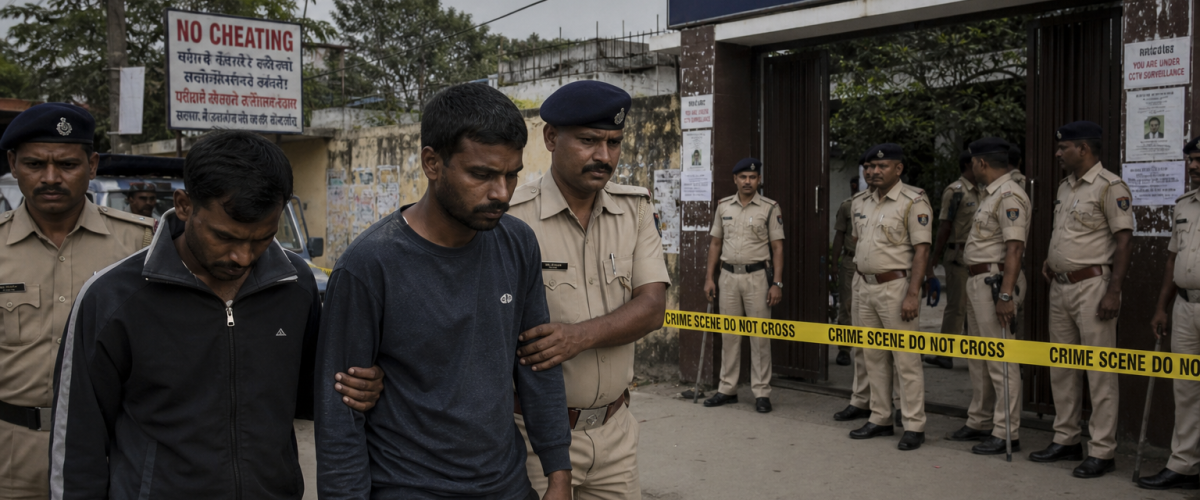
Bihar Police have busted a brazen “Munnabhai MBBS”-style proxy examination racket during the NEET-UG 2026 retest in Lakhisarai district, arresting 24 people including proxy candidates — known as “solvers” — who attempted to impersonate genuine aspirants at an examination centre. The arrests, which came during yesterday’s high-security retest, have raised fresh and deeply uncomfortable questions about insider access, systemic vulnerabilities, and the limits of even the most aggressive security measures.
The irony is devastating: the NEET-UG 2026 retest was conducted specifically because the original May 3 examination was compromised by question paper leaks. The retest deployed unprecedented security — Delhi Police, sniffer dogs, biometric verification, and a nationwide Telegram ban affecting 150 million users. Yet in Lakhisarai, a sophisticated cheating network managed to breach these defences, raising the question: if this happened at one centre, how many others escaped detection?
How the Racket Worked
The Lakhisarai operation was a classic proxy examination scam — a format that has plagued Indian competitive examinations for years but rarely on this scale during a retest designed to prevent exactly this kind of fraud:
The Solvers: The arrested group included professional exam “solvers” — individuals with medical knowledge who were hired to sit the exam in place of genuine candidates. These solvers were provided with fake identification documents, doctored admit cards with their photographs replacing the original candidates’ photos, and detailed instructions on how to behave at the centre to avoid detection.
Related: NEET-UG 2026 Retest Underway: 22 Lakh Students Appear Amid Unprecedented Security
The Insider Connection: For proxy candidates to enter an examination centre, some level of insider access is typically required. Bihar Police are investigating whether centre staff, invigilators, or administrative personnel facilitated the entry of proxy candidates — a line of inquiry that could expose a much larger network than the 24 individuals currently arrested.
The Scale: Twenty-four arrests at a single centre is an unusually large number, suggesting that this was not an isolated case of one or two individuals attempting to cheat but an organised operation involving recruiters, solvers, identity document forgers, and potentially corrupt officials.
The “Munnabhai” Comparison
Indian media have immediately drawn comparisons to the 2003 Bollywood film Munna Bhai M.B.B.S., in which the protagonist — a gangster with no medical qualifications — sends a proxy candidate to sit his medical entrance exam. The comparison, while entertaining, understates the seriousness of the situation:
Related: Telegram Ban Ends June 22: What Happens Next for India’s 150 Million Users After NEET Retest
In the film, the proxy scheme is played for comedy. In Lakhisarai, it represents a criminal conspiracy that potentially deprives genuine, hardworking NEET aspirants of medical college seats — seats that represent not just career opportunities but, for many families, generational economic mobility. The human cost of examination fraud in India is measured not in laughs but in destroyed dreams.
Security Gaps Exposed
The Lakhisarai bust exposes critical vulnerabilities in the NEET examination security framework:
Biometric Limitations: While several centres implemented biometric verification, the system is only effective if the biometric data in the database is accurate. If proxy candidates managed to register their own biometric data in advance — through insider access to the registration system — the technology becomes useless as a fraud prevention tool.
Human Element: No security system is stronger than its weakest human link. The Lakhisarai case suggests that some individuals within the examination infrastructure were willing to facilitate cheating — undermining the multi-crore security apparatus deployed for the retest.
Legal Consequences
The 24 arrested individuals face charges under multiple sections of the Indian Penal Code and potentially the Public Examinations (Prevention of Unfair Means) Act. If convicted, they could face significant prison time and fines. Bihar Police have indicated that the investigation is ongoing and further arrests are expected as the network’s full extent is mapped.
For the NTA and the government, the Lakhisarai bust is both a vindication — the security measures detected the fraud — and an embarrassment — the fraud was attempted despite those measures. The incident will intensify calls for fundamental reforms to India’s examination system, including the adoption of computer-based testing, randomised question papers, and AI-powered proctoring that could make proxy examination schemes significantly harder to execute.
Also Read
- NEET 2026: Lakhs of Students Set to Appear for Medical Entrance Exam on May 3 Under AI Surveillance and Zero Leak Policy as NTA Deploys Unprecedented Security
- NEET 2026 Paper Leak: Cockroach Janta Party Protests at Jantar Mantar Demanding Education Minister Dharmendra Pradhan Resignation
- NEET UG 2026 Paper Leak — Supreme Court Slams NTA, Says ‘Lessons Not Learnt’ as Re-Exam Set for June 21
- NTA Cancels NEET UG 2026 Examination After Paper Leak Allegations in Rajasthan as Centre Orders CBI Probe and Re-Exam
- NEET 2026 Admit Card Released by NTA on neet.nta.nic.in: Exam on May 3 With Download Steps and Key Instructions