AI-Powered Learning Platforms Are Reshaping India’s Education Landscape in 2026


Artificial Intelligence Enters India’s Classrooms and Coaching Centres
The intersection of artificial intelligence and education has moved from theoretical promise to practical reality in India in 2026. Across the country’s sprawling education ecosystem—from government schools in rural Madhya Pradesh to elite coaching centres in Kota, from corporate training programmes in Mumbai to university classrooms in Chennai—AI-powered tools are fundamentally changing how students learn, how teachers teach, and how educational outcomes are measured. The transformation is being driven by a convergence of factors: rapid advances in generative AI and natural language processing, India’s massive and digitally connected student population, and a policy environment that actively encourages technology adoption in education.
The scale of the opportunity is staggering. India has approximately 250 million students across K-12 and higher education, served by over 15 lakh schools, 50,000 colleges, and 1,000 universities. The quality of education varies enormously—from world-class IITs and IIMs to under-resourced rural schools where a single teacher handles multiple grades simultaneously. AI has the potential to democratise educational quality by providing every student, regardless of geography or socioeconomic background, with access to personalised, adaptive learning experiences that were previously available only to those who could afford elite private tutoring.
Adaptive Learning: The Core Technology Revolution
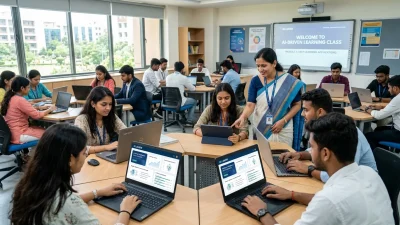
At the heart of AI’s impact on education is adaptive learning technology—systems that continuously assess a student’s knowledge state, identify gaps and misconceptions, and adjust the learning pathway in real-time. Unlike traditional classroom instruction, which delivers identical content to all students at the same pace, adaptive learning creates a personalised educational experience that responds to each student’s strengths, weaknesses, and learning speed.
Several Indian startups are at the forefront of this technology. Embibe, acquired by the Adani Group’s education vertical, uses AI to analyse student performance across millions of practice questions, identifying not just incorrect answers but the specific conceptual misunderstandings that lead to errors. The platform then prescribes targeted remediation content—videos, worked examples, and practice problems—designed to address each student’s unique knowledge gaps. Companies like Toppr (now integrated with BYJU’S infrastructure), Doubtnut, and Vedantu have also invested heavily in adaptive algorithms that personalise the learning experience.
The effectiveness of adaptive learning is supported by emerging evidence from Indian classrooms. A pilot programme conducted by the Central Board of Secondary Education (CBSE) in 500 schools across five states found that students using AI-adaptive tools showed 15-20 per cent improvement in learning outcomes compared to traditional instruction, with the most significant gains observed among students who were initially performing below grade level. These findings align with global evidence and have prompted the Ministry of Education to consider scaling AI-adaptive tools across government schools as part of the National Education Policy implementation. This educational technology revolution is deeply connected to India’s broader AI ambitions, as explored in our analysis of India’s AI Summit 2026 and its structural challenges.
Generative AI: The Teacher’s Assistant
Generative AI—the technology behind ChatGPT, Google Gemini, and their Indian counterparts—is emerging as a powerful tool for both students and educators. For students, AI chatbots serve as 24/7 doubt-resolution engines, capable of explaining complex concepts in multiple languages, generating practice problems tailored to the student’s level, and providing step-by-step solutions that illuminate the reasoning process rather than just the answer.
For teachers, generative AI is automating time-consuming tasks that have historically consumed a disproportionate share of instructional time. Lesson plan generation, assessment creation, answer evaluation, and progress report writing can now be accomplished in minutes rather than hours. A teacher in a government school in Bihar, who previously spent evenings creating question papers manually, can now use AI tools to generate differentiated assessments aligned with curriculum standards in under five minutes. This time savings allows teachers to redirect their energy toward the irreplaceable human aspects of education: motivation, mentorship, emotional support, and the cultivation of curiosity.
Indian language capabilities are critical for AI’s educational impact in a country where fewer than 15 per cent of the population is comfortable learning in English. Startups like Krutrim, Sarvam AI, and Bhashini (the government’s language translation initiative) are developing large language models that can operate fluently in Hindi, Tamil, Telugu, Bengali, Marathi, and other Indian languages. The ability to deliver AI-powered education in a student’s mother tongue dramatically expands access and effectiveness, particularly in rural and semi-urban areas where English-medium instruction has historically been a barrier to learning.
Voice AI and Conversational Learning
Among the most innovative applications of AI in Indian education is voice-based learning, which addresses the reality that many Indian students—particularly those from lower-income households—lack access to devices with large screens or reliable text-based internet. Stimuler, which raised $5.8 million in early 2026, uses voice AI to help non-native speakers achieve conversational fluency in English through guided spoken interactions with an AI partner. The platform simulates real-world conversational scenarios—job interviews, customer service interactions, casual social conversations—providing real-time feedback on pronunciation, grammar, and fluency.
Other voice AI applications are emerging for regional language learning, spoken English assessment, and oral examination preparation. For competitive exam preparation—where subjects like UPSC interviews and medical school practicals require oral communication skills—AI-powered practice tools offer a scalable and affordable alternative to human mock interview panels.
The Government’s AI Education Push
The Indian government’s commitment to AI in education, backed by ₹15,000 crore allocated to AI infrastructure in the Union Budget 2026-27, is creating a supportive ecosystem for edtech innovation. The establishment of three new AI centres of excellence in partnership with IITs will focus partially on educational applications, developing open-source AI tools that can be deployed at scale across India’s public education system.
The National AI Mission’s education vertical is developing a national repository of AI-generated educational content across all subjects and grade levels, available free of charge to students and educators. This initiative, modelled partly on initiatives in countries like Finland and Singapore, aims to ensure that the benefits of AI-powered education are not limited to those who can afford premium edtech subscriptions but are available as a public good to every student in the country.
Challenges: Infrastructure, Quality, and Equity
Despite the promise, significant challenges remain. Internet connectivity, while improving rapidly, is still inconsistent in rural India, where approximately 40 per cent of students lack reliable access to broadband. The quality of AI-generated educational content—particularly in regional languages and for specialised subjects—requires continuous improvement and human oversight. And the risk of excessive screen time and AI dependence among young learners demands thoughtful integration guidelines that balance technology’s benefits with the developmental needs of children.
The digital divide remains the most pressing equity concern. Students in well-resourced urban schools have access to AI tutors, adaptive platforms, and digital assessment tools, while their rural counterparts may lack basic internet connectivity and devices. Bridging this gap requires not just technology deployment but investment in physical infrastructure—internet connectivity, device distribution, and teacher training—that enables meaningful technology adoption in under-resourced settings.
As India’s edtech sector navigates consolidation and innovation simultaneously, the role of AI represents the most transformative force in the sector’s evolution. The Unacademy-upGrad merger and the rise of AI-native learning platforms signal a sector that is maturing rapidly, moving from the growth-at-all-costs phase to one focused on genuine educational impact. For India’s 250 million students, this technological transformation holds the promise of a more personalised, accessible, and effective educational experience—a promise that, if fulfilled, could accelerate the country’s human capital development and economic potential for generations to come.