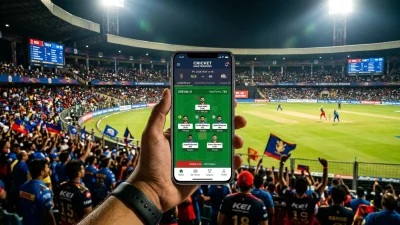
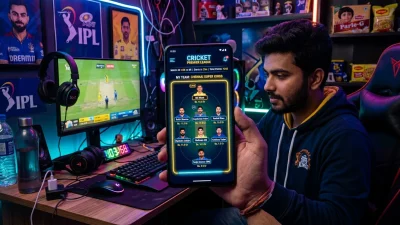
India’s Fantasy Sports Market Marches Toward ₹50,000 Crore Valuation as Regulation Brings Clarity

Important Update (3 April 2026): This article was published before the Indian Parliament passed the Promotion and Regulation of Online Gaming Bill, 2025, in August 2025, which effectively banned real-money fantasy sports platforms in India. The market projections and regulatory outlook described below reflect conditions prior to the ban. For current developments, see our coverage: India’s Fantasy Sports Ban: The August 2025 Decision.
India’s fantasy sports industry, once a regulatory grey area operating on the contested boundary between skill and gambling, is steadily marching toward a projected market valuation of ₹50,000 crore ($6 billion) by 2028, according to the latest estimates from the IMARC Group. The catalyst behind this bullish outlook is not just user growth or technology innovation—it is the increasingly clear regulatory framework that has begun to emerge at both the central and state levels in India. After years of legal uncertainty, the fantasy sports industry is entering a phase where regulatory clarity is unlocking institutional investment, corporate partnerships, and consumer confidence at an unprecedented scale.
The Regulatory Turning Point
The defining regulatory moment for India’s fantasy sports industry came in 2023, when the Ministry of Electronics and Information Technology (MeitY) notified the Online Gaming (Regulation) Rules under the Information Technology Act. These rules formally distinguished between “permissible online games” (games of skill that may involve real-money entry fees) and gambling, providing a legal foundation that fantasy sports platforms had long sought.
Under the framework, fantasy sports platforms must register with a Self-Regulatory Organisation (SRO) approved by MeitY, comply with Know Your Customer (KYC) norms, implement responsible gaming measures, and ensure that game outcomes are determined predominantly by skill rather than chance. Three SROs have been approved to date—the Federation of Indian Fantasy Sports (FIFS), the E-Gaming Federation (EGF), and the All India Gaming Federation (AIGF)—collectively covering over 95 per cent of the organised fantasy sports market.
Also read: IPL 2026 Season Preview: Key Transfers, Injuries, and Franchise Strategies
Also read: AI Summit 2026: India Showcases Ambitions but Structural Gaps Exposed
State-Level Progress
While the central framework has provided the legal scaffolding, state-level developments have been equally consequential. States like Rajasthan, Madhya Pradesh, and Chhattisgarh, which had previously banned or restricted online gaming including fantasy sports, have begun revising their stances following legal challenges and the central government’s lead. In January 2026, the Rajasthan High Court ruled that fantasy cricket is a game of skill and cannot be prohibited under the state’s gambling laws—a landmark judgment that effectively opened one of India’s largest markets for fantasy platforms.
Tamil Nadu, another key state that had attempted to ban online gaming in 2022, has also adopted a more nuanced approach. The state’s revised Gaming Act, passed in 2025, explicitly exempts skill-based online games registered with a recognised SRO from its prohibition, while maintaining strict controls on gambling and betting. This pragmatic approach has been cited as a model by industry bodies advocating for a uniform national framework.
The Numbers: Growth and Scale
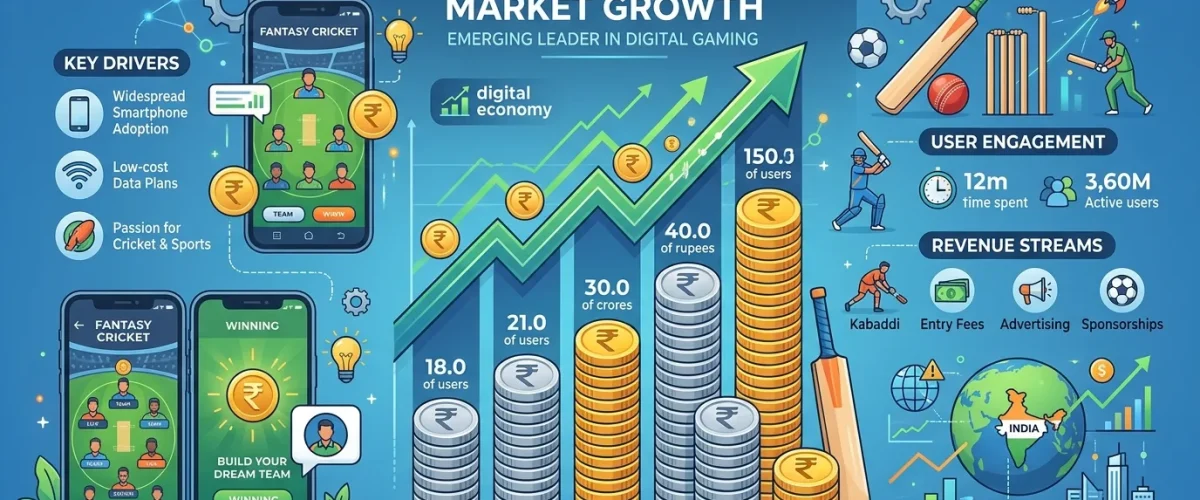
The impact of regulatory clarity on the fantasy sports market’s growth metrics has been dramatic. According to FIFS data, India’s fantasy sports user base grew from 180 million in 2024 to an estimated 250 million in 2026, driven by both new user acquisition and the re-entry of platforms into previously restricted states. The total gross gaming revenue (GGR) for the fantasy sports segment is estimated at ₹18,000 crore for FY2026, up from ₹12,500 crore in FY2024.
Dream11, the market leader, remains the industry bellwether. The company’s FY2025 revenue was ₹9,200 crore, with a net profit of ₹1,100 crore—making it one of the most profitable consumer internet companies in India. Its valuation, last pegged at $8 billion in a secondary market transaction, places it among India’s most valuable unlisted technology companies. My11Circle (Games24x7), MPL, and Paytm First Games collectively account for another ₹6,000 crore in annual GGR.
Institutional Investment Flows In
The regulatory clarity has also unlocked institutional investment that was previously held back by legal uncertainty. In Q1 2026 alone, Indian fantasy sports companies raised over $350 million in fresh funding. Dream11 completed a $200 million secondary sale at an $8 billion valuation, while Vision11 raised a $60 million Series B led by Tiger Global. Even smaller platforms like FanFight and Howzat have secured Series A rounds, indicating that investor confidence extends across the market, not just to the leader.
Beyond venture capital, the industry is attracting strategic corporate investment. Media companies like Disney Star and Viacom18 have taken equity stakes in fantasy platforms, recognising the synergies between live sports broadcasting and fantasy engagement. Telecom companies, particularly Jio, have integrated fantasy sports features into their entertainment super-apps, exposing the format to hundreds of millions of subscribers.
The GST Question
The one regulatory issue that continues to create friction is the Goods and Services Tax (GST) treatment of fantasy sports. In October 2023, the GST Council imposed a 28 per cent tax on the full face value of deposits into online gaming platforms, a move that the industry argued was economically irrational—since it effectively taxes the entry fee rather than the platform’s commission (margin), resulting in effective tax rates exceeding 100 per cent of the platform’s actual revenue.
Industry bodies have been lobbying aggressively for a revision, proposing that GST be levied on platform fees (gross gaming revenue) rather than total deposits. Several fantasy sports companies have challenged the GST provision in court, and a ruling from the Supreme Court is expected later in 2026. The outcome will have significant implications for the industry’s profitability and growth trajectory.
Toward ₹50,000 Crore
Despite the GST headwind, the trajectory is unmistakably upward. The convergence of regulatory clarity, technological innovation (AI-powered features, vernacular interfaces, real-time analytics), and India’s insatiable appetite for cricket creates a growth dynamic that few industries in the digital economy can match. If the GST issue is resolved favorably and the remaining state-level restrictions are lifted, the ₹50,000 crore valuation target by 2028 is not optimistic—it is conservative. India’s fantasy sports market is maturing into one of the country’s most significant digital economy success stories.

- India’s Startup Funding Crosses $7.2 Billion in H1 2026 - July 1, 2026
- After Ireland Shock, India’s T20I Side Faces Bigger Test - July 1, 2026
- Ireland Stun World Champions India 2-0 in Belfast, Sooryavanshi Debate Rages On - June 29, 2026