India’s Food Delivery Industry Crosses $10 Billion in 2026 as Cloud Kitchens and Quick Commerce Reshape Dining

India’s food delivery industry has reached a historic milestone in 2026, crossing the $10 billion mark in annual gross merchandise value (GMV) for the first time. The achievement, driven by the twin engines of traditional food delivery and the explosive growth of quick commerce food ordering, confirms India’s position as one of the world’s largest and fastest-growing food delivery markets. Behind the headline number lies a complex ecosystem of cloud kitchens, virtual brands, aggregator platforms, and quick commerce operators that is reshaping how 200 million urban Indians eat.
The Numbers: Scale and Growth
According to data from RedSeer Strategy Consultants and Inc42, India’s food delivery market generated approximately $10.2 billion in GMV in the fiscal year ending March 2026, representing a 22 per cent increase over the previous year. The market is dominated by two platforms—Zomato and Swiggy—which together account for approximately 93 per cent of the organised food delivery market. Zomato, which is publicly listed and reported revenues of ₹17,500 crore for FY2026, has been the market leader since overtaking Swiggy in 2024.
The growth has been driven by several factors: expanding geographic coverage (both platforms now serve over 1,000 cities), increasing order frequency among existing users, and the entry of new user segments including older adults and families in smaller towns. The average Indian food delivery user ordered 4.2 times per month in 2025, up from 3.1 times in 2023—a frequency increase driven largely by improvements in delivery speed and the expansion of affordable meal options.
Also read: IPL 2026 Season Preview: Key Transfers, Injuries, and Franchise Strategies
Also read: AI Summit 2026: India Showcases Ambitions but Structural Gaps Exposed
Cloud Kitchens: The Infrastructure Play
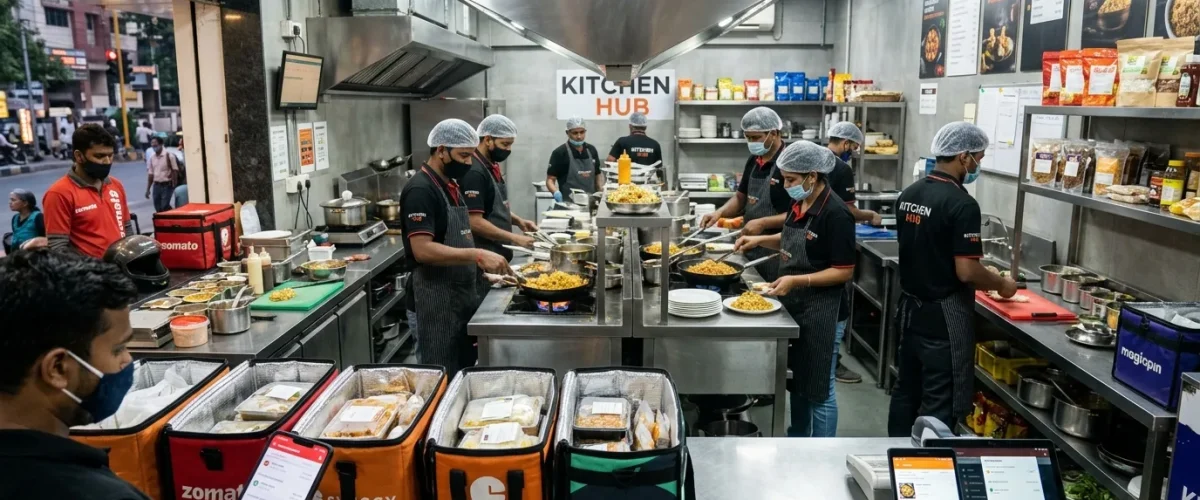
The cloud kitchen model—delivery-only food preparation facilities without dine-in space—has become a defining feature of India’s food delivery ecosystem. An estimated 75,000 cloud kitchens operate across India in 2026, up from 35,000 in 2022. These range from small, single-brand operations run by individual entrepreneurs to multi-brand facilities operated by companies like Rebel Foods (which runs brands including Faasos, Behrouz Biryani, and Oven Story Pizza), CloudKitchens (backed by Uber founder Travis Kalanick), and Swiggy’s own Swiggy Access programme.
Rebel Foods, India’s largest cloud kitchen company with over 450 kitchens across 70 cities, has been at the forefront of the virtual brand concept. A single Rebel Foods kitchen can operate six or more brands simultaneously, each targeting a different cuisine or price point, with shared infrastructure and centralised supply chains. The economics are compelling: a cloud kitchen can achieve break-even within 6-8 months, compared to 18-24 months for a traditional restaurant, because it eliminates rent, décor, and front-of-house staff costs.
Quick Commerce Meets Food Delivery
The most significant structural shift in India’s food landscape in 2026 is the convergence of food delivery and quick commerce. Platforms like Blinkit (owned by Zomato), Zepto, and Swiggy Instamart have expanded from grocery delivery into prepared food, offering ready-to-eat meals, fresh sandwiches, and snacks delivered in 10-15 minutes. This “instant food” category has grown from negligible volumes in 2024 to an estimated $800 million in 2026, cannibalising both traditional food delivery (which typically takes 30-45 minutes) and the QSR (Quick Service Restaurant) segment.
For consumers, the appeal is obvious: a freshly prepared meal delivered faster than it takes to cook one at home, at prices that are often competitive with homemade food costs when time value is considered. For the industry, the convergence creates new competitive dynamics. Traditional restaurants now compete not just with other restaurants on delivery platforms but with packaged food brands and cloud kitchens that optimise specifically for the quick commerce format.
Profitability: The Elusive Prize
Despite the impressive top-line growth, profitability remains a challenge for much of the food delivery ecosystem. Zomato achieved full-year profitability in FY2025 for the first time, reporting a net profit of ₹450 crore—but this was achieved partly through accounting gains from its Blinkit investment and aggressive cost management. Swiggy, which went public in late 2025, continues to report operating losses, though the losses are narrowing.
For cloud kitchens and virtual brands, the economics are more favourable at the individual unit level but challenged at the aggregate level. High competition, platform dependence (Zomato and Swiggy control customer access), and rising raw material costs have compressed margins. Industry analysts estimate that only 35-40 per cent of cloud kitchens in India are profitable at the EBITDA level.
The Employment Dimension
India’s food delivery industry is also one of the country’s largest gig economy employers. An estimated 2.5 million delivery partners work across food delivery and quick commerce platforms, making it the largest category of gig work in India. The conditions of this employment—low per-delivery earnings, lack of benefits, and physical demands—have become a subject of increasing public and regulatory scrutiny.
The Rajasthan Gig Workers Act, passed in 2025, was the first Indian legislation to mandate minimum earnings, insurance, and grievance redressal mechanisms for gig workers. Other states are considering similar legislation, and the central government’s Social Security Code includes provisions for platform workers, though implementation has been slow. For food delivery companies, regulatory compliance costs are likely to increase, adding another layer of complexity to the profitability equation.
What Comes Next
India’s food delivery industry at $10 billion is still in its growth phase—penetration remains low compared to China ($150 billion) and the United States ($70 billion), and the addressable market is enormous. The next phase of growth will likely be driven by three factors: expansion into smaller cities and towns, the development of healthier and more diverse food options, and the integration of AI for personalised menu recommendations and demand prediction. The industry’s trajectory suggests that $20 billion in annual GMV is achievable by 2030—but getting there profitably will require operational discipline and regulatory adaptability that the industry is still developing.

- Fentanyl Vaccine Breakthrough: Scripps Research Develops Shot That Blocks Deadly Overdoses Before They Reach the Brain - June 13, 2026
- Nipah Virus Returns to Kerala — First Case of 2026 Confirmed, State Declares High Alert - June 12, 2026
- Jill Biden Reveals She Wanted to Keep PM Modi’s 7.5-Carat Diamond Gift but Returned It After State Department Valued It at $20,000 - June 8, 2026