India Unemployment Rate Hits Six-Month High of 5.2 Percent in April 2026 as Rural Joblessness Rises While Urban Employment Shows Marginal Improvement

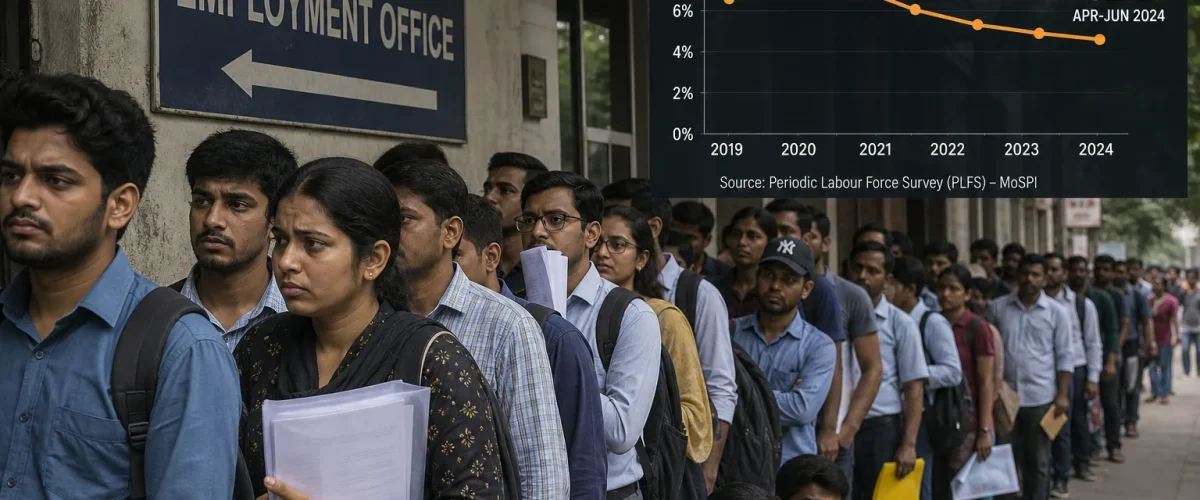
India’s unemployment rate among persons aged 15 years and above climbed to a six-month high of 5.2 per cent in April 2026, according to the latest data from the Periodic Labour Force Survey released by the Ministry of Statistics and Programme Implementation. The figure, which matches the previous high of 5.2 per cent recorded in October 2025, represents a marginal deterioration from the 5.1 per cent rate seen in both March 2026 and April 2025, and signals that the labour market recovery is losing momentum amid global economic headwinds.
Rural-Urban Divergence in Employment Trends
The April PLFS data reveals a notable divergence between rural and urban labour markets. Rural unemployment increased to 4.6 per cent from 4.4 per cent in March 2026, while urban unemployment eased marginally to 6.6 per cent from 6.8 per cent in the previous month.
The rise in rural unemployment is particularly concerning as it coincides with a period when agricultural activity should normally be picking up ahead of the kharif sowing season. Labour economists attribute the rural deterioration to a combination of factors: the delayed onset of pre-monsoon showers in many agricultural states, reduced demand for non-farm rural labour due to a slowdown in construction activity, and the lingering effects of the energy crisis on rural enterprises.
“The rural labour market is a bellwether for the broader Indian economy. When rural unemployment rises at a time when it should seasonally be falling, it suggests structural problems that go beyond cyclical fluctuations,” said Professor Santosh Mehrotra, a labour economist at the Centre for Labour Studies, Jawaharlal Nehru University.
Youth Unemployment Remains Elevated
While the headline unemployment rate of 5.2 per cent appears modest by international standards, the picture is significantly worse for young workers. India’s youth unemployment rate, measured for persons aged 15 to 29 years, has remained in the range of 12 to 15 per cent through most of 2025-26, according to quarterly PLFS estimates. For graduates, the rate is even higher, with over 20 per cent of degree holders in the 20 to 29 age group reporting themselves as unemployed or underemployed.
The youth employment challenge has become a central political issue, with opposition parties citing the PLFS data to attack the government’s job creation record. The government has pointed to schemes like the Pradhan Mantri Mudra Yojana and the recently launched National Apprenticeship Promotion Scheme to argue that formal employment opportunities are expanding, but critics note that many of these involve self-employment or informal work that may not provide stable incomes.
Sectoral Analysis: Where Are the Jobs?
The PLFS data for the January-March 2026 quarter, the most recent period for which sectoral breakdowns are available, shows that employment growth has been concentrated in a few sectors while others have stagnated or contracted.
The construction sector, which is one of the largest employers of semi-skilled and unskilled workers, saw a decline in employment share from 13.2 per cent to 12.6 per cent, reflecting the impact of higher input costs driven by the energy crisis on new project launches. The information technology sector, another major employer of educated youth, has been undergoing a hiring slowdown as global clients cut discretionary spending amid economic uncertainty.
In contrast, the healthcare and education sectors showed modest employment growth, driven by government spending on public health infrastructure and the expansion of private educational institutions. The gig economy also continued to absorb workers, though labour rights advocates point out that gig work often lacks the social security protections and income stability of formal employment.
Labour Force Participation Rate Holds Steady
One positive indicator in the April data is the stability of the labour force participation rate (LFPR), which measures the proportion of the working-age population that is either employed or actively seeking work. The LFPR for persons aged 15 and above stood at 60.1 per cent in April 2026, broadly stable compared to 60.0 per cent in March and 59.8 per cent in April 2025.
A stable or rising LFPR alongside a rising unemployment rate suggests that more people are entering the labour market and looking for work but are unable to find suitable employment. This is a positive development in the sense that it indicates confidence in the possibility of finding work, but it also means that the absolute number of unemployed persons is growing.
Government Response and Policy Measures
The Union Labour Ministry has said it is monitoring the employment situation closely and implementing measures to boost job creation. These include an expansion of the Production-Linked Incentive scheme to additional manufacturing sectors, the launch of new skill development programmes under the National Education Policy, and incentives for companies that formalise their workforce through contributions to the Employees’ Provident Fund Organisation.
Finance Ministry officials have pointed to the strong Services PMI reading of 58.8 in April as evidence that economic activity remains robust and that the employment situation should improve as the effects of the global energy crisis moderate. However, independent economists caution that PMI data reflects business sentiment among a relatively small sample of firms and may not capture the employment challenges faced by the informal sector, which accounts for over 80 per cent of India’s workforce.
Comparison With Global Trends
India’s unemployment rate of 5.2 per cent compares favourably with many peer economies. Brazil’s unemployment rate stands at 7.5 per cent, South Africa’s at 31 per cent, and Turkey’s at 9.2 per cent. However, direct comparisons are complicated by differences in measurement methodology and the much larger share of informal and self-employment in India’s labour market, which can mask underemployment and disguised unemployment.
The International Labour Organisation’s latest World Employment and Social Outlook report, released in April, projected that India’s employment growth would slow to 1.2 per cent in 2026-27 from 2.1 per cent in 2025-26, citing the impact of the global energy crisis and the El Niño-driven agricultural slowdown as key risks.
What the Data Means for Households
For millions of Indian households, the unemployment data translates into real-world stress. The PLFS monthly bulletins track not just unemployment but also earnings and working conditions. Recent data shows that average daily wages for casual workers have grown at just 3 per cent year-on-year, well below the consumer price inflation rate of 3.8 per cent, meaning that real wages have effectively declined for the most vulnerable segments of the workforce.
The combination of rising fuel prices, higher food costs, and stagnant wages creates a challenging environment for consumption-driven economic growth, which remains the primary engine of India’s GDP expansion. Economists will be watching the May PLFS data closely to see whether the April uptick in unemployment is a temporary blip or the beginning of a more sustained deterioration in labour market conditions.