RBI Holds Repo Rate at 5.25% in February 2026: What It Means for India’s Economy

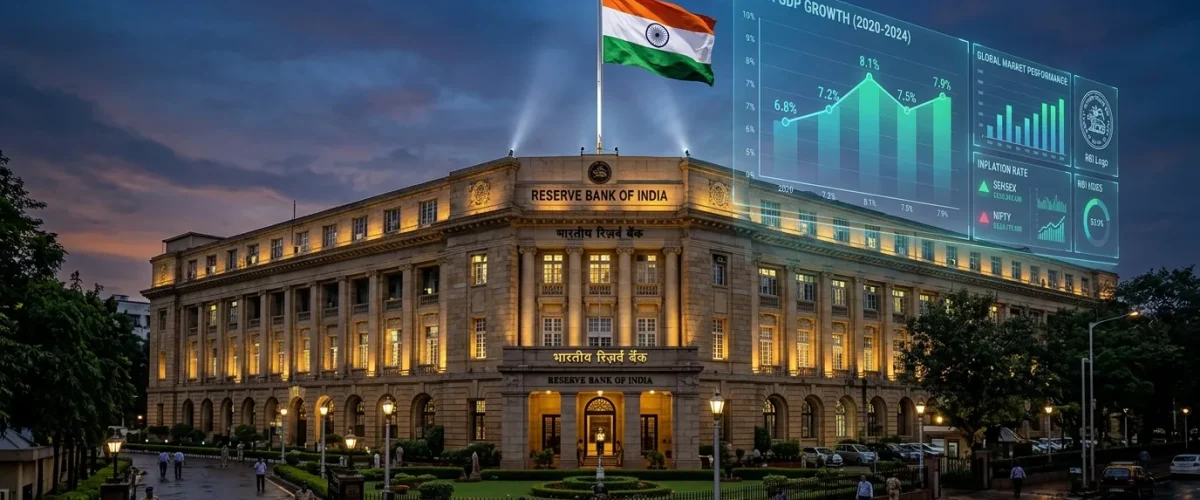
Monetary Policy Committee Holds Repo Rate at 5.25% in February 2026
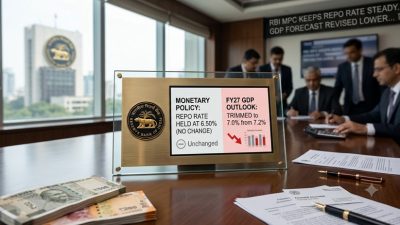
The Reserve Bank of India’s Monetary Policy Committee (MPC), in its February 2026 policy review, voted to hold the benchmark repo rate steady at 5.25 per cent. The decision, announced by RBI Governor Sanjay Malhotra on February 6, 2026, reflects a carefully calibrated approach that balances growth support with inflation vigilance in an increasingly complex global environment.
This follows the cumulative 50 basis point reduction between August and December 2025 that brought the repo rate down from 5.75 per cent. The pause signals that the committee believes the current rate level is appropriate for sustaining growth momentum while keeping inflation within its target corridor. The next MPC meeting is scheduled for April 6–8, 2026, with the policy decision expected on April 8.
GDP Growth Outlook: Projections Under Review
India’s GDP growth trajectory remains a subject of active debate among economists. While the RBI has maintained an optimistic outlook on growth, external forecasters have offered more tempered assessments for the period ahead. Goldman Sachs Research, in a February 2026 report, projected India’s real GDP growth at 6.9 per cent for calendar year 2026, citing domestic consumption, infrastructure investment, and India’s improving position in global supply chains as key drivers.
However, the firm also flagged several headwinds: uncertainty around US trade policy and tariffs, elevated crude oil prices, and the potential impact of a global slowdown on India’s export-oriented sectors. The Indian economy’s resilience will depend on the government’s ability to sustain capital expenditure momentum—with a budget outlay exceeding ₹11 lakh crore for FY27—and on private investment picking up to complement public spending.
High-frequency indicators present a mixed picture. The Purchasing Managers’ Index (PMI) for manufacturing has remained above the expansionary threshold of 50 for consecutive months, while the services PMI has registered robust readings. GST collections have reflected strong consumption and business activity. However, the sustainability of these trends amid global uncertainties remains a key question for policymakers.
Inflation: Significantly Below Target
One notable development in the February 2026 policy review was the RBI’s lowered inflation projection for FY26, brought down to approximately 2 per cent—well below the 4 per cent medium-term target and comfortably within the 2–6 per cent target band. This decline reflects a combination of easing food prices, as rabi crop arrivals improved and vegetable prices normalised, and benign core inflation.
The sharp drop in inflation has fuelled expectations of further rate cuts in 2026. With inflation running significantly below target, the MPC has room to prioritise growth support—though the committee has been cautious about acting too aggressively given external risks.
Key risks to the inflation outlook include global crude oil prices, which have been elevated due to geopolitical tensions in the Middle East, and potential upward pressure from the government’s minimum support price (MSP) revisions for the kharif season.
Implications for the Financial Sector
The rate pause, combined with the low-inflation environment, has significant implications for India’s banking sector. Credit growth, which moderated from 16 per cent in FY24 to approximately 12 per cent in FY25 following the RBI’s targeted macroprudential measures, may see a pickup if rate cuts resume later in 2026.
For borrowers, the current interest rate environment—with lending rates ranging from 8.5 to 9.5 per cent for home loans—represents a relatively favourable window. However, the RBI has indicated that future rate actions will be “data dependent,” leaving open the possibility of further cuts if inflation remains benign, or a pause extension if commodity prices spike. This monetary policy environment is also relevant for understanding how technology investments are shaping India’s financial infrastructure, as discussed in our analysis of India’s AI Summit 2026 and its structural challenges.
Global Context: How India Compares
India’s monetary policy stance contrasts with several major economies. The US Federal Reserve has kept rates elevated amid persistent inflation concerns. The European Central Bank has been easing, while the Bank of Japan continues its cautious normalisation from decades of ultra-loose policy.
Among emerging markets, India’s position is relatively strong. Brazil has been forced to hike rates to combat inflation, while Turkey and Argentina continue to deal with macroeconomic instability. China, facing deflationary pressures and a prolonged property downturn, has cut rates to historic lows but struggles to stimulate demand. India’s combination of moderate inflation, a stable policy framework, and a large domestic market makes it an attractive destination for global capital—though recent FII outflows suggest that global risk appetite remains fragile.
The Road Ahead: Will Rate Cuts Resume?
The consensus among economists is that the RBI is likely to consider one or two more rate cuts of 25 basis points each in the coming quarters, potentially bringing the repo rate to 4.75–5.00 per cent by end of FY27. This view is predicated on inflation remaining well below target, the monsoon delivering normal rainfall, and global commodity prices not experiencing a sustained spike.
The April 6–8 MPC meeting will be closely watched for signals on whether the committee is ready to resume easing or prefers to extend the pause given heightened global uncertainty. Markets will also be parsing any revisions to the RBI’s growth and inflation projections for clues about the policy path ahead.
As India navigates the opening months of FY27, the RBI’s cautious approach reflects the complexity of the current environment: inflation running well below target argues for easing, while external headwinds counsel patience. The central bank’s credibility—built through careful communication and predictable policy actions—will be its most important asset in the quarters ahead.
Correction (3 April 2026): An earlier version of this article stated that the RBI raised the FY26 GDP growth forecast to 7.4 per cent. External forecasters, including Goldman Sachs, project India’s GDP growth at approximately 6.9 per cent for calendar year 2026. The article has also been updated to reflect the RBI’s significantly lowered inflation projection of approximately 2 per cent for FY26 and to include the upcoming MPC meeting schedule (April 6–8, 2026).