Berkshire Hathaway Takes 2.6 Billion Dollar Stake in Delta Air Lines and Triples Alphabet Investment in First Major Moves Under Greg Abel Leadership

Berkshire Hathaway Inc., the investment conglomerate built by Warren Buffett, disclosed on Thursday, 15 May 2026, a series of dramatic portfolio moves in its quarterly 13F filing with the US Securities and Exchange Commission (SEC). The most significant revelations were a new USD 2.6 billion stake in Delta Air Lines, a tripling of its position in Alphabet Inc. (Google’s parent company), and a complete exit from its Amazon.com investment — moves that signal a meaningful shift in investment strategy as incoming CEO Greg Abel prepares to take the reins.
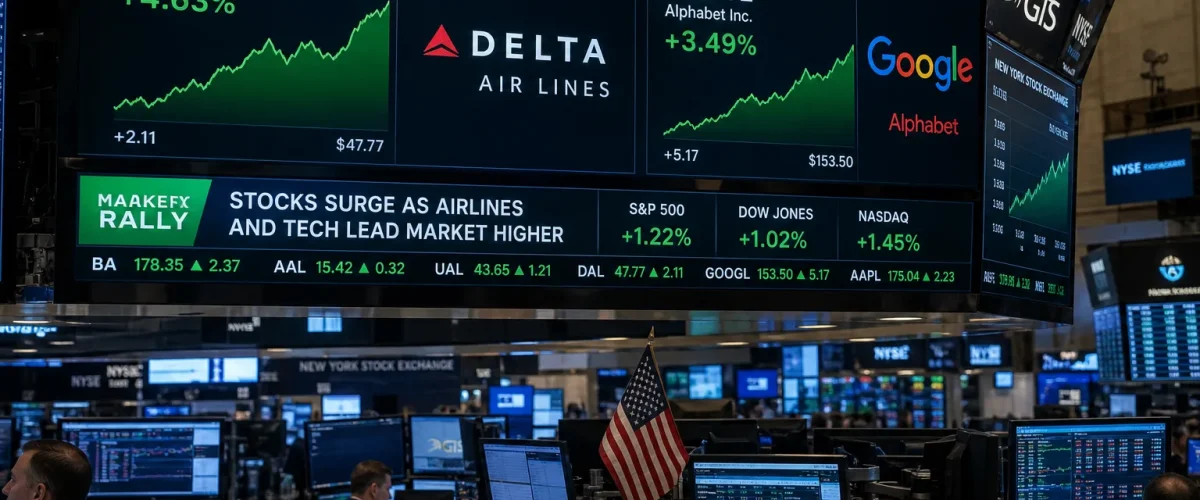
Delta Air Lines shares surged 3.2 per cent in after-hours trading to $72.45 on the news, while Alphabet rose 1.8 per cent. The filings revealed that Berkshire purchased approximately 36 million shares of Delta during the first quarter of 2026, valued at approximately $2.6 billion at quarter-end prices. Simultaneously, the company added 36.4 million shares of Alphabet to its existing position, roughly tripling its stake in the search and AI giant to a total value exceeding $8 billion.
Return to Airlines: A Reversal of Buffett’s Pandemic Decision
The Delta investment is particularly noteworthy because it represents a dramatic reversal of Buffett’s 2020 pandemic-era decision to dump Berkshire’s entire airline portfolio — which included stakes in Delta, American Airlines, United Airlines and Southwest Airlines — at significant losses. At the time, Buffett told shareholders: “The world has changed for the airlines, and I don’t know how it’s changed.”
Six years later, Berkshire’s bet on Delta suggests that the investment thesis on airlines has fundamentally shifted. Delta has emerged as the most profitable and operationally disciplined of the major US carriers, reporting record revenue of $63 billion in 2025 and an operating margin of 14 per cent — among the highest in the industry’s history. The airline’s premium strategy, focused on higher-fare business travellers and loyalty programme monetisation, has insulated it from the fare wars that plague low-cost competitors.
Market analysts noted that the timing of the Delta investment is also interesting given the current global energy crisis. While higher fuel costs are generally negative for airlines, Delta’s aggressive fuel hedging programme has protected it from the worst of the crude oil price surge, giving it a cost advantage over competitors who did not hedge as effectively. “Delta is essentially a hedge fund that happens to fly planes,” joked Ed Bastian, the airline’s CEO, in a recent earnings call — a quip that appears to have resonated with Berkshire’s investment team.
Tripling Down on Alphabet and AI
The Alphabet position increase is equally significant. Berkshire first took a position in Alphabet in 2022 under the direction of Buffett’s investment lieutenants Todd Combs and Ted Weschler. The tripling of that position suggests that Berkshire — or more likely Abel, who has been increasingly involved in investment decisions — sees substantial upside in Alphabet’s AI-driven business transformation.
Alphabet has invested over $50 billion in AI infrastructure over the past two years, and its Gemini AI models are now integrated across Search, YouTube, Google Cloud and the company’s advertising platform. Revenue growth has accelerated to 18 per cent year-over-year in the most recent quarter, driven primarily by AI-enhanced advertising targeting and the rapid growth of Google Cloud’s enterprise AI services. The clearing of Nvidia chip sales to China at the Trump-Xi summit has also boosted sentiment across the tech sector, as it signals continued growth in AI infrastructure demand.
Exiting Amazon: End of a Cautious Bet
Berkshire’s complete exit from Amazon was less surprising. The position, initiated by Combs in 2019, was always relatively small by Berkshire’s standards and represented more of a personal conviction bet than a core holding. With Amazon’s stock price having underperformed the broader market over the past year amid slowing e-commerce growth and regulatory headwinds, the decision to sell appears driven by a reallocation of capital toward higher-conviction positions like Delta and Alphabet.
Buffett himself had repeatedly expressed regret at not investing in Amazon earlier, calling it “a huge mistake” to have underestimated Jeff Bezos. The exit under Abel’s watch suggests a willingness to move on from positions that no longer fit the evolving investment thesis — a characteristic that may define the Abel era at Berkshire.
The Greg Abel Era Takes Shape
The portfolio moves are widely interpreted as the first significant expression of Greg Abel’s investment philosophy. While Buffett, now 95, remains Berkshire’s chairman and a towering presence, Abel — who was designated as Buffett’s successor as CEO in 2021 — has been taking on increasing responsibility for capital allocation decisions.
Abel’s background as an operations-focused executive (he built Berkshire Hathaway Energy into one of the largest US utility companies) suggests a preference for companies with strong operational moats, pricing power and infrastructure-heavy business models. Both Delta (with its dominant route network and loyalty programme) and Alphabet (with its AI infrastructure and advertising monopoly) fit this profile. Global markets have been volatile amid the energy crisis, and Berkshire’s massive $170 billion cash pile gives it the firepower to make opportunistic bets during periods of dislocation.
Implications for Indian Markets
While Berkshire Hathaway does not have direct investments in Indian equities, the company’s portfolio moves are closely watched by Indian institutional and retail investors as a barometer of global investment sentiment. The airline bet, in particular, could have implications for Indian aviation stocks, as it validates the thesis that well-managed carriers can deliver strong returns even in a high-fuel-cost environment.
Indian airline companies such as InterGlobe Aviation (IndiGo), Air India (under Tata ownership) and Akasa Air have been navigating similar fuel cost pressures, though none has Delta’s level of premium positioning or fuel hedging sophistication. Analysts at CLSA and Morgan Stanley noted that the Berkshire-Delta development could draw increased institutional interest toward the Indian aviation sector. Indian markets will be watching Berkshire’s next moves closely as the post-Buffett investment era begins in earnest.