Boeing Wins 200-Jet Order From China as Trump-Xi Beijing Summit Delivers First Major Trade Deal in Nearly a Decade With Nvidia Chip Sales Also Cleared

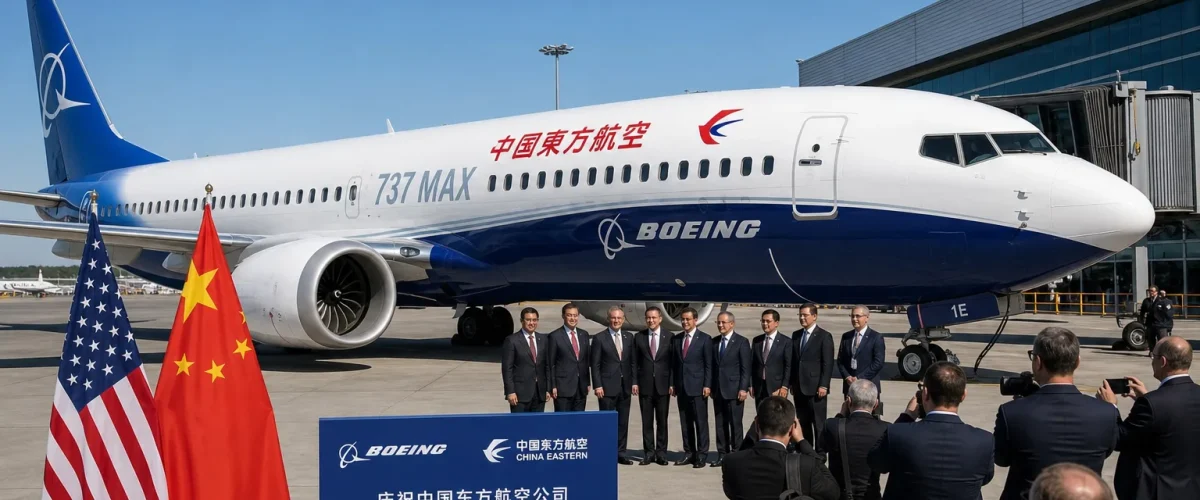
China has agreed to purchase 200 Boeing aircraft, US President Donald Trump announced on Thursday, 15 May 2026, marking Beijing’s first major order of American commercial planes in nearly a decade and delivering the biggest headline deal from the two-day Trump-Xi summit at the Great Hall of the People. In a parallel development, Reuters reported that the United States had quietly cleared limited sales of Nvidia’s H200 artificial intelligence chips to 10 major Chinese technology firms, including Alibaba, Tencent, ByteDance, JD.com, Lenovo, and Foxconn.
Trump, speaking in a Fox News interview from Beijing, described the summit as producing “fantastic trade deals” and called the Boeing order a landmark commercial achievement. “China is going to buy 200 Boeing jets — that’s a big, big deal,” the president said. However, the announcement fell short of market expectations, with Boeing shares dropping over 4 per cent after the deal was confirmed, as investors had anticipated an order of up to 500 narrow-body jets plus additional wide-body aircraft worth significantly more.
The Boeing Deal: Significance and Shortfall
The 200-aircraft order effectively ends Boeing’s order drought in the Chinese market, which has persisted since trade tensions between Washington and Beijing escalated under Trump’s first term. China, the world’s second-largest aviation market, had been exclusively ordering from European rival Airbus for several years, a shift that cost Boeing tens of billions in potential revenue and contributed to the company’s strategic and financial difficulties.
Reports from Reuters and Bloomberg had suggested during the pre-summit preparations that China was considering a much larger package — potentially 500 Boeing 737 MAX narrow-body jets plus discussions around 100 wide-body aircraft orders. The actual 200-jet order, while significant, represented roughly 40 per cent of what the market had been pricing in, explaining the investor disappointment. Details about the specific aircraft types, the airlines involved, and delivery timelines were not immediately disclosed.
Despite the shortfall relative to expectations, aviation analysts described the order as strategically important. “Any Boeing order from China after years of zero activity is significant,” said Richard Aboulafia, an aerospace analyst at AeroDynamic Advisory. “It signals that the trade relationship is moving in a positive direction, even if the volume is below the ambitious targets that were floated before the summit.” The order also supports Boeing’s production ramp-up plans for the 737 MAX, which remains the company’s best-selling aircraft.
Nvidia Chips: AI as Trade Currency
Perhaps more consequential for the long-term trajectory of US-China relations is the reported clearance of Nvidia H200 chip sales to Chinese firms. The H200, Nvidia’s second-most powerful AI chip, has been at the centre of the technology trade war between Washington and Beijing. US export controls imposed since 2022 have restricted the sale of advanced AI chips to China, limiting Chinese tech companies’ ability to train large-scale AI models and compete in the global AI race.
Nvidia CEO Jensen Huang — who was personally included in Trump’s delegation at the last minute, travelling with the president on Air Force One — had been aggressively lobbying for expanded access to the Chinese market. His inclusion in the delegation was one of the summit’s biggest business storylines, with analysts interpreting it as a signal that AI and semiconductor trade would be central to the negotiations.
The reported clearance covers 10 named Chinese companies, which include some of China’s largest technology firms. If confirmed and implemented, the sales would represent a significant — though controlled — relaxation of US export restrictions, potentially worth billions of dollars in revenue for Nvidia. However, US Trade Representative Jamieson Greer cautioned that broader export controls on the most advanced chips and chipmaking equipment “remain firmly in place,” and Treasury Secretary Scott Bessent emphasised the “utmost importance” of the US maintaining its AI leadership.
Other Summit Outcomes: Board of Trade and Managed Competition
Beyond the headline deals, the summit produced an agreement to establish a “Board of Trade” — a new bilateral mechanism designed to manage trade disputes between the two countries without constantly reopening tense tariff negotiations. The mechanism is intended to provide a structured framework for resolving commercial disagreements, reducing the kind of escalatory tariff wars that characterised the early Trump years and disrupted global supply chains.
The creation of the Board of Trade reflects what analysts are calling a shift towards “managed competition” between Washington and Beijing — an acknowledgement that complete economic decoupling is neither feasible nor desirable, but that the economic relationship needs guardrails and dispute resolution mechanisms. The board is expected to meet quarterly, with senior trade officials from both sides addressing specific commercial issues.
The trade truce agreed between Trump and Xi last October — which saw Washington suspend tariff increases on Chinese goods while Beijing eased restrictions on rare earth exports — remains in effect. The summit appears to have strengthened this framework rather than fundamentally altering it, with both sides seeking stability while pursuing their broader strategic interests.
Market Reaction: Disappointment Despite Deals
Global markets reacted with mixed signals to the summit outcomes. Boeing shares fell over 4 per cent on the lower-than-expected order, while broader US equity indices continued their record-breaking rally, with the S&P 500 closing above 7,500 for the first time and the Dow crossing 50,000. Nvidia shares rose modestly on the chip sales reports, though the full impact will depend on the scale and timing of actual shipments.
For the broader global economy, the summit’s most important outcome may be the absence of escalation. Neither side announced new tariffs, restrictions or sanctions, and the overall tone — described by both delegations as “constructive” and “highly productive” — suggests that the US-China economic relationship is entering a more stable phase, even as strategic competition continues in areas like AI, semiconductors, and military technology.
What It Means for India
For India, the Trump-Xi summit outcomes have both positive and negative implications. On the positive side, any stabilisation of US-China trade relations reduces the risk of broader global economic disruption. The potential relaxation of chip export controls could also benefit Indian tech companies that rely on Nvidia hardware for AI development, as increased supply could moderate chip prices.
On the negative side, a closer US-China economic relationship could reduce India’s leverage as an alternative manufacturing destination and supply chain partner. India has positioned itself as a beneficiary of US-China decoupling, attracting manufacturing investment from companies seeking to diversify away from China. A US-China trade rapprochement could slow this trend.
As PM Modi embarks on his own diplomatic tour of the UAE and Europe, the strategic implications of the Trump-Xi summit will be closely analysed in New Delhi. India’s response will likely focus on strengthening its own bilateral relationships with key partners, accelerating domestic manufacturing capabilities, and ensuring that India’s interests are protected in the evolving global economic order.