Indian Rupee Plunges to Record Low of 95.5 Against US Dollar as Crude Oil Surge and Iran Tensions Weigh on Markets

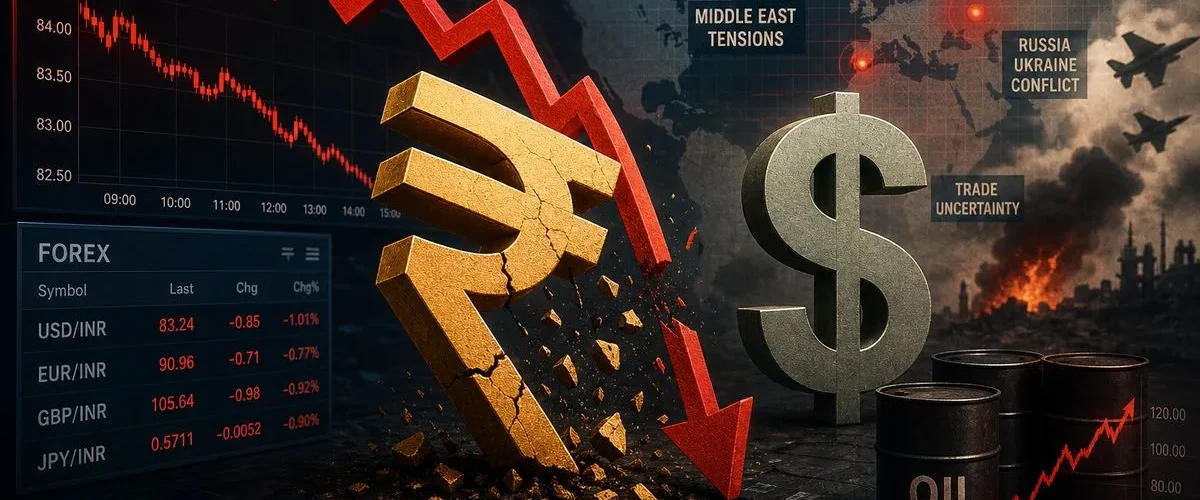
The Indian rupee weakened to a record low of 95.5 against the United States dollar on Tuesday, May 5, 2026, as a toxic combination of soaring crude oil prices, escalating geopolitical tensions in the Middle East, and sustained foreign investor outflows pushed India’s currency to its weakest level ever. The sharp depreciation has rattled markets and raised concerns about imported inflation, widening trade deficits, and the Reserve Bank of India’s ability to defend the currency without depleting its forex reserves further.
What Is Driving the Rupee’s Fall
The primary catalyst for the rupee’s latest slide is the surge in global crude oil prices. Brent crude, the international benchmark, spiked past $114 per barrel on Monday after Iran launched missile and drone strikes on UAE energy infrastructure near Fujairah, sending shockwaves through global commodity markets. India, which imports over 85 per cent of its crude oil requirement, is acutely vulnerable to oil price shocks — and with Brent having risen nearly 40 per cent from its February 2026 lows, the impact on India’s current account deficit has been severe.
Adding to the pressure is the sustained outflow of foreign portfolio investment (FPI) from Indian markets. As reported in our earlier coverage, FPI outflows from India have already surpassed the entire 2025 total in just four months, with foreign investors pulling over Rs 1.8 lakh crore from Indian equities and debt markets since January 2026. This exodus has created sustained dollar demand in the foreign exchange market, pushing the rupee lower despite RBI intervention.
The US dollar itself has been strengthening globally as the Federal Reserve signals that interest rate cuts — which were expected in the first half of 2026 — are now unlikely before September at the earliest. The dollar index (DXY), which measures the greenback against a basket of major currencies, is trading near 106, its highest level in three months.
RBI’s Dilemma: Defend or Preserve
The Reserve Bank of India has been actively intervening in the forex market to slow the rupee’s decline, selling dollars from its reserves. However, this intervention comes at a cost — India’s forex reserves have declined from their peak of over $680 billion in September 2025 to approximately $620 billion currently, a drawdown of $60 billion in less than eight months.
RBI Governor Sanjay Malhotra, speaking at a recent industry event, acknowledged the challenges but sought to reassure markets. “The RBI has adequate reserves to manage currency volatility,” he said. “Our intervention is not about defending any particular level but about smoothing out excessive volatility that could be disruptive to the real economy.”
However, analysts are less sanguine. “If Brent stays above $110 for an extended period, the rupee could test 97-98 levels against the dollar,” said Ananth Narayan, professor of finance at SP Jain Institute and former head of South Asia FX at Standard Chartered. “The RBI will have to make difficult choices about how much reserves to deploy. At some point, it may need to allow the rupee to adjust to reflect the new reality.”
Impact on Indian Economy
A weaker rupee has wide-ranging implications for the Indian economy. The most immediate impact is on the cost of imports, particularly crude oil, which accounts for approximately one-third of India’s total import bill. With oil prices elevated and the rupee at record lows, the landed cost of crude in rupee terms is at its highest ever — a double whammy that will flow through to higher petrol, diesel, and LPG prices.
The government, which has been considering a Rs 4-5 per litre hike in petrol and diesel prices, may now be forced to act sooner than planned. However, any fuel price increase would be politically sensitive, particularly in the wake of the BJP’s election victories — the party would want to avoid dampening the post-election euphoria with an unpopular economic measure.
Imported inflation is another concern. A weaker rupee makes all imports more expensive, from electronic components and machinery to edible oils and gold. This could push headline inflation higher at a time when the RBI is already grappling with food price pressures. If inflation breaches the RBI’s upper tolerance band of 6 per cent, it could constrain the central bank’s ability to cut interest rates — a move that the growth-oriented government has been pushing for.
Stock Market Under Pressure
Indian equity markets have also felt the pinch. The Nifty 50 closed at 24,033 on Tuesday — down 0.4 per cent — while broader markets showed relative resilience, with the Midcap 100 and Smallcap 100 indices eking out modest gains. However, the overall sentiment remains cautious, as the euphoria from the election results that drove a 997-point Sensex rally just days ago has given way to concerns about macroeconomic headwinds.
Foreign institutional investors were net sellers on Tuesday, pulling out over Rs 2,800 crore from Indian equities. Domestic institutional investors (DIIs), particularly mutual funds, partially offset the selling, but the imbalance between foreign outflows and domestic inflows remains a source of market vulnerability.
What History Tells Us
The rupee has hit record lows multiple times in the past — the previous all-time low of 99.82 per dollar was reached briefly in March 2026 during a liquidity crisis triggered by the sudden collapse of a major Indian NBFC. The currency has recovered from that extreme, but the trend has been consistently downward, losing approximately 8 per cent against the dollar in 2026 alone.
Historically, sharp rupee depreciation episodes have been followed by stabilisation as the factors driving the decline either reverse (oil prices fall, geopolitical tensions ease) or the economy adjusts (exports become more competitive, import substitution accelerates). However, the current combination of structural factors — persistent trade deficit, elevated global oil prices, and geopolitical instability — makes a quick recovery less likely.
What to Watch
Several factors will determine the rupee’s trajectory in the coming days and weeks. The most critical is the evolution of the Iran-UAE conflict and its impact on oil prices. If diplomatic efforts — including reported China-Iran talks — succeed in de-escalating tensions, crude prices could retreat, providing relief to the rupee.
The RBI’s monetary policy meeting later this month will also be closely watched. Any signal on interest rates, forex intervention strategy, or macroeconomic assessment will influence currency markets. Additionally, India’s April trade data, expected later this week, will provide the latest reading on the import bill and trade deficit.
For Indian consumers and businesses, the message is clear: a weaker rupee means higher costs for imported goods and services, from foreign holidays to electronics to fuel. For exporters, particularly in IT services and pharmaceuticals, the depreciation provides a competitive advantage in global markets — a silver lining in an otherwise concerning economic outlook.

- Indian Army Gets New Chief as General Dwivedi Hands Over Command Amid Push for Indigenous Defence Tech - July 1, 2026
- Ayodhya Ram Temple Donation Scandal Deepens as Trustees Resign and SIT Arrests Eight - June 29, 2026
- Bengal Seven Weeks On: Modi’s Historic Win and the Questions That Won’t Go Away - June 28, 2026