SBI Posts Record Rs 83,299 Crore Annual Profit in FY26 but Shares Tumble 7 Percent as Margin Compression Worries Investors

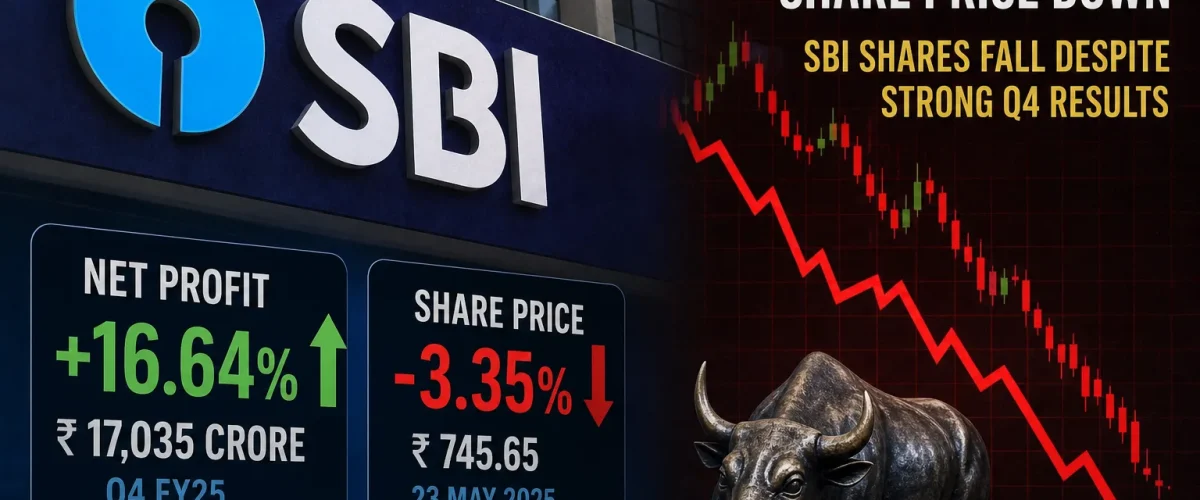
State Bank of India (SBI), the country’s largest public sector lender, reported the second-biggest annual corporate profit in India’s history for the financial year ending March 2026 — a staggering Rs 83,299 crore that trails only Reliance Industries among Indian companies. Yet, in a paradox that underscores the complexity of modern banking, SBI shares tumbled approximately 7 percent on Friday, 09 May, as investors reacted to mounting concerns about margin compression and treasury losses in the March quarter.
The sharp sell-off, which wiped out thousands of crores in market capitalisation, reflects a growing tension between SBI’s headline profitability and the underlying pressures on its core banking metrics. While loan growth remained robust and asset quality continued to improve, the bank’s net interest margin (NIM) contracted and treasury income — a key earnings driver — deteriorated significantly due to surging government bond yields during the January-March quarter.
Q4 FY26 Results: The Numbers
SBI’s Q4 FY26 net profit came in at approximately Rs 17,800 crore — broadly in line with some analyst estimates but below the more optimistic forecasts that had projected up to Rs 20,000 crore. The quarterly profit represented a modest year-on-year increase but a notable sequential decline from the December quarter, driven primarily by the treasury income hit.
Net interest income (NII) — the difference between interest earned on loans and interest paid on deposits — grew approximately 8 percent year-on-year to around Rs 43,000 crore, reflecting the bank’s strong loan book growth. However, the net interest margin fell to approximately 2.7 percent, down 9 basis points from the year-ago quarter and 7 basis points from the previous quarter, as the cost of deposits rose faster than lending rates.
The operating profit for the full year FY26 grew by 11.25 percent to Rs 1,23,015 crore — a strong headline number that was overshadowed by the margin deterioration. Loan growth remained healthy at approximately 14 percent, driven by retail lending, corporate credit, and the government’s infrastructure push.
Why Did the Stock Fall Despite Record Profit?
The 7 percent stock decline — one of SBI’s worst single-day falls in recent years — was driven by several factors that concerned institutional investors. First and foremost was the treasury loss. As government bond yields surged during the March quarter, the market value of SBI’s massive bond portfolio declined, resulting in mark-to-market losses that dragged down non-interest income.
Second, the NIM compression raised questions about the sustainability of SBI’s earnings growth. With the Reserve Bank of India maintaining elevated interest rates to combat inflation, deposit costs have been rising steadily. Banks like SBI that rely heavily on retail deposits are particularly vulnerable, as they must offer competitive rates to retain customers while facing pressure on lending rates from market competition.
Third, analysts flagged concerns about the credit cost trajectory. While asset quality metrics remained strong — with gross non-performing assets (NPAs) below 2 percent — some brokerages noted a slight uptick in slippages during Q4, suggesting that the credit cycle may be approaching an inflection point after several years of improvement.
Analyst Reactions and Forecasts
Analyst reactions to SBI’s results were mixed. Nomura maintained a cautious stance, noting that while the bank’s annual profit was impressive, the quarterly trajectory showed “clear signs of margin fatigue.” The brokerage maintained its target price with a neutral rating, suggesting limited upside from current levels.
Kotak Institutional Equities, which had earlier forecast a 12 percent year-on-year decline in Q4 profit, was more constructive on the full-year numbers. “SBI’s ability to deliver Rs 83,000+ crore in annual profit despite a challenging treasury environment speaks to the fundamental strength of its franchise,” the brokerage said, while cautioning that FY27 margins could face further pressure.
On the positive side, India’s strong economic growth momentum is expected to support robust credit demand in FY27, which could partially offset margin headwinds for SBI and other large banks.
SBI in the Context of Indian Banking
Despite the stock market reaction, SBI’s FY26 performance underscores its position as the backbone of Indian banking. With a balance sheet exceeding Rs 65 lakh crore, over 22,000 branches, and more than 450 million customers, SBI processes a significant share of India’s financial transactions. The bank has also been investing heavily in digital infrastructure, with its YONO app surpassing 80 million registered users.
The bank’s performance also reflects broader trends in Indian banking. After nearly a decade of NPA-driven stress that peaked around 2018, India’s banking sector has staged a remarkable recovery. Combined profits of listed banks exceeded Rs 3 lakh crore in FY26, and the sector’s gross NPA ratio has fallen to its lowest level in over a decade.
Investment Outlook
For retail investors, the key question is whether the 7 percent decline represents a buying opportunity or a warning signal. SBI’s dividend yield — the bank is expected to announce a generous payout given its record profit — makes it attractive for income-focused investors. However, those focused on earnings momentum may want to wait for clarity on the NIM trajectory before adding to positions.
The broader Indian stock market has been volatile in recent weeks, driven by global uncertainties including the US-Iran conflict, fluctuating oil prices, and the weakening rupee. SBI’s results add another layer of complexity to the market narrative — record profits coexisting with genuine earnings concerns in India’s most systemically important financial institution.
Investors will be closely watching SBI’s guidance for FY27, particularly on NIMs, credit growth targets, and the outlook for treasury income as global markets remain turbulent. The bank’s annual analyst meeting, held on Friday evening, is expected to provide additional clarity on these critical metrics.