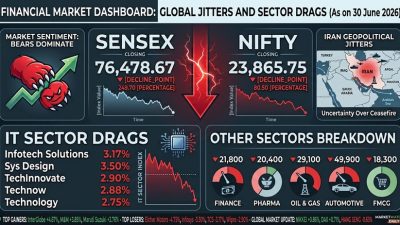
Sensex Snaps 5-Day Rally, Crashes 600 Points as IT Stocks Drag Indian Markets Down

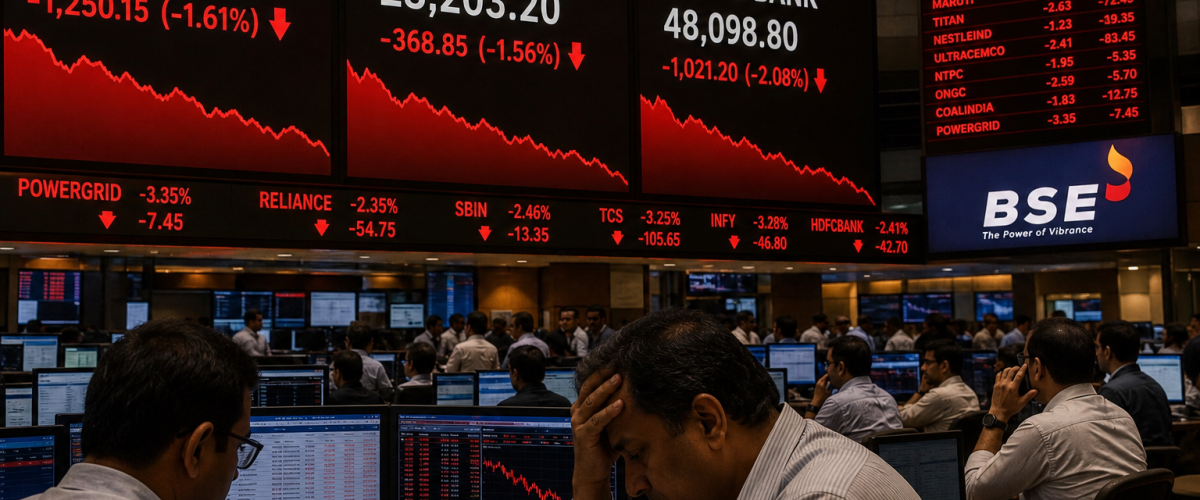
The Indian stock market’s impressive five-day winning streak came to an abrupt end on Friday as the BSE Sensex crashed over 600 points and the Nifty 50 slipped sharply, dragged down by a brutal sell-off in IT stocks and weaker-than-expected global cues. The reversal wiped out a significant portion of the gains accumulated during the rally that had taken the Nifty above 24,000 earlier in the week, leaving traders questioning whether the breakout was sustainable or a bear market rally.
The Sensex, which had been trading above 79,000 at Thursday’s close, fell to around 78,400, while the Nifty retreated from its five-session highs. Market breadth was decidedly negative, with advancing stocks outnumbered by decliners across both the BSE and NSE platforms.
Why Did Markets Fall?
Multiple factors converged to trigger Friday’s sell-off:
IT Sector Carnage: The Nifty IT index led the decline, falling sharply as concerns about slowing global technology spending and potential US tariff impacts on Indian IT services weighed on sentiment. Major IT stocks including TCS, Infosys, Wipro, and HCL Tech all closed significantly lower, with the sector wiping billions off market capitalisation in a single session.
Related: Sensex Falls 750 Points on April 22 as IT Stocks Crash and Iran Ceasefire Doubts Rock Dalal Street
Hawkish US Federal Reserve: Overnight cues from the US were bearish. The Federal Reserve’s tone in its latest policy communication was interpreted as more hawkish than expected, with officials signalling that interest rates could remain elevated for longer than markets had priced in. This dampened risk appetite globally and hit India’s rate-sensitive and export-oriented sectors particularly hard.
Profit-Taking: After five consecutive sessions of gains — during which the Nifty climbed from below 23,500 to above 24,100 — some profit-booking was inevitable. Traders who had accumulated positions during the rally used the weak global cues as a trigger to lock in gains, adding to the selling pressure.
Oil Price Concerns: Despite the US-Iran MOU framework creating expectations of lower oil prices, Brent crude held firm around $81-82 per barrel, providing less relief than bulls had hoped for. India’s oil import bill remains a structural concern for the current account and corporate margins.
Sector-Wise Performance
The damage was widespread but not uniform:
Worst Hit: IT (-3.5%), Banking, Real Estate, and Consumption indices all closed in the red. The IT sector’s outsized decline reflected both global concerns and India-specific worries about currency movements affecting rupee-denominated revenue guidance for the upcoming quarter.
Pockets of Strength: Defensive sectors — including Pharma, Healthcare, Media, and Chemicals — bucked the trend, closing in positive territory. The rotation into defensive names suggests that institutional investors are hedging against further downside rather than aggressively buying the dip.
Mid and Small Caps: Select midcap healthcare and chemical stocks showed resilience, but broader mid and small-cap indices tracked the benchmarks lower, indicating that the sell-off was not limited to large caps.
FII Flow Reversal
One of the most closely watched data points in recent sessions has been Foreign Institutional Investor (FII) activity. After several sessions of net buying during the five-day rally, preliminary data from Friday suggests that FIIs turned net sellers — a reversal that, if sustained, could undermine the market’s recent recovery.
Domestic Institutional Investors (DIIs) continued their buying, providing a floor for the market. However, the DII support has limits — sustained FII selling historically overwhelms DII buying over multi-week periods.
What Happens Next?
Technical analysts are divided on the market’s near-term direction. The key levels to watch are:
Support: The 23,800-23,850 zone (which aligns with the 100-day EMA) is the first major support level. A breach below this would suggest the breakout above 24,000 was a false move, potentially opening the door to 23,500.
Resistance: The 24,100-24,200 zone, which acted as the high during the five-day rally, now becomes overhead resistance. The market needs to reclaim this zone convincingly to re-establish bullish momentum.
With Saturday and Sunday providing a cooling-off period, Monday’s opening will be critical. Global cues over the weekend — particularly any developments in the US-Iran situation, oil prices, and the Fed’s rhetoric — will set the tone for the coming week.
Also Read
- Sensex Crashes Over 3000 Points in Four Days as IT Stocks Plunge and FII Selling Intensifies Amid Crude Oil Surge and Rupee Crisis
- Sensex Jumps Nearly 1,000 Points and Nifty Surges Past 24,200 as Election Trends and Easing Iran Tensions Fuel Massive Stock Market Rally
- Sensex Surges 1100 Points, Nifty Reclaims 24000 as Crude Oil Crashes on Iran Peace Deal
- Sensex Crashes Over 840 Points, Nifty Slips Below 23,100 as Global Sell-Off Triggered by AI Bubble Fears and Surging Oil Prices Hits Dalal Street
- Sensex Surges Over 500 Points and Nifty Crosses 23800 as Middle East Peace Hopes and Nvidia Earnings Drive Global Market Rally