NCERT Restores Mohenjo-Daro ‘Dancing Girl’ After Textbook Censorship Backlash

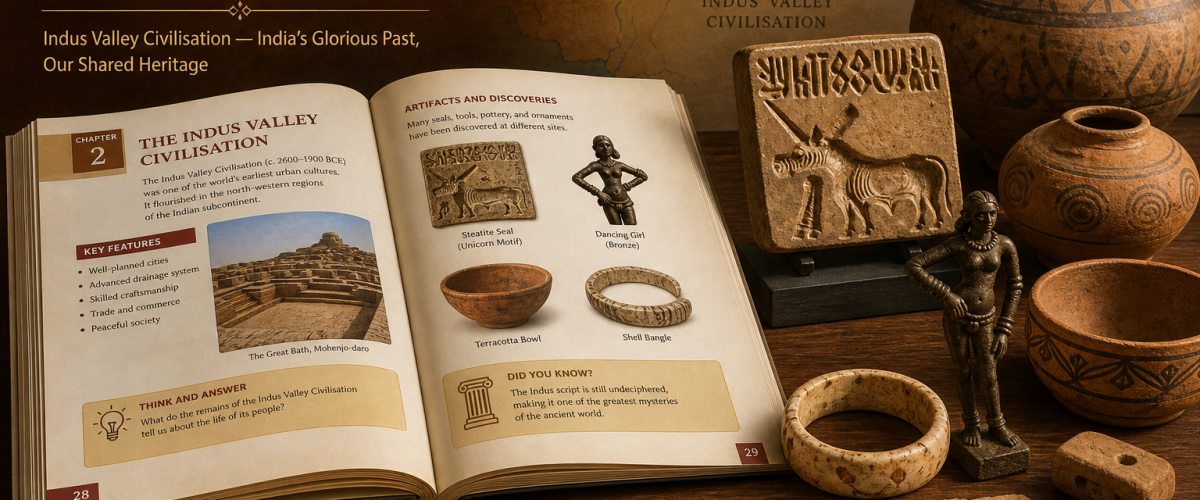
The National Council of Educational Research and Training (NCERT) has announced the restoration of the original, uncensored image of the Mohenjo-daro ‘Dancing Girl’ bronze sculpture in its Class 9 textbook, following a fierce backlash from historians, educators, and the public over the alteration of one of India’s most iconic archaeological artefacts. The controversy, which erupted over the weekend, saw the NCERT accused of distorting history by modifying the 4,500-year-old figurine’s image to obscure its anatomical details with dark shading — a decision that historians called unprecedented and unacceptable.
The Dancing Girl, a 10.5-centimetre bronze statuette dated to approximately 2500 BCE, is among the most celebrated artefacts of the Indus Valley Civilisation. Discovered during excavations at Mohenjo-daro in present-day Pakistan in 1926 — exactly a century ago this year — the figure depicts a young woman standing with one hand on her hip and the other resting on her thigh, adorned with bangles and a necklace. The sculpture is housed in the National Museum in New Delhi and has been featured in Indian textbooks for decades as a symbol of the artistic sophistication of one of humanity’s earliest urban civilisations.
What Was Changed — and Why It Matters
In the newly issued Class 9 textbook, the NCERT had replaced the standard photograph of the Dancing Girl with an altered version in which the figurine’s torso was obscured with dark shading, concealing its anatomical details. The modification was made without any public announcement, explanation, or consultation with historians and archaeologists — leading to accusations that the change was driven by ideological considerations rather than educational ones.
Related: CBSE Re-Evaluation Fee Controversy — Rahul Gandhi Accuses Board of Profiting from Its Own Mistakes
The discovery of the alteration triggered an immediate and intense response from the academic community. Historians pointed out that the Dancing Girl has been displayed in its original form in museums, textbooks, and academic publications for a century without controversy. The sculpture is a masterpiece of Bronze Age art, and its anatomical accuracy is integral to its historical and artistic significance.
“This is a 4,500-year-old artefact of immense cultural importance,” said one prominent historian. “Altering its image in a textbook is not just historically inaccurate — it sends a deeply troubling message about how we approach our own heritage. You cannot censor history.”
The Backlash and NCERT’s Reversal
The backlash came from across the political and intellectual spectrum. Social media erupted with criticism, trending hashtags, and side-by-side comparisons of the original and altered images. Educators expressed concern that the modification could set a precedent for further alterations to historical content in textbooks, potentially undermining the integrity of Indian education.
Facing mounting pressure, NCERT Director Dinesh Saklani announced that the original image would be restored. “After discussions with specialists, the department is substituting the image. The original, unaltered photograph of the Dancing Girl will be reinstated in the digital edition of the textbook immediately, and future print editions will also feature the uncensored image,” Saklani told journalists.
The speed of the reversal — within days of the controversy going public — suggests that the NCERT leadership recognised the severity of the backlash and the damage the alteration was causing to the institution’s credibility. However, the episode has raised questions about the editorial processes that allowed the change to be made in the first place and whether similar alterations have been made to other historical content without public scrutiny.
The Dancing Girl: A Century of Discovery
The timing of the controversy is particularly poignant. The year 2026 marks the centenary of the Dancing Girl’s discovery by British archaeologist Ernest Mackay during the 1926 excavation season at Mohenjo-daro. The figurine, created using the lost-wax casting technique, demonstrates a level of metallurgical sophistication that astonished archaeologists and established the Indus Valley Civilisation as one of the ancient world’s most advanced societies.
Sir John Marshall, the Director-General of the Archaeological Survey of India who oversaw the Mohenjo-daro excavations, famously described the Dancing Girl as a figure that “would not be out of place in a modern art exhibition.” The sculpture’s confident posture, naturalistic proportions, and expressive quality have made it an enduring symbol of India’s artistic heritage — a status that makes the textbook alteration all the more jarring.
What the Episode Reveals
The controversy over the Dancing Girl is not an isolated incident. In recent years, the NCERT has faced criticism for multiple changes to school textbooks, including the removal of content related to the Mughal period, alterations to chapters on democracy and social movements, and revisions that critics argue reflect a particular ideological orientation rather than pedagogical improvement.
The restoration of the original image is a welcome outcome, but the episode raises broader questions about transparency, accountability, and the processes that govern the content of textbooks used by hundreds of millions of Indian students. In a country where education is central to social mobility and national identity, the integrity of textbooks is not a minor matter — it is fundamental to the trust that students, parents, and educators place in the educational system.
Also Read
- CBSE Makes Three Languages Mandatory for Class 9 and 10 From July 2026 Under National Education Policy as Two Must Be Native Indian Languages
- Odisha CM Mohan Majhi Announces Free KG-to-PG Education for Economically Weaker Students as BJP Government Turns Two
- RBI Holds Repo Rate at 5.25% — MPC Votes Unanimously to Maintain Neutral Stance Amid Global Uncertainty
- NEET 2026 Paper Leak: Cockroach Janta Party Protests at Jantar Mantar Demanding Education Minister Dharmendra Pradhan Resignation
- Cockroach Janta Party Founder Abhijeet Dipke to Return to India on June 6 for Jantar Mantar Education Protest