21-Year-Old UPSC Aspirant Found Murdered in Delhi’s Amar Colony: How Police Cracked the IRS Officer’s Daughter Case Within Hours

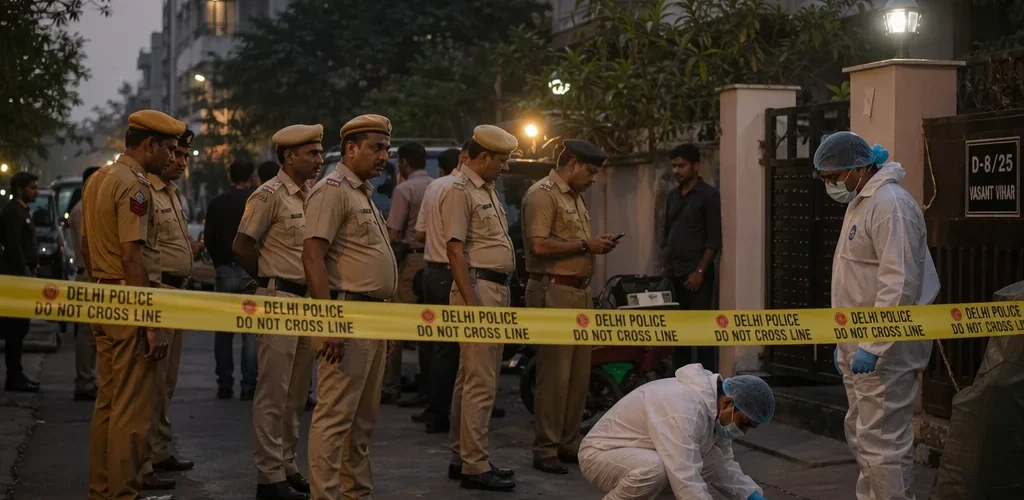
The upscale residential neighbourhood of Amar Colony in South Delhi was shaken on April 22, 2026, when a 21-year-old woman — the daughter of a senior Indian Revenue Service (IRS) officer and an active UPSC examination aspirant — was found murdered inside her family home. Her parents discovered the body upon returning home after a brief absence, finding their daughter strangled, reportedly with a mobile phone charging cable. The scene indicated a violent crime that included elements of robbery. Delhi Police, moving with unusual speed, identified and arrested the prime suspect — a former domestic help named Rahul Meena — within hours of the crime being reported, using a combination of CCTV footage analysis and rapid forensic work.
The Crime: What Happened on April 22
According to the police investigation, the victim — whose identity is being withheld to protect the family’s privacy — was alone at the family’s Amar Colony apartment on the morning of April 22. Her parents had left the house briefly, leaving her studying for the UPSC Civil Services examination, for which she had been preparing intensively.
When the parents returned, they found the apartment in disarray and their daughter unresponsive. Initial medical examination revealed that she had been strangled, with a mobile phone charging cable identified as the weapon. The scene also showed signs of a struggle, with a lamp and heavy objects displaced, suggesting the victim had fought back against her attacker.
The crime sent shockwaves through the neighbourhood and across Delhi. Amar Colony, located in the Lajpat Nagar area, is a well-established residential colony that houses many government officials, professionals, and families — the kind of neighbourhood where such violent crimes are exceptionally rare.
The Investigation: CCTV Trail and Rapid Arrest
Delhi Police’s response was swift and methodical. Within hours of the crime being reported, a dedicated investigation team was assembled and began the painstaking work of reviewing CCTV footage from cameras throughout the Amar Colony area.
The footage proved crucial. Investigators were able to identify a familiar face entering and leaving the vicinity of the apartment around the time of the crime — Rahul Meena, a young man who had previously worked as domestic help for the family. Meena was known to the household, having been employed there before being let go.
A forensic team was dispatched to the scene simultaneously, collecting fingerprints, DNA samples, and other physical evidence. The forensic analysis, combined with the CCTV identification, gave police enough evidence to locate and arrest Meena within hours.
During interrogation, police officials reported that Meena showed “no remorse” for the crime. According to investigators, Meena had entered the apartment with the intention of robbery, knowing the family’s routine and that the daughter would likely be alone during the morning hours. When the victim confronted him, a violent struggle ensued, during which Meena overpowered and killed her.
The Accused: Rahul Meena’s Background
Rahul Meena, described as a young man in his mid-20s, had worked as domestic help for the IRS officer’s family before being dismissed. His familiarity with the household — including the layout of the apartment, the family’s daily schedule, and the entry points — gave him both the knowledge and the confidence to attempt the crime.
Police are investigating whether Meena had planned the robbery in advance or acted opportunistically. The fact that he targeted a time when the parents were absent suggests premeditation, though the chaotic nature of the crime scene — including the improvised use of a charging cable as a weapon — could indicate that the killing itself was not premeditated but rather escalated from a robbery gone wrong.
Investigators are also examining Meena’s financial situation and associates to determine whether anyone else was involved in planning or facilitating the crime.
A UPSC Aspirant’s Dreams Cut Short
Perhaps the most poignant element of the case is the victim’s aspirations. As a UPSC Civil Services aspirant, she was one of millions of young Indians who devote years of their lives to preparing for one of the world’s most competitive examinations, with the dream of serving the nation as an administrator.
The IRS officer’s daughter was reportedly a dedicated student, spending most of her time studying at home and at coaching centres in the Rajinder Nagar and Old Rajinder Nagar areas — the heart of Delhi’s UPSC preparation ecosystem. Her death has resonated deeply with the student community in Delhi, where thousands of young men and women live alone or with minimal family supervision while preparing for competitive examinations.
Student groups and UPSC coaching institutes in the area held vigils and demanded enhanced security measures in residential areas that house large numbers of students preparing for competitive examinations.
Delhi’s Safety Debate Reignited
The murder has reignited the perennial debate about women’s safety in India’s capital. Despite significant investments in surveillance infrastructure — Delhi now has one of the densest CCTV networks of any city in the world — violent crimes against women continue to shock the city with distressing regularity.
The case has drawn comparisons to other high-profile crimes against women in Delhi, with activists pointing out that the victim was not safe even in her own home in an upscale residential colony. Women’s rights organisations have called for stricter verification processes for domestic workers, better community surveillance, and faster police response times.
The Delhi Police, for their part, have pointed to the rapid arrest as evidence that their surveillance and investigative capabilities are effective. The extensive CCTV network that helped crack this case is part of a city-wide surveillance programme that has been credited with improving crime detection rates, even as concerns about privacy and the overall safety environment persist.
Domestic Worker Background Checks: A Systemic Gap
The case has highlighted a systemic gap that affects millions of Indian households: the lack of standardised background verification for domestic workers. While platforms like UrbanClap (Urban Company) and local agencies offer verified workers, a significant proportion of domestic help in India is hired informally through word-of-mouth recommendations without formal identity verification or criminal background checks.
Security experts have long advocated for a national registry of domestic workers linked to Aadhaar-based verification, which could flag individuals with criminal records or pending cases. Several states have implemented or are developing such systems, but national coverage remains patchy.
The Amar Colony case — where a former domestic worker allegedly used his knowledge of the household to commit a violent crime — provides a stark example of the risks associated with the current informal system. Whether the tragedy leads to systemic reforms or becomes another forgotten data point in Delhi’s crime statistics remains to be seen.
Legal Process and What Comes Next
Rahul Meena has been charged with murder, robbery, and related offences under the Bharatiya Nyaya Sanhita (BNS). He has been remanded to judicial custody, and the investigation is ongoing. Police are building a comprehensive case that includes CCTV evidence, forensic analysis, witness statements, and Meena’s own statements during interrogation.
For the victim’s family — a senior IRS officer who has spent his career serving the nation — the loss is immeasurable. The case serves as a painful reminder that safety, even in seemingly secure environments, cannot be taken for granted, and that the systems meant to protect vulnerable individuals require constant strengthening and vigilance.