Suvendu Adhikari Takes Oath as West Bengal’s First BJP Chief Minister at Historic Brigade Parade Grounds Ceremony

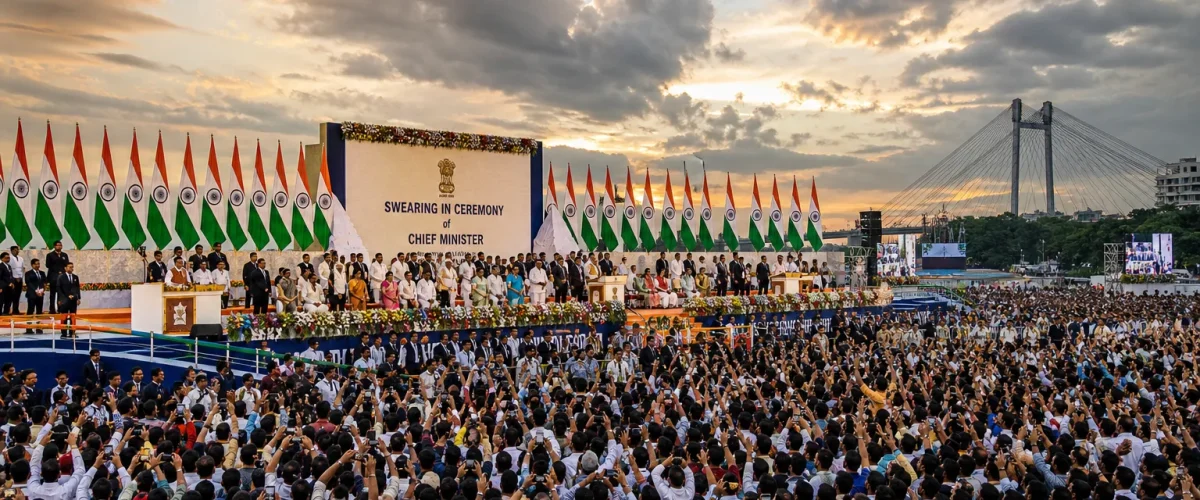
In a moment of profound political transformation, Suvendu Adhikari was sworn in as the Chief Minister of West Bengal on 09 May 2026 at a grand ceremony held at Kolkata’s iconic Brigade Parade Grounds. The event marks the first time in the state’s history that a BJP leader has assumed the top executive post, bringing to a close Mamata Banerjee’s 15-year rule and fundamentally altering the political landscape of eastern India.
Governor R N Ravi administered the oath of office to Adhikari before an audience that included Prime Minister Narendra Modi, Union Home Minister Amit Shah, around 20 Chief Ministers from BJP-ruled states, and tens of thousands of party supporters who packed the parade grounds to witness the historic occasion. Five cabinet ministers — including Dilip Ghosh and Agnimitra Paul — also took their oaths alongside Adhikari, forming the initial core of the new state government.
The Road to the Chief Minister’s Chair
Adhikari’s elevation was unanimously endorsed by the BJP legislature party in a meeting chaired by Amit Shah on Friday, 08 May. The decision came after the BJP secured a commanding 207 seats in the 294-member West Bengal Assembly, the most dominant victory the party has ever achieved outside its traditional strongholds in northern and western India. Adhikari himself defeated Mamata Banerjee in the bitterly contested Bhabanipur constituency by a margin of over 15,000 votes — a result that sent shockwaves through Indian politics.
Speaking after his selection, Adhikari said: “Bhoi is out and, as Prime Minister Modi ji has said, bharosa is in. The people of Bengal have given us a historic mandate. We will fulfil all the promises made in the BJP’s poll manifesto in Bengal.” The new Chief Minister also pledged to implement the Ayushman Bharat health insurance scheme in West Bengal as one of the first acts of his government — a scheme that the previous TMC government had refused to adopt.
PM Modi’s Address at Brigade Parade Grounds
Prime Minister Narendra Modi, addressing the massive gathering after the ceremony, described the result as a “victory of the people’s faith in democracy and development.” He highlighted the BJP’s promises to Bengal, including a crackdown on illegal infiltration from Bangladesh, protection of women’s safety, and major infrastructure investments in the state.
Modi also referenced the post-poll violence that claimed the life of Suvendu Adhikari’s personal assistant Chandranath Rath, calling it “unacceptable in a democracy” and vowing that the new government would ensure justice for all victims of political violence. The Prime Minister’s speech was interrupted several times by thunderous applause from the crowd.
Adhikari’s Cabinet and Governance Priorities
The initial cabinet of five ministers reflects the BJP’s effort to balance regional representation across West Bengal’s diverse geography. Dilip Ghosh, a former state BJP president and prominent leader from north Bengal, and Agnimitra Paul, a popular face from the party’s women’s wing, are among those who took the oath. The full cabinet expansion is expected within the coming weeks, with sources indicating that up to 30 ministers could eventually be inducted.
Among the immediate governance priorities outlined by the new administration are the implementation of Ayushman Bharat, a comprehensive review of the state’s law and order machinery, a crackdown on cattle smuggling along the India-Bangladesh border, and a special investigation into political violence incidents from the past decade. The BJP has also promised a Rs 5,000 monthly stipend for women below the poverty line and free ration for 10 crore beneficiaries.
Mamata Banerjee’s Response and TMC’s Future
The Trinamool Congress, which has governed Bengal since 2011, has continued to reject the election results. Mamata Banerjee, however, appeared to soften her stance on Friday when she updated her X (formerly Twitter) bio to describe herself as a former Chief Minister. Party sources say she is now focused on rebuilding the TMC as a strong opposition force rather than contesting the mandate itself.
The TMC won just 73 seats in the election — down from 213 in 2021 — a catastrophic decline that political analysts attribute to anti-incumbency, corruption allegations surrounding the national security narrative amplified after the Pahalgam terror attack, and the BJP’s aggressive grassroots campaign led by Adhikari. Several prominent TMC leaders, including MPs Mahua Moitra and Abhishek Banerjee, now face an uncertain political future.
Security Arrangements and Public Celebrations
Security for the swearing-in ceremony was unprecedented. Over 15,000 police personnel and several companies of central paramilitary forces were deployed across Kolkata, with additional coverage from the National Security Guard. Roads leading to Brigade Parade Grounds were closed from early morning, and a no-fly zone was imposed over the area during the ceremony.
Despite the tight security, the public celebration was massive. Supporters from across Bengal’s diverse cultural landscape gathered to mark the occasion, with many having traveled overnight from districts in north and south Bengal. Firecrackers, dhak drums, and slogans of “Jai Shri Ram” echoed across the maidan as the ceremony concluded.
What This Means for Indian Politics
The BJP’s victory in West Bengal completes the party’s dominance across the Gangetic belt. Every major state through which the Ganga flows — from Uttarakhand and Uttar Pradesh through Bihar, which recently expanded its own BJP-led cabinet, to Jharkhand and now West Bengal — is governed by the BJP or its NDA allies. This geographic consolidation gives the party an enormous advantage heading into the 2029 Lok Sabha elections.
For the opposition, the loss of Bengal is devastating. The Congress, which failed to win a single seat in the state, and the Left Front, which was reduced to just three seats, now have virtually no presence in eastern India. The INDIA alliance, which had hoped Bengal would remain a key bastion, must now recalibrate its strategy entirely.
As Suvendu Adhikari begins his term, the scale of expectations — and challenges — is immense. Bengal’s economy, education system, and infrastructure have long lagged behind other large states. Whether the BJP’s first government in the state can deliver on its ambitious promises will be one of the defining political questions of the next five years.

- Indian Army Gets New Chief as General Dwivedi Hands Over Command Amid Push for Indigenous Defence Tech - July 1, 2026
- Ayodhya Ram Temple Donation Scandal Deepens as Trustees Resign and SIT Arrests Eight - June 29, 2026
- Bengal Seven Weeks On: Modi’s Historic Win and the Questions That Won’t Go Away - June 28, 2026