World Health Day 2026: AIIMS Delhi Showcases AI-Driven Healthcare as India Pushes Science-Led Health Equity

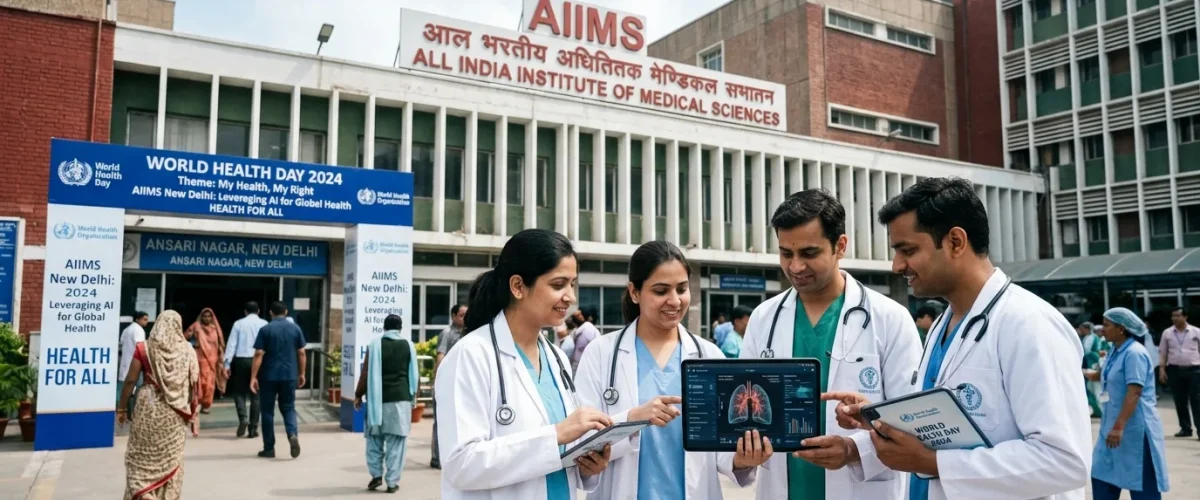
AIIMS New Delhi marked World Health Day 2026 on 7 April by showcasing its role as India’s largest tertiary care hospital and a pioneer in AI-driven medical innovation. The global theme this year, “Together for Health, Stand with Science,” resonates strongly with India’s push to bridge healthcare gaps through technology, scale and scientific research.
AIIMS by the Numbers
AIIMS Director M. Srinivas highlighted the institution’s unprecedented operational scale during a World Health Day address. The hospital operates approximately 4,000 beds and handles around 50 lakh (5 million) outpatient visits annually. Over 3.6 lakh inpatient admissions and approximately 3.1 lakh surgeries were performed in 2024-25, including complex and super-speciality procedures.
The institution’s research credentials are equally significant. Fifty-seven AIIMS faculty members rank among the world’s top 2 per cent of scientists according to Stanford University’s global ranking. This concentration of clinical and research talent makes AIIMS a critical pillar of India’s healthcare infrastructure.
AI-Driven Healthcare Innovation
AIIMS has been designated a Centre of Excellence in Healthcare Artificial Intelligence, pioneering innovations in tuberculosis diagnosis, cancer screening and non-communicable disease detection. AI-assisted diagnostic tools developed at AIIMS are now deployed across 200 district hospitals under the Ayushman Bharat Digital Mission.
The healthtech sector has crossed 100 million AI diagnostic scans in India, with rural telemedicine scaling to 400 districts. AIIMS’s role in training AI models on Indian patient data has been essential to ensuring these tools work accurately across the country’s diverse population.
India’s Healthcare Divide Remains Wide
Despite institutional achievements, India’s healthcare divide persists. The country has just 0.7 doctors per 1,000 people, well below the WHO-recommended ratio of 1:1,000. Rural areas bear the brunt of this shortage, with many primary health centres operating without a single qualified doctor.
Public health expenditure remains below 2.5 per cent of GDP, although the 2026-27 budget increased allocations for the National Health Mission and the Pradhan Mantri Jan Arogya Yojana (Ayushman Bharat). The scheme now covers 55 crore beneficiaries for secondary and tertiary hospitalisation.
ISRO Collaboration Expands Medical Frontiers
AIIMS and ISRO signed a landmark space medicine research MoU ahead of the Gaganyaan mission. The partnership focuses on developing health monitoring systems for astronauts and understanding the effects of microgravity on the human body. Insights from this research have potential applications for remote patient monitoring on Earth.
Global Context and Way Forward
The WHO’s 2026 theme underscores the importance of evidence-based approaches in an era of health misinformation. India’s investment in health and wellness is growing, but experts emphasise that technology alone cannot close the gap. Strengthening primary healthcare, training more medical professionals and ensuring equitable access to science-led care remain the defining challenges for the world’s most populous nation.

- Fentanyl Vaccine Breakthrough: Scripps Research Develops Shot That Blocks Deadly Overdoses Before They Reach the Brain - June 13, 2026
- Nipah Virus Returns to Kerala — First Case of 2026 Confirmed, State Declares High Alert - June 12, 2026
- Jill Biden Reveals She Wanted to Keep PM Modi’s 7.5-Carat Diamond Gift but Returned It After State Department Valued It at $20,000 - June 8, 2026