BRICS Agriculture Ministers to Meet in Indore — Five-Day Summit to Focus on Food Security, Smart Farming and AI in Agriculture

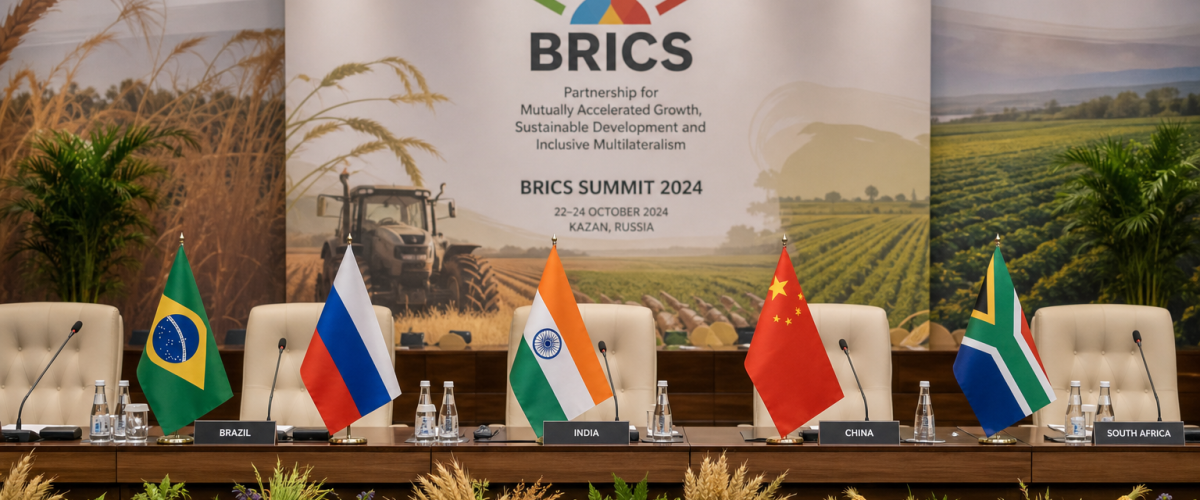
India’s commercial capital of Madhya Pradesh is set to host one of the most significant global agricultural diplomacy events of 2026, as agriculture ministers from BRICS member nations gather in Indore for a five-day summit from June 9 to 13. The meeting, held under India’s BRICS presidency, will focus on food security, climate-resilient smart agriculture, digital farming technologies, and farmer welfare — issues that affect billions of people across the Global South.
Union Agriculture Minister Shivraj Singh Chouhan announced that the officials-level working group meetings are already underway (June 9-11), ahead of the ministerial sessions on June 12-13. A joint declaration is expected at the conclusion, setting the agenda for multilateral agricultural cooperation among the five-nation bloc — Brazil, Russia, India, China, and South Africa — which collectively accounts for over 40% of the world’s population and a significant share of global food production.
Agenda: From AI to Farmer Welfare
The Indore summit’s agenda is both ambitious and wide-ranging. Delegates from the five nations, along with invited experts and international organisations, will deliberate on several critical themes including food security and nutrition, which remains a pressing challenge despite global food production reaching record levels. Climate-resilient smart agriculture is another key focus, addressing how farmers can adapt to increasingly unpredictable weather patterns driven by climate change.
The summit will also address facilitation of international agricultural trade and supply chains, which have been severely disrupted by the US-Iran conflict and shifting global trade policies. Digital agriculture — including the use of artificial intelligence, machine learning, and robotics in farming — will feature prominently, reflecting India’s push to modernise its agricultural sector through technology.
Research, knowledge exchange, and capacity building round out the agenda, with a focus on sharing best practices across BRICS nations. “The meeting, to be held under the leadership of Prime Minister Narendra Modi, will prove to be a historic opportunity for the global agriculture sector,” said Chouhan. “It will provide a new direction to the world.”
Why Indore?
The choice of Indore — a city better known for its business and food culture — is deliberate. Madhya Pradesh is one of India’s leading agricultural states, often called the “soybean capital” of the country, with significant production of wheat, pulses, and oilseeds. The state has also been a pioneer in agricultural reforms, including e-mandis (electronic marketplaces) and crop insurance schemes.
Hosting the summit in Indore rather than Delhi also aligns with the Modi government’s strategy of decentralising high-profile international events across Indian cities, showcasing the country’s diversity and development beyond the national capital. Previous BRICS events under India’s presidency have been held in cities including Varanasi, Goa, and Agra.
The Food Security Imperative
The Indore meeting comes at a critical time for global food security. The US-Iran war has disrupted shipping routes, driving up food prices and threatening supplies to import-dependent nations. Climate change continues to cause extreme weather events — from droughts in East Africa to floods in South Asia — that destroy crops and livelihoods. The UN Food and Agriculture Organization (FAO) estimates that 735 million people worldwide still face chronic hunger.
For BRICS nations, the stakes are particularly high. India, with its 1.4 billion population, remains the world’s largest consumer of food grains. China’s shifting dietary patterns are increasing demand for protein and processed foods. Brazil, a global agricultural superpower, faces the challenge of balancing production with Amazon conservation. Russia’s agricultural exports have been affected by sanctions and logistics disruptions. South Africa, meanwhile, grapples with land reform and water scarcity.
Finding common ground on trade policies, technology sharing, and climate adaptation is essential for all five nations. The Indore declaration is expected to commit member states to specific targets on reducing food waste, increasing digital agriculture adoption, and establishing joint research programs.
India’s Agricultural Diplomacy Push
The summit is part of India’s broader push to position itself as a leader in agricultural diplomacy. Under its BRICS presidency, India has prioritised the “BRICS for Agriculture” theme, organising seminars, hackathons, and B2B meetings alongside the ministerial sessions. Indian agri-tech startups have been invited to showcase innovations in drone farming, precision irrigation, and AI-based crop monitoring.
For Indian farmers, the summit’s outcomes could have tangible benefits — from better market access for Indian agricultural products in BRICS nations to the adoption of climate-smart technologies that improve yields and reduce input costs. The meeting also provides a platform for India to share its success stories, including the Digital India Agriculture mission and the PM-KISAN direct benefit transfer scheme that has benefited over 11 crore farmers.
Also Read
- World Environment Day 2026 — India Faces Climate Action Reckoning as Baku Hosts Global Observance Under ‘Inspired by Nature’ Theme
- Trump Praises Modi as ‘Good Friend’ and Says US Will Finalise Trade Deal with India Soon After Reversing Years of Trade Imbalance
- India and US Resume High-Level Trade Talks in New Delhi — Interim Bilateral Trade Deal Nearly Finalised Says Piyush Goyal
- Bharat Gen AI: India Launches Its First Government-Funded Multilingual LLM
As Indore gears up for the ministerial sessions later this week, the world will be watching closely. In an era of geopolitical fragmentation and climate crisis, multilateral cooperation on food security isn’t just desirable — it’s essential for survival.