Delhi-Dehradun Expressway Inaugurated by PM Modi: ₹12,000 Crore, 210 km Corridor Cuts Travel Time to 2.5 Hours

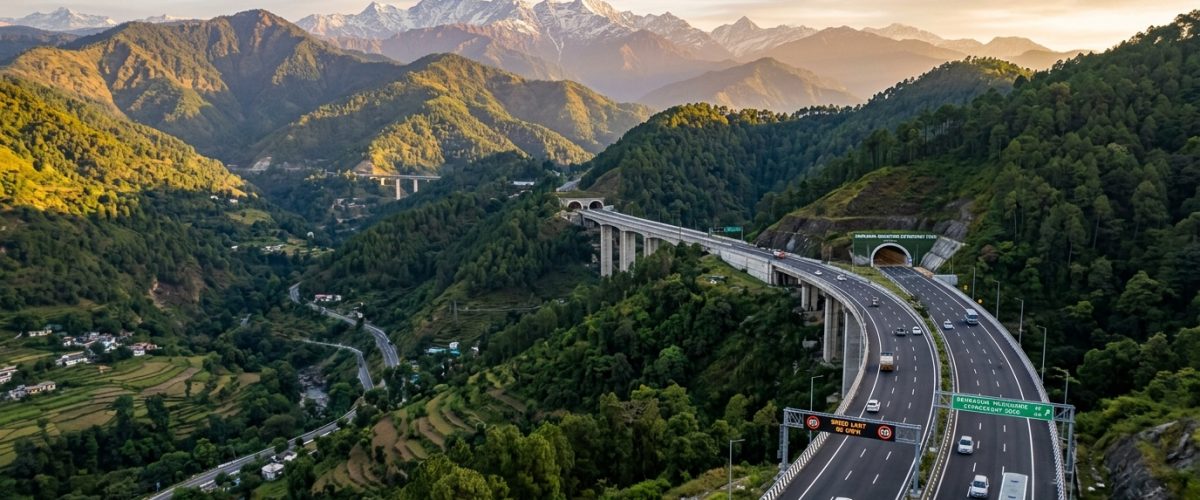
Prime Minister Narendra Modi on April 14, 2026 inaugurated the Delhi-Dehradun Expressway, a six-lane access-controlled corridor built at an estimated cost of ₹12,000 crore. Spanning approximately 210-213 km, the expressway connects the national capital to Uttarakhand’s capital, slashing travel time from the current six hours to about 2.5 hours. It is one of India’s most anticipated infrastructure projects, promising to transform road connectivity between the Delhi-NCR region and the Himalayan foothills.
Before the inauguration ceremony, PM Modi offered prayers at the Maa Dat Kali Temple near Dehradun and conducted a review of the wildlife passage along an elevated stretch of the highway — a design feature that ensures minimal disruption to the Rajaji National Park ecosystem through which the expressway passes.
Route, Design, and Key Features
The expressway begins near Akshardham in Delhi and terminates in Dehradun, passing through several towns in Uttar Pradesh including Baghpat, Baraut, Muzaffarnagar, Shamli, and Saharanpur. The corridor has been developed in four phases, combining greenfield (newly constructed) and brownfield (upgraded existing road) sections.
Key engineering features include:
- Access-controlled design with no intersections — vehicles enter and exit only through designated interchanges
- Multiple entry and exit points, interchanges, bridges, and service roads for local connectivity
- Wildlife corridors including elevated sections that allow animal movement beneath the expressway, particularly near the Rajaji Tiger Reserve
- Link road to Haridwar — a branch connects the expressway to the holy city, facilitating pilgrim traffic
- Integration with the Char Dham Highway network — improving access to Badrinath, Kedarnath, Gangotri, and Yamunotri
- Speed limit of up to 100 km/h across the corridor
Indicative travel times from key cities include approximately 2 hours 15 minutes from Ghaziabad, about 2 hours 45 minutes from Noida, and roughly 3.5 to 4 hours from Gurugram. For millions of residents in the Delhi-NCR region, this makes Dehradun, Mussoorie, and Haridwar accessible for day trips or weekend getaways.
Impact on Tourism and the Uttarakhand Economy
The expressway is expected to be a game-changer for Uttarakhand’s tourism industry. Hill stations like Mussoorie, Dhanaulti, and Landour — already popular with Delhi residents — will see dramatically reduced travel times. The Haridwar-Rishikesh spiritual tourism corridor, which attracts over 30 million visitors annually, will become significantly more accessible.
India’s rail and road infrastructure developments have always driven tourism growth, and the Delhi-Dehradun Expressway is no exception. As domestic summer travel trends show, Indian tourists are increasingly choosing road trips over flights for short-haul destinations, and this new corridor is perfectly positioned to capture that demand.
Uttarakhand Chief Minister Pushkar Singh Dhami has projected that the expressway will boost state tourism revenue by 25-30% within its first full year of operation. Real estate developers are also expected to benefit, with land prices along the expressway route already seeing appreciation in anticipation of the inauguration.
Toll Charges and Operational Details
While the final toll structure was still awaiting formal notification at the time of inauguration, preliminary reports suggest tolls will be competitive with existing national highway rates. For a car making the full Delhi-Dehradun journey, estimated toll charges are expected to be in the ₹500-700 range one way. Commercial vehicles will have a separate rate structure.
The expressway will be managed by the National Highways Authority of India (NHAI) with electronic toll collection (FASTag) at all entry points. NHAI has also planned rest areas, fuel stations, and emergency services at regular intervals along the corridor.
India’s Expressway Building Boom
The Delhi-Dehradun Expressway is part of India’s ambitious national highway expansion programme, which aims to connect all major cities with access-controlled expressways by 2030. Other recent mega-projects include the Mumbai-Pune Expressway upgrades, the Bundelkhand Expressway, the Gorakhpur Link Expressway, and the planned Delhi-Mumbai Expressway.
India’s travel and tourism infrastructure has seen unprecedented investment in recent years. The economic growth trajectory of 6.6-6.9% projected for FY2026-27 is partly built on this infrastructure backbone, which improves logistics, reduces transportation costs, and connects previously remote regions to major markets.
The real estate sector is also a direct beneficiary, with property values along new expressway corridors typically appreciating 30-50% within two years of opening. The Delhi-Dehradun Expressway is expected to follow this pattern, particularly for plots near interchange points in Baghpat, Saharanpur, and the Dehradun outskirts.
A New Era of Connectivity
For decades, the Delhi-Dehradun journey was synonymous with traffic jams, slow-moving trucks, and unpredictable travel times. The new expressway promises to change that fundamentally. With six lanes, wildlife-friendly design, and integration with existing highway networks, it represents the best of modern Indian infrastructure engineering.
As PM Modi stated during the inauguration: “This is not just a road — it is a bridge between development and aspiration.” For the millions who travel between Delhi and Uttarakhand for work, worship, and leisure, that bridge is now open.

- Delhi-Dehradun Expressway Inaugurated by PM Modi: ₹12,000 Crore, 210 km Corridor Cuts Travel Time to 2.5 Hours - April 17, 2026
- BGIS 2026 Grand Finals Crown Champions With Rs 4 Crore Prize Pool as India Prepares Asian Games Esports Medal Push - April 16, 2026
- India Live Music Scene Explodes in 2026 With Shakira Historic Tour AR Rahman Ramayana Score and Arijit Singh Return - April 16, 2026