Indian Railways Approves 220 Kmph Train as Delhi-Mumbai Expressway and Vande Bharat Sleeper Drive India’s Transport Revolution

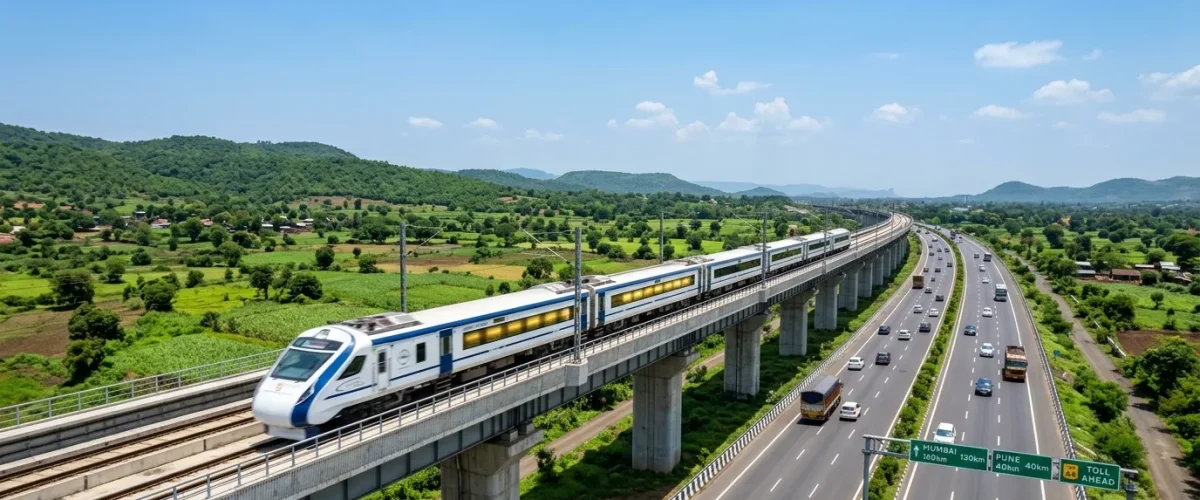
Indian Railways has taken a significant step towards upgrading the country’s passenger rail network by approving the development of two new train sets with a design speed of 220 kilometres per hour, making them faster than the current Vande Bharat Express fleet. The Railway Board issued formal approval to the Integral Coach Factory in Chennai on 23 March 2026, directing the inclusion of the new train sets in the 2027-28 coach production programme. The project, contracted to BEML at a cost of Rs 866.87 crore, is expected to deliver the first prototype by early 2027.
This development comes alongside rapid progress on India’s expressway programme and the expansion of the Vande Bharat Sleeper service, which commenced its first commercial run on 17 January 2026. Together, these projects represent the most ambitious overhaul of India’s surface transport infrastructure in decades.
The 220 Kmph Trains: Beyond Vande Bharat
The new 220 kmph trains will feature 16 coaches each, running on broad-gauge tracks with steel-body construction. While the design speed is 220 kmph, the maximum operating speed is expected to be 200 kmph. This compares to the current Vande Bharat Express, which has a design speed of 180 kmph but operates at lower speeds on most stretches due to track limitations across the Indian Railways network.
The project’s origins date to October 2024, when ICF awarded BEML the contract for the design, manufacture and commissioning of two high-speed train sets. The Rs 866.87 crore budget covers design, development and testing. Currently, 81 pairs of Vande Bharat services operate across the country, and the new 220 kmph trains represent the next evolution in India’s semi-high-speed rail ambitions.
Railway Minister Ashwini Vaishnaw has described the overall rail modernisation programme as central to India’s infrastructure vision. The Union Budget 2026-27 allocated Rs 2.78 lakh crore for railways, with the announcement of seven new high-speed rail corridors connecting major cities including Mumbai-Pune, Pune-Hyderabad, Hyderabad-Bengaluru, Hyderabad-Chennai, Chennai-Bengaluru, Delhi-Varanasi and Varanasi-Siliguri. These corridors, once operational, will fundamentally alter intercity travel patterns across India.
Vande Bharat Sleeper Expands After January Launch
The Vande Bharat Sleeper Express entered commercial service on 17 January 2026, with its first route connecting Howrah to Kamakhya. The 968-kilometre journey is completed in 14 hours, with the train reaching a maximum speed of 110 kmph on the route. Each trainset accommodates up to 823 passengers across 16 coaches, including 11 AC 3-Tier coaches, 4 AC 2-Tier coaches and one AC First Class coach.
Indian Railways plans to roll out 12 Vande Bharat Sleeper services by March 2027. A second route connecting KSR Bengaluru to Mumbai CSMT was approved on 5 April 2026 and is expected to begin operations soon. The approximately 1,125-kilometre route will offer a 16-hour journey at speeds of up to 130 kmph, providing an air-conditioned sleeper alternative to existing Rajdhani services.
Multiple manufacturers are involved in the Vande Bharat Sleeper programme. BEML has manufactured two prototype rakes and received approval for the remaining eight sets. The Indo-Russian joint venture Kinet recently unveiled the design of the First AC coach and is preparing to begin production at Indian Railways’ Latur factory. A Titagarh-BHEL consortium has been tasked with manufacturing 80 additional sets, while ICF is developing its own version with a prototype targeted for December 2026.
Delhi-Mumbai Expressway Nears Full Completion
The 1,362-kilometre Delhi-Mumbai Expressway, one of India’s most ambitious road projects, is expected to be fully completed by November 2026. Large portions of the eight-lane expressway are already operational, and the crucial section linking Central Delhi to the main corridor is now in its final stages. The DND-Jaitpur stretch is 94.23 per cent complete, and the 59-kilometre DND-Faridabad-Sohna link is under construction in three packages.
Once fully operational, the expressway will reduce travel time between Delhi and Mumbai from approximately 24 hours by road to around 12 hours. The route passes through six states and includes India’s longest tunnel at the Mukundra Hills in Rajasthan. The project is expected to significantly improve logistics efficiency, reduce transport costs and ease congestion on existing national highways.
Several other major expressway projects are also nearing completion in 2026. The Bengaluru-Chennai Expressway is expected to open by June 2026, cutting travel time between the two cities from seven hours to approximately three. The Ahmedabad-Dholera Expressway, with 98 per cent of work complete, will open in 2026 and reduce the journey to 40-45 minutes. The 594-kilometre Ganga Expressway in Uttar Pradesh, built at a cost of over Rs 36,200 crore, is 90 per cent complete and will become the state’s longest expressway.
Barrier-Free Tolling and Road Safety Reforms
Alongside physical infrastructure, the government is overhauling how highways are operated. Road Transport and Highways Minister Nitin Gadkari announced plans for nationwide seamless, barrier-free tolling on national highways, with the first 10 tenders already floated. Gadkari stated that the shift would reduce the cost of toll collection from approximately 15 per cent to 3 per cent of total collections, potentially saving up to Rs 8,000 crore annually on an estimated Rs 50,000-60,000 crore in annual toll revenue.
Road safety remains a critical concern, particularly as the Indian economy expands and traffic volumes increase. Government data shows that road accident deaths rose 2.3 per cent in 2024 to more than 1.77 lakh, averaging 485 fatalities per day. A new Road Safety Bill is being prepared to address this crisis through stricter regulations, better enforcement and improved road design standards.
The highways ministry plans to award road projects covering 12,000 kilometres in 2025-26 and a higher target of 13,000 to 13,500 kilometres in 2026-27. However, execution challenges persist, with 649 highway projects worth Rs 4.2 lakh crore currently delayed due to land acquisition, contractor issues and environmental clearances.
India’s Transport Transformation in Context
The simultaneous progress on high-speed rail, sleeper train services, expressways and tolling reforms represents a coordinated push to modernise India’s rail and road infrastructure. The broader travel and transport sector is being transformed. The scale of investment, with the railway budget alone exceeding Rs 2.78 lakh crore, reflects the government’s recognition that transport connectivity is fundamental to economic growth, employment generation and quality of life.
For passengers, the benefits are becoming tangible. The Vande Bharat Sleeper offers a modern alternative to decades-old rolling stock. The 220 kmph trains will eventually provide near-high-speed connectivity on upgraded corridors. Expressways are slashing journey times between major cities. And barrier-free tolling promises a smoother driving experience.
The challenge remains execution at scale. India’s infrastructure ambitions are vast, but delivering projects on time, within budget and to quality standards requires sustained institutional capacity. The progress made in 2026 is encouraging, but the true test will be whether these projects translate into a fundamental improvement in how 1.4 billion people move across the country.

- Indian Army Gets New Chief as General Dwivedi Hands Over Command Amid Push for Indigenous Defence Tech - July 1, 2026
- Ayodhya Ram Temple Donation Scandal Deepens as Trustees Resign and SIT Arrests Eight - June 29, 2026
- Bengal Seven Weeks On: Modi’s Historic Win and the Questions That Won’t Go Away - June 28, 2026