RBI Holds Repo Rate at 5.25% as India’s FY26 GDP Hits 7.6% — But Trump Tariffs and Oil Shocks Cloud FY27

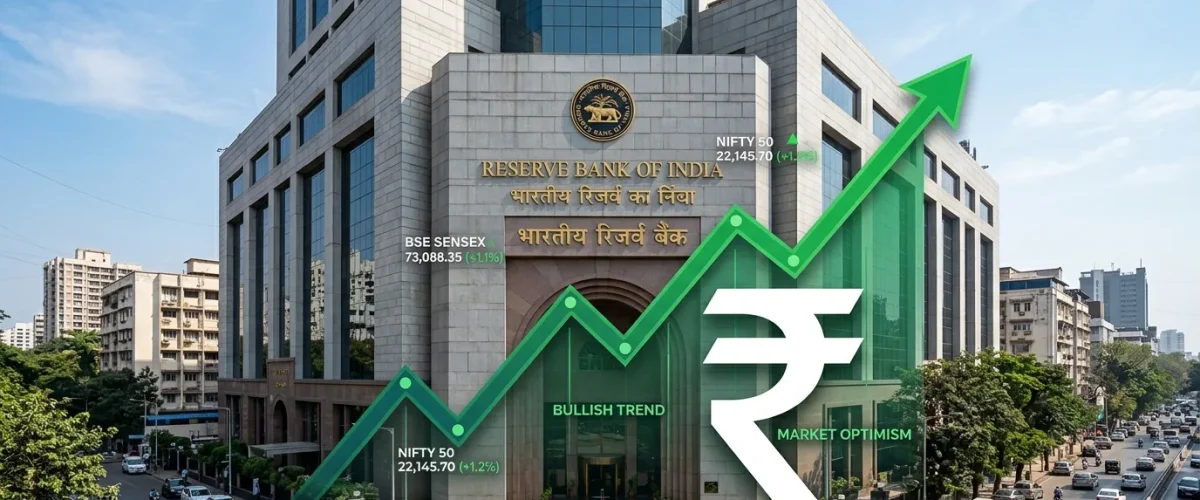
India’s economic story in April 2026 is defined by a striking paradox: record-breaking GDP growth in the fiscal year just ended, set against a darkening global outlook that could blunt the country’s momentum in the months ahead. The Reserve Bank of India’s latest policy meeting, held on April 8, painted this picture in sharp detail — holding the repo rate at 5.25 per cent while upgrading FY26 growth and warning of headwinds in FY27.
RBI Holds Repo Rate at 5.25 Per Cent
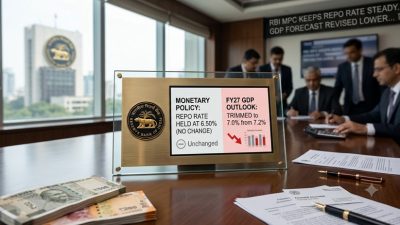
RBI Governor Sanjay Malhotra announced that the Monetary Policy Committee (MPC) voted unanimously to hold the benchmark repo rate at 5.25 per cent for the second consecutive meeting. The decision was widely expected by markets and economists, who had anticipated that the central bank would wait for more clarity on global crude oil prices and the impact of United States tariffs before adjusting rates further.
Governor Malhotra struck a cautiously optimistic tone, noting that “growth momentum remained strong before March” but flagging “rising energy prices and geopolitical tensions” as key risks. He hinted at the possibility of rate cuts in the short to medium term, a signal that bond markets interpreted as dovish — yields on the 10-year government security dropped by roughly 5 basis points in the hours after the announcement.
FY26 GDP Growth Lifted to 7.6 Per Cent
The headline surprise was the RBI’s upward revision of India’s FY26 GDP growth estimate to 7.6 per cent, up from its earlier projection of 6.7 per cent. The upgrade was driven by stronger-than-expected private consumption, robust services-sector output, and a bumper Rabi harvest. India’s wheat production is tracking toward a new all-time record, which has helped keep food inflation in check and boosted rural demand.
The 7.6 per cent figure is calculated under the RBI’s new base-year methodology, which has been the subject of debate among economists. Some argue that the revised series overstates growth by around half a percentage point compared with the old methodology. Nevertheless, even conservative estimates place India comfortably as the world’s fastest-growing major economy for the third consecutive year.
FY27 Outlook: 6.9 Per Cent but Clouds Gathering
While FY26’s numbers are impressive, the RBI’s FY27 forecast tells a different story. The central bank projects real GDP growth of 6.9 per cent for the current fiscal year — a meaningful deceleration that reflects several converging risks:
- US Tariffs: The Trump administration’s reciprocal tariffs of 25 per cent, announced in April, have caught India’s export sector off guard. Although the Economic Survey 2026 noted that India’s trade buffers can absorb some of the shock, sectors like textiles, pharmaceuticals, and IT services face margin pressure.
- Oil Prices: The Iran–US tension, which had already triggered a brief spike in Brent crude above $95 per barrel in early April, remains an unresolved tail risk. India imports over 85 per cent of its crude oil, making even modest price spikes a drag on the current account and fiscal deficit.
- Global Slowdown: The eurozone is barely growing, China’s recovery has stalled, and the US itself is grappling with stagflationary pressures from its own tariff policies.
Inflation: CPI Rises to 3.4 Per Cent in March
Consumer price inflation edged up to 3.4 per cent in March 2026, driven primarily by food prices. Vegetable and cereal prices remain above comfort levels in several states, although the arrival of the summer crop is expected to ease pressure. The RBI’s inflation target band of 2–6 per cent is well within range, giving the MPC room to consider rate cuts later in the year without risking price stability.
The wholesale price index, meanwhile, has stayed muted — reflecting subdued global commodity prices outside of crude oil. This divergence between retail and wholesale inflation is a structural feature of the Indian economy, rooted in supply-chain inefficiencies and intermediary markups that disproportionately affect consumers.
Forex Reserves and the Rupee
India’s foreign exchange reserves declined to $698.35 billion as of March 20, down from $709.76 billion the previous week. The drawdown was largely attributed to RBI intervention in the currency market to stabilise the rupee, which has been under pressure from FPI outflows and a strong US dollar. Despite the decline, India’s reserves remain the fourth-largest in the world, providing roughly 11 months of import cover — a comfortable cushion by any standard.
The rupee itself has traded in a narrow band of ₹85.5–86.2 against the dollar in April, with the RBI’s active management keeping volatility low. Exporters, however, have flagged that the relatively stable rupee — combined with US tariffs — is squeezing their competitiveness against rivals like Vietnam and Bangladesh.
UPI: 228 Billion Transactions in 2025
On the digital-economy front, a Worldline report confirmed that India’s Unified Payments Interface processed a staggering 228 billion transactions in calendar year 2025, cementing the country’s status as a micro-payments powerhouse. The data underscores the structural transformation of India’s economy: from a cash-heavy system just a decade ago to one where a ₹10 chai purchase is routinely settled via QR code. This digital payments revolution is now a key enabler of financial inclusion and small-business growth.
What It Means for Consumers and Investors
For the average Indian consumer, the immediate outlook is mixed. Personal finance decisions in FY27 will need to account for potentially lower interest rates on deposits, stable but elevated food prices, and an uncertain job market for export-dependent industries. For investors, the equity market is likely to remain range-bound until there is clarity on US trade policy and the monsoon forecast. The bond market, by contrast, is pricing in one or two rate cuts by September — making longer-duration government securities an attractive play for fixed-income portfolios.
India’s macro fundamentals remain enviable by emerging-market standards, but the next six months will test the economy’s resilience against a uniquely hostile global backdrop. As Governor Malhotra put it: “India is well-placed, but not immune.” The policy tightrope — balancing growth support with inflation vigilance — has never been more delicate.
For more on Business & Economy, follow Daily Tips for daily analysis and expert insights.

- India’s Startup Funding Crosses $7.2 Billion in H1 2026 - July 1, 2026
- After Ireland Shock, India’s T20I Side Faces Bigger Test - July 1, 2026
- Ireland Stun World Champions India 2-0 in Belfast, Sooryavanshi Debate Rages On - June 29, 2026