West Bengal Elections 2026 Phase 1 Records Historic 92.59 Per Cent Voter Turnout

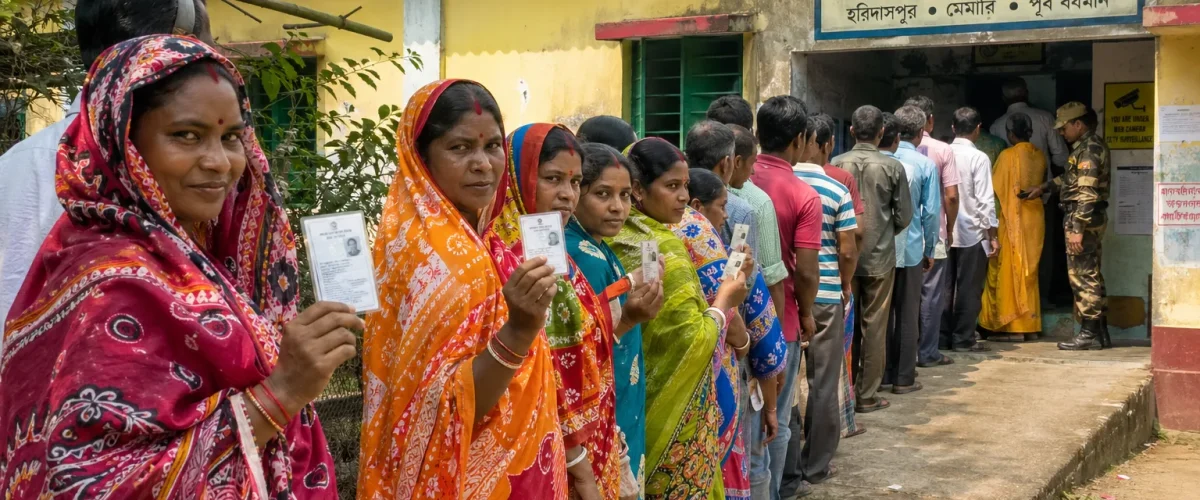
West Bengal recorded a historic voter turnout of 92.59 per cent in the first phase of its 2026 Assembly elections held on 23 April, surpassing all previous records for the state. Polling was conducted across 152 constituencies spanning north Bengal and several districts in the southern part of the state, with over 4.2 crore voters eligible to cast their ballots.
The Election Commission of India confirmed the final figure on 24 April after tabulating data from all polling stations. The previous highest Phase 1 turnout in West Bengal was 84.63 per cent, recorded during the 2021 Assembly elections. The 2026 figure represents nearly an eight-percentage-point jump, signalling extraordinarily high voter engagement in what has become one of the most fiercely contested state elections in recent Indian history.
District-Wise Turnout: Dakshin Dinajpur Leads
Among individual districts, Dakshin Dinajpur recorded the highest turnout at approximately 96 per cent, followed by Paschim Medinipur at 95.2 per cent. Even traditionally low-turnout urban constituencies in parts of Kolkata recorded figures above 85 per cent, a remarkable number for metropolitan areas. The high voter participation was linked to intense campaigning by both major parties and a widespread sense that this election would determine the trajectory of Indian social and political trends for years to come.
By 11 AM, turnout had already crossed 41 per cent — an unusually high number for the morning hours, suggesting that voters were arriving at polling stations well before they opened. By 1 PM, the figure stood at 62.18 per cent, with Paschim Medinipur leading at 65.77 per cent. The 3 PM reading showed 78.8 per cent, and by 5 PM the number was 89.93 per cent, indicating that large numbers of voters continued to cast their ballots in the final hours.
TMC vs BJP: The Battle for Bengal
The election is widely seen as a direct contest between Chief Minister Mamata Banerjee’s Trinamool Congress (TMC) and the BJP, which has made West Bengal its top priority after falling short of expectations in the 2021 elections. Mamata Banerjee has been campaigning aggressively, framing the election as a fight to protect Bengal’s identity and autonomy, while the BJP has focused on governance issues, corruption allegations, and the promise of a “double engine” government with the same party ruling at both the state and central levels.
In the run-up to polling, both parties accused each other of voter intimidation and booth capturing, though election officials reported relatively peaceful polling conditions across most constituencies. Five police officers were suspended for alleged partisan behaviour during voting, underscoring the high tension surrounding the process.
North Bengal Emerges as Key Battleground
North Bengal, which accounts for a significant number of Phase 1 constituencies, has been the epicentre of political activity this cycle. The region, which traditionally supported the Left Front, has seen a dramatic shift toward the BJP in recent years, driven by issues of identity, development, and migration. In the broader context of the 2026 state elections, North Bengal’s verdict could prove decisive for the final outcome.
TMC’s strategy in the region focused on welfare programmes and localised candidate selection, while the BJP deployed its top national leaders, including Prime Minister Narendra Modi and Home Minister Amit Shah, for multiple rallies. The high turnout in north Bengal districts suggests mobilisation efforts by both parties were effective.
Phase 2 and the Road to Results
The remaining 140 constituencies in West Bengal will vote in Phase 2 on 29 April. These include critical seats in and around Kolkata, the Hooghly belt, and the Sundarbans region. A shifting cultural and demographic landscape in urban Bengal adds further unpredictability to the outcome.
Vote counting for both phases is scheduled for 4 May, with results expected by evening. Exit polls, which are restricted from publication until after Phase 2 voting ends, are expected to generate intense speculation in the days following 29 April.
What the Record Turnout Might Signal
Political analysts are divided on what the record turnout means for the two main parties. Historically, high turnout in West Bengal has favoured the incumbent — Mamata Banerjee’s TMC won landslide victories in 2011, 2016, and 2021, all of which featured elevated voter participation. The argument is that a motivated electorate often reflects satisfaction with the ruling party’s welfare delivery and a desire to protect existing benefits.
However, BJP strategists argue that the surge in turnout reflects voter anger against alleged TMC corruption and a desire for change. They point to the house-help migration story — thousands of Bengali domestic workers returned home from cities like Gurugram and Delhi specifically to vote — as evidence of emotional engagement that transcends routine electoral participation.
The truth, as always, will emerge on counting day. What is clear is that the people of West Bengal have spoken with their feet, turning out in numbers that put most democracies to shame. This election, like the ongoing India Census 2026, will generate data that political scientists and demographers will study for years. The 92.59 per cent turnout is not just a statistic — it is a powerful declaration of democratic faith in a state that has always taken its politics seriously.
With Bihar’s dramatic political transition still fresh in public memory, the West Bengal result will either confirm or complicate the narrative of BJP’s expanding dominance across Indian states.