Indian Navy’s Operation Urja Suraksha: How India Rescued 18 Stranded Ships From Strait of Hormuz

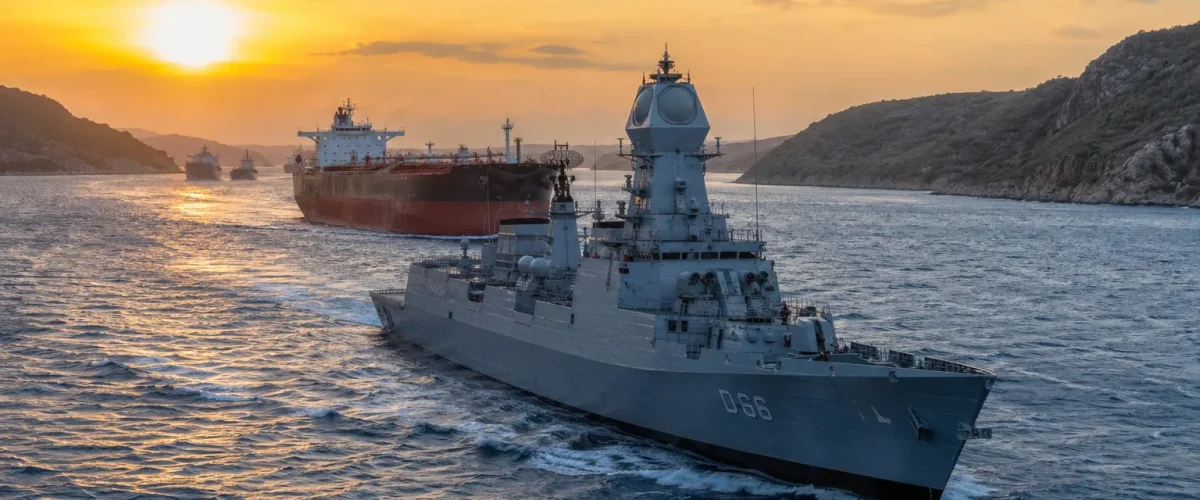
The Indian Navy launched Operation Urja Suraksha in April 2026 to rescue and escort 18 ships stranded in the Strait of Hormuz, the narrow waterway between Iran and Oman through which approximately 20 per cent of the world’s oil passes daily. The operation, confirmed by Defence Minister Rajnath Singh, represents one of the most significant Indian naval deployments in the Persian Gulf since the 1990-91 Gulf War evacuation.
The 18 stranded vessels included 11 crude oil tankers, four LPG carriers, and three LNG ships. Of these, five were sailing under the Indian flag, while the remaining 13 were leased or chartered by Indian companies. All were carrying cargo bound for India when escalating hostilities between the United States and Iran made transit through the strait increasingly dangerous.
Why the Strait of Hormuz Matters
The Strait of Hormuz, just 33 kilometres wide at its narrowest point, is the world’s most critical oil chokepoint. Approximately 17 to 18 million barrels of oil pass through it daily, representing roughly one-fifth of global crude consumption. For India, the stakes are even higher — the country imports over 85 per cent of its crude oil, and a significant portion of those imports transits the strait.
When the US-Iran conflict intensified in early 2026, following the US-Israeli strikes that killed senior Iranian leaders, Iran fired on commercial ships in the Strait of Hormuz and imposed what it called a “defensive blockade” of certain shipping lanes. This immediately disrupted global oil supply chains and sent crude prices above $100 per barrel, triggering economic consequences felt around the world.
The Rescue Operation
Defence Minister Rajnath Singh confirmed the operation during a press conference in early April, stating: “Our Navy is safely escorting Indian tankers out of the Strait of Hormuz. There is no dearth of fuel or gas in the country.” This was the first official acknowledgement of what had been reported days earlier as a major naval deployment.
The operation involved deploying at least one major Indian warship to the Hormuz region, accompanied by support vessels and helicopters. The warship entered the strait and provided armed escort to the stranded vessels, navigating them through the conflict zone under naval protection. Maritime tracking data showed Indian Navy helicopters maintaining continuous aerial surveillance during the transit.
According to Marine Insight, the multi-ministry task force overseeing the operation also worked to clear more than 100,000 TEUs (twenty-foot equivalent units) of backlogged cargo at Indian ports, which had accumulated due to the shipping disruption. The logistical challenge extended well beyond the naval escort itself — port congestion, customs processing delays, and insurance complications all required coordinated government intervention. This was a dramatic escalation from the earlier disruption when the US-Iran ceasefire expired on 22 April, further destabilising the region.
India’s Energy Security at Stake
The Hormuz crisis exposed the vulnerability of India’s energy supply chain. At the time of the blockade, India’s strategic petroleum reserves held approximately 45 days of supply — a buffer that experts considered adequate for a short disruption but dangerously thin for a prolonged conflict.
The government responded on multiple fronts. The petroleum ministry activated emergency procurement protocols, sourcing additional crude from non-Hormuz routes including West Africa, the United States, and South America. India’s refineries adjusted their crude slate to accommodate different grades, and the government issued orders to ensure that domestic fuel supplies were prioritised over export commitments.
On the international stage, India engaged in intensive diplomacy with both the United States and Iran, seeking to maintain its traditional policy of strategic balance. India has historically maintained cordial relations with Iran while deepening its defence and economic partnership with the US, a balancing act that the Hormuz crisis tested severely.
The Economic Fallout
The shipping disruption had immediate consequences for the Indian economy. Crude oil prices spiking above $100 per barrel pushed up fuel costs, fed into inflation expectations, and pressured the Indian rupee. The Sensex fell 750 points on 22 April as IT stocks crashed and Hormuz-related uncertainty dominated market sentiment.
The impact was felt beyond financial markets. Petrochemical companies faced feedstock shortages, airlines warned of potential fare increases, and agricultural input costs rose due to higher diesel prices. The total economic cost of the Hormuz disruption to India is estimated at several thousand crore rupees per week, though precise figures are still being calculated.
A Show of Naval Strength
Operation Urja Suraksha showcased the growing capabilities of the Indian Navy, which has undergone significant modernisation in recent years. The deployment demonstrated India’s ability to project power beyond its immediate neighbourhood and protect its strategic interests in distant waters. Defence analysts noted that the operation also served as a signal to regional powers that India will not passively accept disruptions to its trade and maritime routes.
The operation also highlighted the importance of India’s expanding network of overseas military logistics agreements, including the Logistics Exchange Memorandum of Agreement (LEMOA) with the United States and similar pacts with France, Japan, and Australia. These agreements provide Indian naval vessels with refuelling and maintenance access at foreign ports, extending the Navy’s operational range.
As tensions in the Strait of Hormuz continue to evolve, Operation Urja Suraksha will be studied as a case study in how mid-sized powers can protect their energy security through a combination of military capability, diplomatic engagement, and economic diversification. For India, the lesson is clear: in an interconnected world, naval power is not a luxury — it is a necessity.