Uttarakhand Forest Fires: 160 Incidents Since November — Four Times Last Year — as Char Dham Yatra Route Faces Wildfire Threat and Staff Leaves Cancelled

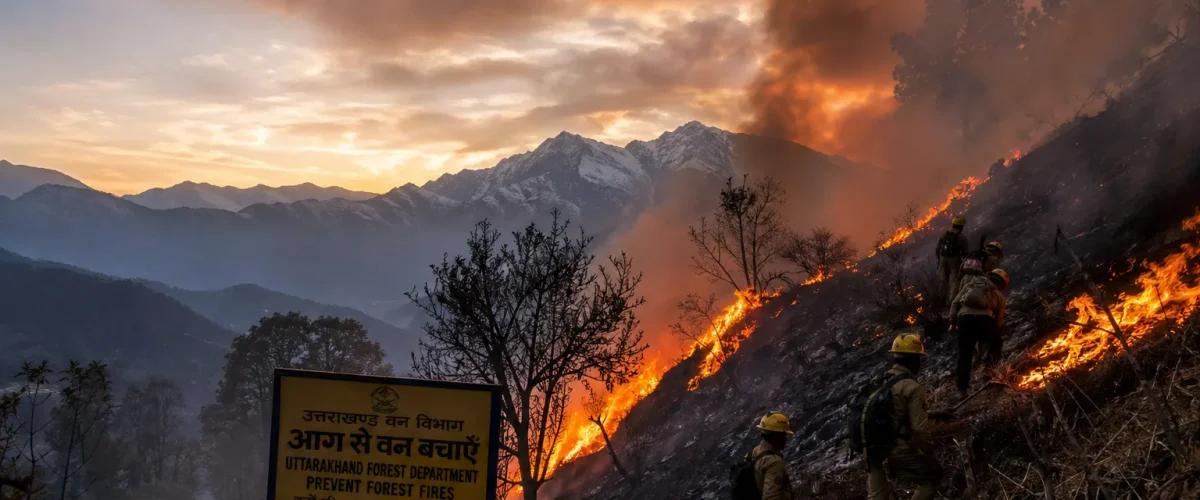
Uttarakhand is facing its worst forest fire crisis in recent memory, with 160 fire incidents recorded between 1 November 2025 and 16 April 2026 — a figure that is nearly four times higher than the 40 incidents registered during the same period the previous year. The fires have destroyed approximately 100 hectares of forest land across the Himalayan state, and the Forest Department has been forced to cancel all staff leaves and deploy Quick Response Teams (QRTs) along sensitive routes, including the Char Dham Yatra pilgrimage corridor, which is set to open in the coming weeks.
The dramatic surge in wildfire activity has been attributed to a combination of factors: an unusually dry winter that ended early, rising temperatures associated with climate change, and the onset of what meteorologists are predicting will be one of the most intense summer seasons in decades. With over 60 fire alerts issued in just two days in mid-April, the crisis has escalated from a seasonal concern to a full-blown environmental emergency.
Chamoli District: The Epicentre of the Crisis
Chamoli district in the Garhwal division has emerged as the worst-affected area, recording the highest number of fire incidents this season. The Badrinath Forest Division alone has seen 62 incidents, followed by the Kedarnath Wildlife Division with 48 incidents and the Nanda Devi Forest Division with 10. An additional 11 incidents were reported in the Alaknanda Soil Conservation Forest Division, highlighting the widespread nature of the crisis across the district.
Chamoli’s vulnerability is compounded by its location along the Char Dham Yatra route — the annual Hindu pilgrimage to the four sacred shrines of Badrinath, Kedarnath, Gangotri, and Yamunotri. The yatra, which attracts millions of pilgrims each year, is scheduled to begin in early May. Forest officials have expressed serious concern that active fire zones could pose a direct threat to pilgrims and the infrastructure along the yatra route, including roads, rest houses, and emergency service points.
Divisional Forest Officer (Badrinath) Rohit Sharma told reporters that the fires have been particularly difficult to control in the upper reaches of the division, where steep terrain and limited road access hamper firefighting efforts. “We are deploying QRTs at eight divisions that fall on the Char Dham route,” he said. “The Kedarnath and Badrinath divisions are considered the most sensitive, and we have issued special alerts for both.”
Why the Fires Are Four Times Worse This Year
Multiple factors have converged to create what forest officials describe as a “perfect storm” for wildfires in Uttarakhand this season. The primary driver is an exceptionally dry winter. Rainfall across the state was significantly below normal during the October-March period, leaving the forest floor covered in dry leaf litter and dead vegetation that acts as fuel for fires. The Indian Meteorological Department (IMD) has confirmed that the 2025-26 winter was one of the driest in Uttarakhand in the past two decades.
The early end of winter, followed by a rapid transition to summer conditions, has exacerbated the situation. Temperatures across the state have been running 3-5 degrees above normal for this time of year, further drying out vegetation and lowering humidity levels in the forest canopy. The combination of abundant dry fuel and high temperatures creates conditions where even a small ignition source — a discarded cigarette, an agricultural burn that escapes control, or a lightning strike — can trigger a major fire.
Climate change is increasingly recognised as an amplifying factor. Studies by the Indian Institute of Tropical Meteorology (IITM) have shown that the frequency of extreme heat events in the Himalayan region has increased by approximately 30 per cent over the past two decades. This trend is expected to continue, meaning that forest fire seasons in Uttarakhand may become longer and more intense in the coming years.
Human Activities and Negligence
While natural factors such as drought and heat create the conditions for forest fires, human activities remain the leading cause of ignition. Forest Department data shows that the majority of fires in Uttarakhand are started by human negligence, including agricultural burning that spreads beyond intended areas, fires lit by graziers to promote fresh grass growth, and careless disposal of burning materials by trekkers and pilgrims.
In some cases, fires are deliberately set. Land encroachment disputes, timber smuggling operations seeking to clear evidence, and conflicts between forest departments and local communities over resource access have all been cited as motives for arson in Uttarakhand’s forests. The Forest Department has filed multiple FIRs this season against individuals suspected of starting fires, but prosecution rates remain low due to the difficulty of proving intent in remote forest areas.
The state government has launched awareness campaigns targeting villages along the forest fringe, urging residents to exercise caution with fire during the dry season. However, ground-level enforcement remains challenging given the vast area of forest cover — approximately 71 per cent of Uttarakhand’s total geographical area — and the limited number of forest guards and fire watchers available.
Char Dham Yatra and the Road Ahead
The timing of the fire crisis is particularly concerning given the impending Char Dham Yatra. The pilgrimage, which is one of the most significant Hindu religious events in the calendar, saw over 56 lakh devotees in 2024. With similar or higher numbers expected in 2026, the safety of pilgrims traversing through fire-prone forest areas is a top priority for both the state administration and the Forest Department.
Chief Secretary Radha Raturi has convened an inter-departmental coordination meeting to ensure that fire management, disaster response, and yatra logistics are seamlessly integrated. IAF helicopters have been placed on standby for aerial firefighting operations if ground-based efforts prove insufficient. The Uttarakhand Disaster Management Authority has also updated its evacuation protocols for yatra routes in the event that fires approach road corridors.
Environmental activists have called for a more fundamental rethinking of forest management in Uttarakhand, arguing that reactive firefighting is insufficient and that the state needs to invest in fire prevention infrastructure, including firebreaks, early detection systems using satellite imagery, and community-based fire management programmes. Some have also called for a temporary restriction on tourism in the most fire-affected areas until the situation is brought under control.