FPI Outflows From India Surpass Entire 2025 Total in Just Four Months as Foreign Investors Pull Over Rs 1.8 Lakh Crore From Equities in 2026

Record-Breaking FPI Exodus: 2026 Outflows Already Surpass Full-Year 2025 Total
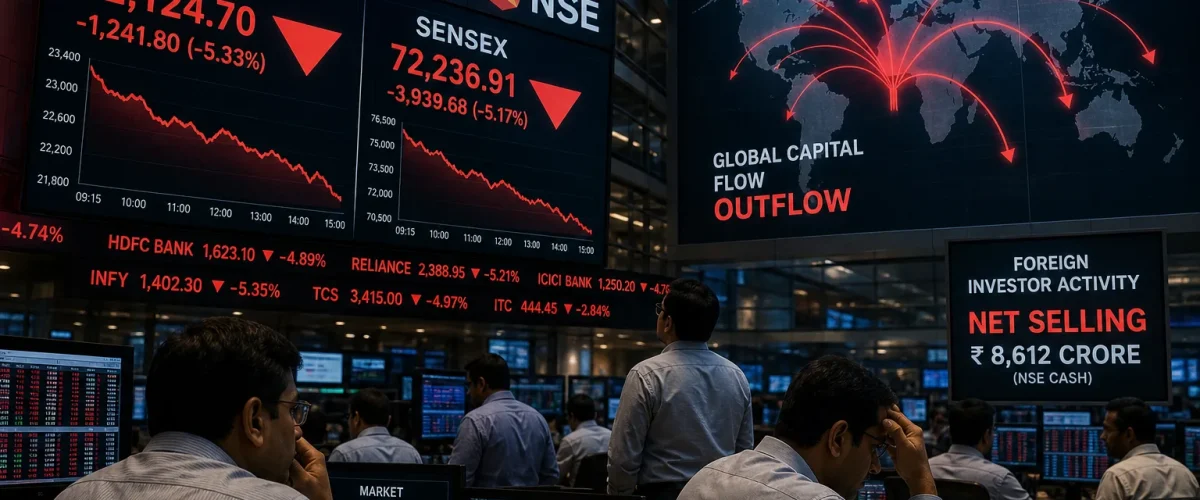
Foreign portfolio investors (FPIs) have pulled out over Rs 1.8 lakh crore (approximately $19.2 billion) from Indian equities in just the first four months of 2026, surpassing the entire 2025 full-year outflow of Rs 1.59 lakh crore — which itself was the worst year for foreign investment in Indian markets in over a decade. The staggering outflows, driven by a combination of global geopolitical turmoil, the AI-driven trade rotation, and elevated crude oil prices, have raised concerns about the resilience of India’s equity markets.
According to NSDL data, the month-wise breakdown paints a stark picture: FPIs sold Rs 78,027 crore in January, Rs 34,574 crore in February, and a record-shattering Rs 1.17 lakh crore in March — the largest monthly outflow in Indian market history. April added another Rs 48,213 crore in the first 10 days alone, with the selling trend showing no signs of reversal despite brief periods of net buying.
Why Are Foreign Investors Fleeing India
Several structural and cyclical factors are converging to drive the unprecedented FPI exodus from Indian equity markets.
The AI Trade Rotation
The most significant factor is the global rotation of capital toward AI and semiconductor stocks, which are concentrated in markets like the United States, South Korea, and Taiwan. As artificial intelligence companies continue to deliver explosive earnings growth, global fund managers have been reallocating capital from emerging markets — including India — toward AI-exposed markets. South Korea’s Kospi index, driven by Samsung and SK Hynix’s semiconductor boom, recently crossed the $4 trillion market cap milestone, attracting capital that might otherwise have flowed to India.
Analysts note that as long as the AI trade continues to outperform, the trend of FPI outflows from India is likely to persist. India’s relative lack of major listed AI and semiconductor companies means it is less attractive to thematic funds focused on the technology revolution. This structural disadvantage is unlikely to change quickly, even as Indian companies like TCS and Infosys invest in AI capabilities.
The Strait of Hormuz Crisis
The ongoing US-Iran conflict and the Strait of Hormuz blockade have injected massive volatility into global markets. With Brent crude prices sustained above $120 per barrel, India — which imports approximately 85 per cent of its oil — faces a deteriorating current account balance, inflationary pressures, and fiscal strain. The Sensex dropped 583 points on April 30 partly due to these elevated energy costs, and FPIs have been reducing exposure to oil-importing emerging markets as a risk management strategy.
Weak Rupee and Valuation Concerns
The Indian rupee’s depreciation against the US dollar has further eroded returns for foreign investors who invest in dollar terms. When combined with India’s relatively high equity valuations — with the Nifty 50 trading at a premium to historical averages — the risk-reward calculus has shifted against India in FPI allocation models. Many global funds follow quantitative frameworks that automatically reduce allocations when currency-adjusted returns deteriorate, contributing to the mechanical selling pressure.
A Brief Ray of Hope
In a sign that the trend may not be entirely one-directional, India recorded its first net FPI inflows of $106 million in seven weeks during a brief window in late April. While the amount was modest compared to the scale of outflows, it suggested that some foreign investors see current market levels as attractive for selective buying. Analysts pointed to India’s strong domestic economic fundamentals — including a GDP growth rate revised to 7.6 per cent for FY26 — as a potential catalyst for FPI re-engagement once global uncertainties ease.
However, the inflow proved short-lived, and selling resumed within days. The pattern of brief inflows followed by sustained outflows has been a recurring feature of 2026, frustrating market participants who had expected a stabilisation after the brutal March sell-off.
Domestic Investors Holding the Line
Despite the FPI exodus, India’s equity markets have shown remarkable resilience, supported by strong domestic institutional investor (DII) buying. Mutual funds, insurance companies, and pension funds have absorbed much of the foreign selling, preventing a more severe market decline. Systematic Investment Plans (SIPs) by retail investors through mutual funds have continued to grow, providing a steady flow of domestic capital that has partially offset the FPI drain.
The contrast between foreign and domestic investor behaviour highlights a structural shift in Indian markets. Domestic savings are increasingly being channelled into equities through mutual funds, reducing the market’s historical dependence on foreign capital. This “democratisation” of the Indian stock market may ultimately prove to be one of the most significant financial developments of this decade.
What Comes Next
Market experts remain divided on when the FPI selling trend will reverse. Bulls point to India’s superior economic growth, improving corporate earnings, and the eventual resolution of the Hormuz crisis as catalysts for a return of foreign capital. Bears counter that India’s high valuations, the AI-driven capital reallocation, and persistent global uncertainties make a quick turnaround unlikely.
For Indian investors, the message from the FPI data is nuanced. While the headline outflow numbers are alarming, the market’s ability to absorb this selling without a major crash — the Nifty is down roughly 10-12 per cent from its highs rather than the 25-30 per cent decline that such outflows might have caused a decade ago — demonstrates the growing depth and maturity of India’s capital markets. Whether this resilience continues will depend largely on how the global geopolitical landscape evolves in the coming months, particularly the outcome of the Hormuz crisis and the trajectory of the global defence and energy spending cycle.

- Indian Army Gets New Chief as General Dwivedi Hands Over Command Amid Push for Indigenous Defence Tech - July 1, 2026
- Ayodhya Ram Temple Donation Scandal Deepens as Trustees Resign and SIT Arrests Eight - June 29, 2026
- Bengal Seven Weeks On: Modi’s Historic Win and the Questions That Won’t Go Away - June 28, 2026