Sensex Drops 583 Points on April 30 as Crude Oil Crosses 120 Dollars and FII Outflows Shake Dalal Street

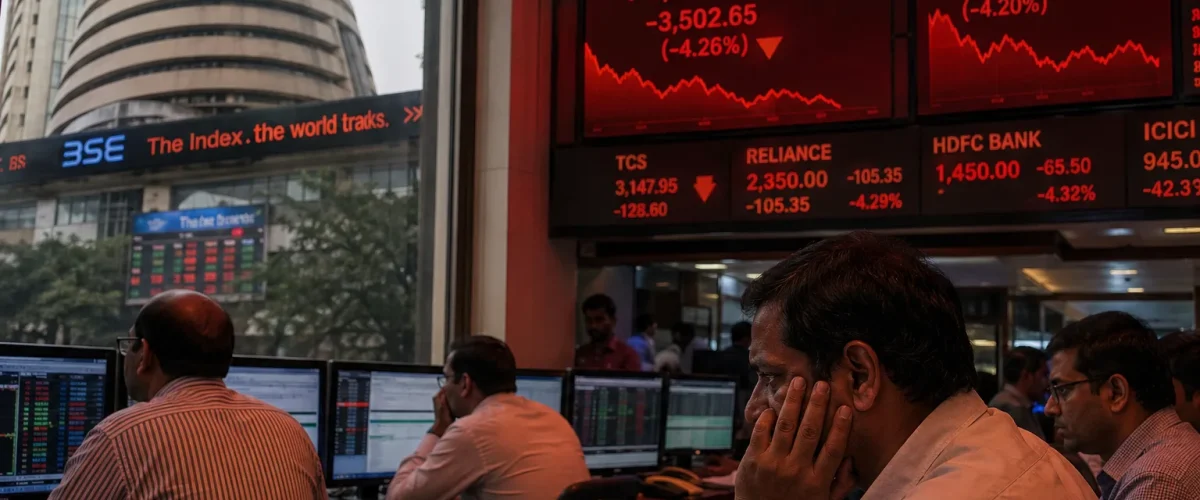
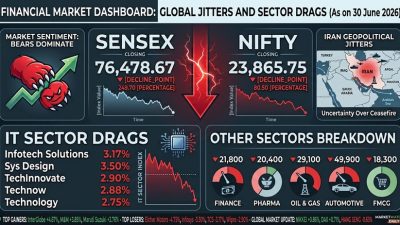
India’s benchmark equity indices closed sharply lower on Thursday, 30 April 2026, as surging crude oil prices, weak global cues, and sustained foreign fund outflows combined to rattle investor sentiment on Dalal Street. The 30-share BSE Sensex fell 582.86 points, or 0.75 per cent, to settle at 76,913.50, while the NSE Nifty50 declined 180.10 points, or 0.74 per cent, to close at 23,997.55 — slipping below the psychologically important 24,000 mark.
The session was marked by extreme volatility. The Sensex plunged as much as 1,237.5 points, or 1.59 per cent, to touch an intra-day low of 76,258.86 before recovering part of the losses in the second half of trading. The partial recovery was driven by bargain-hunting in select pharma and IT counters, but it was not enough to prevent a decisive red close.
Why Markets Fell on April 30
The primary trigger for Thursday’s sell-off was the sustained surge in global crude oil prices. Brent crude, the international benchmark, breached the $120 per barrel mark during Asian trading hours — its highest level in months — before easing slightly to trade 1.52 per cent lower at $116.2 by the close of Indian markets. The rally in crude has been fuelled by escalating geopolitical tensions in West Asia, concerns over disruptions to shipping through the Strait of Hormuz, and the impact of the UAE’s decision to exit OPEC and OPEC+ from 1 May on global supply dynamics.
For India, which imports more than 85 per cent of its crude oil requirement, sustained prices above $110 per barrel pose a serious threat to the fiscal deficit, the current account balance, and the rupee. Analysts warned that if crude remains elevated, the Reserve Bank of India may face pressure to reassess its accommodative monetary stance, potentially delaying further interest rate cuts.
Foreign Institutional Investors (FIIs) sold equities worth Rs 2,468.42 crore on Wednesday, according to exchange data, continuing a pattern of net outflows that has persisted through much of April. The combination of a strong US dollar, high US Treasury yields, and geopolitical uncertainty has prompted global investors to reduce exposure to emerging market equities, with India bearing a disproportionate share of the selling.
Top Gainers and Losers on the Sensex
Among the 30 Sensex constituents, Bajaj Auto led the gainers with a 4.73 per cent surge, followed by Sun Pharma at 1.67 per cent and Infosys at 1.23 per cent. Tech Mahindra, Bajaj Finance, Maruti Suzuki, Reliance Industries, Kotak Mahindra Bank, HCL Tech, and Adani Ports also closed in the green.
On the losing side, Hindustan Unilever (HUL) was the worst performer, falling 2.75 per cent. Axis Bank dropped 2.17 per cent, Tata Steel shed 2.10 per cent, and UltraTech Cement lost 2.09 per cent. L&T, M&M, SBI, BEL, ICICI Bank, and TCS also ended with losses.
The broader markets underperformed the benchmarks. The BSE Midcap index fell 1.2 per cent, while the BSE Smallcap index declined 1.4 per cent, reflecting a broad-based risk-off mood among domestic investors.
Expert Analysis: Is More Pain Ahead?
“Indian markets closed a volatile session with a clear shift in intra-day sentiment, where early panic selling was gradually absorbed, leading to a disciplined recovery from the lows,” said Hariprasad K, Research Analyst and Founder of Livelong Wealth. He added that fears around inflation, currency stability, and margin pressure had triggered the early sell-off, but noted that domestic institutional support helped limit the damage.
Vinod Nair, Head of Research at Geojit Investments Limited, pointed to the confluence of rising crude prices and a firm US Federal Reserve stance as the key headwinds. “Tightened conditions for emerging markets mean that India will need to demonstrate strong domestic fundamentals to attract foreign flows. The Q4 FY26 earnings season, which is currently underway, will be critical in setting the near-term direction,” he said.
The Sensex had also fallen 750 points on 22 April when Iran ceasefire doubts first spooked markets, suggesting that geopolitical risk remains the dominant driver of sentiment. Wednesday’s strong rebound — when the Sensex gained 609 points to close at 77,496.36 — proved to be short-lived.
Global Markets Paint a Mixed Picture
European markets traded mixed on Thursday, while US markets had ended mostly lower on Wednesday amid concerns over corporate earnings and the Federal Reserve’s hawkish tone on inflation. Asian markets including Japan’s Nikkei and Hong Kong’s Hang Seng also registered declines, reflecting the global risk-off environment.
The Indian rupee weakened against the US dollar during the session, adding to the headwinds for equity markets. Gold prices, meanwhile, held firm near record highs as investors sought safe-haven assets.
What Investors Should Watch
Market participants will be closely monitoring crude oil price movements, the progress of the Q4 FY26 earnings season, and any developments in the West Asia conflict in the days ahead. The Indian economy remains fundamentally strong, with GDP growth estimated at 7.6 per cent for FY26, but external shocks — particularly from energy markets — have the potential to derail the bull case in the near term.
For retail investors, analysts recommend maintaining a diversified portfolio with a tilt towards defensive sectors such as pharma, FMCG, and IT, while avoiding over-leveraged positions in rate-sensitive sectors until the crude oil outlook stabilises. The next major data point will be the US Federal Reserve’s policy statement, expected in the first week of May, which will set the tone for global capital flows.